

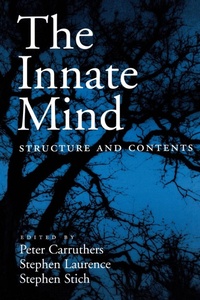
The Innate Mind
Structure and Contents
Published on 11. August 2005
Book
Paperback/Softback
448 pages
978-0-19-517999-6 (ISBN)
Description
This is the first volume of a projected three-volume set on the subject of innateness. The extent to which the mind is innate is one of the central questions in the human sciences, with important implications for many surrounding debates. By bringing together the top nativist scholars in philosophy, psychology, and allied disciplines these volumes provide a comprehensive assessment of nativist thought and a definitive reference point for future nativist inquiry.
The Innate Mind: Structure and Content, concerns the fundamental architecture of the mind, addressing such question as: What capacities, processes, representations, biases, and connections are innate? How do these innate elements feed into a story about the development of our mature cognitive capacities, and which of them are shared with other members of the animal kingdom? The editors have provided an introduction giving some of the background to debates about innateness and introducing each of the subsequent essays, as well as a consolidated bibliography that will be a valuable reference resource for all those interested in this area. The volume will be of great importance to all researchers and students interested in the fundamental nature and powers of the human mind.
Together, the three volumes in the series will provide the most intensive and richly cross-disciplinary investigation of nativism ever undertaken. They point the way toward a synthesis of nativist work that promises to provide a new understanding of our minds and their place in the natural order.
The Innate Mind: Structure and Content, concerns the fundamental architecture of the mind, addressing such question as: What capacities, processes, representations, biases, and connections are innate? How do these innate elements feed into a story about the development of our mature cognitive capacities, and which of them are shared with other members of the animal kingdom? The editors have provided an introduction giving some of the background to debates about innateness and introducing each of the subsequent essays, as well as a consolidated bibliography that will be a valuable reference resource for all those interested in this area. The volume will be of great importance to all researchers and students interested in the fundamental nature and powers of the human mind.
Together, the three volumes in the series will provide the most intensive and richly cross-disciplinary investigation of nativism ever undertaken. They point the way toward a synthesis of nativist work that promises to provide a new understanding of our minds and their place in the natural order.
Reviews / Votes
"This is a terrific collection. It's not just a survey of the terrain, though it is that; it also contains a number of papers that push the boundaries and make major new contributions to several hot debates in cognitive science ...I predict that the book will become a must-have collection, not just for all participants in these fields, but also for those not working in these areas and desiring a comprehensive and accessible guide to the issues."--Fiona Cowie, California Institute of TechnologyMore details
Series
Language
English
Place of publication
New York
United States
Target group
Professional and scholarly
Illustrations
2 halftones, 4 tables and numerous line drawings
Dimensions
Height: 234 mm
Width: 156 mm
Thickness: 24 mm
Weight
670 gr
ISBN-13
978-0-19-517999-6 (9780195179996)
Copyright in bibliographic data and cover images is held by Nielsen Book Services Limited or by the publishers or by their respective licensors: all rights reserved.
Schweitzer Classification
Other editions
Additional editions
E-Book
07/2005
1st Edition
OUP eBook
€40.99
Available for download
E-Book
07/2005
1st Edition
OUP eBook
€40.99
Available for download
Persons
Peter Carruthers is Professor and Chair in the Department of Philosophy at The University of Maryland.
Stephen Laurence is Senior Lecturer in the Department of Philosophy and Co-Director at the Hang Seng Center for Cognitive Studies at University of Sheffield.
Stephen Stich is Board of Governors Professor in the Department of Philosophy and Center for Cognitive Science, Rutgers University.
Stephen Laurence is Senior Lecturer in the Department of Philosophy and Co-Director at the Hang Seng Center for Cognitive Studies at University of Sheffield.
Stephen Stich is Board of Governors Professor in the Department of Philosophy and Center for Cognitive Science, Rutgers University.
Content
List of Contributors
1: Tom Simpson, Peter Carruthers, Stephen Laurence, and Stephen Stich: Introduction: Nativism Past and Present
PART ONE: ARCHITECTURE
2: Gary F. Marcus: What Developmental Biology Can Tell Us about Innateness
3: Brian J. Scholl: Innateness and (Bayesian) Visual Perception: Reconciling Nativism and Development
4: Dan Sperber: Modularity and Relevance: How Can a Massively Modular Mind Be Flexible and Context-Sensitive?
5: Peter Carruthers: Distinctively Human Thinking: Modular Precursors and Components
6: Anna Shusterman and Elizabeth Spelke: Language and the Development of Spatial Reasoning
7: Richard Samuels: The Complexity of Cognition: Tractability Arguments for Massive Modularity
8: Tom Simpson: Toward a Reasonable Nativism
PART TWO: LANGUAGE AND CONCEPTS
9: Scott Atran: Strong versus Weak Adaptationism in Cognition and Language
10: Mark C. Baker: The Innate Endowment for Language: Underspecified or Overspecified?
11: Stephen Crain, Andrea Gualmini, and Paul Pietroski: Brass Tacks in Linguistic Theory: Innate Grammatical Principles
12: Susan A. Gelman: Two Insights about Naming in the Preschool Child
13: Stephen Laurence and Eric Margolis: Number and Natural Language
PART THREE: THEORY OF MIND
14: Daniel J. Povinelli, Christopher G. Prince, and Todd M. Preuss: Parent-Offspring Conflict and the Development of Social Understanding
15: Susan C. Johnson: Reasoning about Intentionality in Preverbal Infants
16: Helen Tager-Flusberg: What Neurodevelopmental Disorders Can Reveal about Cognitive Architecture: The Example of Theory of Mind
PART FOUR: MOTIVATION
17: Joshua D. Duntley and David M. Buss: The Plausibility of Adaptations for Homicide
18: John Tooby, Leda Cosmides, and a. Clark Barrett: Resolving the Debate on Innate Ideas: Learnability Constraints and the Evolved Interpenetration of Motivational and Conceptual Functions
19: Joshua Greene: Cognitive Neuroscience and the Structure of the Moral Mind
20: Shaun Nichols: Innateness and Moral Psychology
References
Index
1: Tom Simpson, Peter Carruthers, Stephen Laurence, and Stephen Stich: Introduction: Nativism Past and Present
PART ONE: ARCHITECTURE
2: Gary F. Marcus: What Developmental Biology Can Tell Us about Innateness
3: Brian J. Scholl: Innateness and (Bayesian) Visual Perception: Reconciling Nativism and Development
4: Dan Sperber: Modularity and Relevance: How Can a Massively Modular Mind Be Flexible and Context-Sensitive?
5: Peter Carruthers: Distinctively Human Thinking: Modular Precursors and Components
6: Anna Shusterman and Elizabeth Spelke: Language and the Development of Spatial Reasoning
7: Richard Samuels: The Complexity of Cognition: Tractability Arguments for Massive Modularity
8: Tom Simpson: Toward a Reasonable Nativism
PART TWO: LANGUAGE AND CONCEPTS
9: Scott Atran: Strong versus Weak Adaptationism in Cognition and Language
10: Mark C. Baker: The Innate Endowment for Language: Underspecified or Overspecified?
11: Stephen Crain, Andrea Gualmini, and Paul Pietroski: Brass Tacks in Linguistic Theory: Innate Grammatical Principles
12: Susan A. Gelman: Two Insights about Naming in the Preschool Child
13: Stephen Laurence and Eric Margolis: Number and Natural Language
PART THREE: THEORY OF MIND
14: Daniel J. Povinelli, Christopher G. Prince, and Todd M. Preuss: Parent-Offspring Conflict and the Development of Social Understanding
15: Susan C. Johnson: Reasoning about Intentionality in Preverbal Infants
16: Helen Tager-Flusberg: What Neurodevelopmental Disorders Can Reveal about Cognitive Architecture: The Example of Theory of Mind
PART FOUR: MOTIVATION
17: Joshua D. Duntley and David M. Buss: The Plausibility of Adaptations for Homicide
18: John Tooby, Leda Cosmides, and a. Clark Barrett: Resolving the Debate on Innate Ideas: Learnability Constraints and the Evolved Interpenetration of Motivational and Conceptual Functions
19: Joshua Greene: Cognitive Neuroscience and the Structure of the Moral Mind
20: Shaun Nichols: Innateness and Moral Psychology
References
Index