

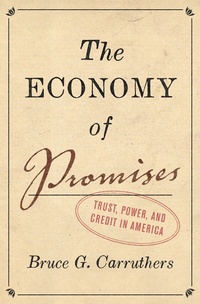
The Economy of Promises
Trust, Power, and Credit in America
Published on 20. August 2024
Book
Paperback/Softback
408 pages
978-0-691-23809-8 (ISBN)
Description
A comprehensive and illuminating account of the history of credit in America-and how it continues to divide the haves from the have-nots
The Economy of Promises is a far-reaching study of credit in nineteenth- and twentieth-century America. Synthesizing and surveying economic and social history, Bruce Carruthers examines how issues of trust stitch together the modern U.S. economy. In the case of credit, that trust involves a commitment by debtors to repay money they have borrowed from lenders. Each promise poses a fundamental question: why does the lender trust the borrower?
The book tracks the dramatic shift from personal qualitative judgments to the impersonal quantitative measurements of credit scores and ratings, which make lending on a much greater scale possible. It discusses how lending is shaped by the shadow of failure, and the possibility that borrowers will break their promises and fail to repay their debts. It reveals how credit markets have been shaped by public policy, regulatory changes, and various political factors. And, crucially, it explains how credit interacts with economic inequality, contributing to vast and enduring racial and gender differences-which are only exacerbated by the widespread use of credit scores and ratings for "big data" and algorithmic decision-making.
Bringing to life the complicated and abstract terrain of human interaction we call the economy, The Economy of Promises is an important study of the tangle of indebtedness that, for better or worse, shapes and defines American lives.
The Economy of Promises is a far-reaching study of credit in nineteenth- and twentieth-century America. Synthesizing and surveying economic and social history, Bruce Carruthers examines how issues of trust stitch together the modern U.S. economy. In the case of credit, that trust involves a commitment by debtors to repay money they have borrowed from lenders. Each promise poses a fundamental question: why does the lender trust the borrower?
The book tracks the dramatic shift from personal qualitative judgments to the impersonal quantitative measurements of credit scores and ratings, which make lending on a much greater scale possible. It discusses how lending is shaped by the shadow of failure, and the possibility that borrowers will break their promises and fail to repay their debts. It reveals how credit markets have been shaped by public policy, regulatory changes, and various political factors. And, crucially, it explains how credit interacts with economic inequality, contributing to vast and enduring racial and gender differences-which are only exacerbated by the widespread use of credit scores and ratings for "big data" and algorithmic decision-making.
Bringing to life the complicated and abstract terrain of human interaction we call the economy, The Economy of Promises is an important study of the tangle of indebtedness that, for better or worse, shapes and defines American lives.
Reviews / Votes
"The Economy of Promises is a model of good social science history. . . . Regardless of your chosen discipline, The Economy of Promises is the best place to start if you want to learn about the evolution of credit in America."---Bradley Hansen, EH.netMore details
Language
English
Place of publication
New Jersey
United States
Target group
College/higher education
Professional and scholarly
Product notice
Paperback (trade)
Dimensions
Height: 234 mm
Width: 156 mm
Thickness: 23 mm
Weight
621 gr
ISBN-13
978-0-691-23809-8 (9780691238098)
Copyright in bibliographic data and cover images is held by Nielsen Book Services Limited or by the publishers or by their respective licensors: all rights reserved.
Schweitzer Classification
Other editions
Additional editions
E-Book
08/2022
1st Edition
Princeton University Press
€29.49
Available for download
Person
Bruce G. Carruthers is the John D. MacArthur Professor of Sociology at Northwestern University. He is the author of City of Capital: Politics and Markets in the English Financial Revolution (Princeton) and the coauthor of, among other books, Money and Credit: A Sociological Approach and Bankrupt: Global Lawmaking and Systemic Financial Crisis.