

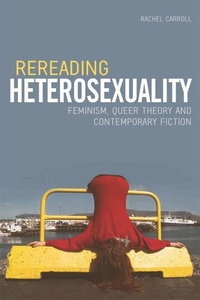
Rereading Heterosexuality
Feminism, Queer Theory and Contemporary Fiction
Published on 4. April 2012
Book
Hardback
168 pages
978-0-7486-3955-7 (ISBN)
Description
Presents new perspectives on representations of female heterosexuality in selected contemporary British and American novels.Drawing on feminist and queer theories of sex, gender and sexuality, this study focuses on female identities at odds with heterosexual norms. In particular, it explores narratives in which the conventional equation between heterosexuality, reproductive sexuality and female identity is questioned. Key Features: * A timely exploration of the dynamic relationship between feminist and queer theory* Offers close analysis of influential novels by leading contemporary authors, including Jeffrey Eugenides's Middlesex (2002), Zoe Heller's Notes on a Scandal (2003), Kazuo Ishiguro's Never Let Me Go (2005), Alan Warner's Morvern Callar (1995), A.M Homes's The End of Alice (1996), and Sarah Waters's Affinity (1999)* Topics range from spinsterhood and intergenerational sexuality to transgender and human cloning
Reviews / Votes
In Rereading Heterosexuality Rachel Carroll steps into provocative and challenging territory. She confronts one of feminisms most thorny dilemmas, namely how to comprehend female heterosexuality which is not simply non-normative but virtually unthinkable to the feminist canon. Written with skill and scholarship in equal measure, there are no easy answers but rather a productive unsettling of expectations. -- Carol Smart, University of Manchester Rachel Carroll makes us 'see' heterosexuality in new and different ways so that we can no longer take it as read. The novels chosen for discussion make interesting bedfellows and the analysis is distinctive and fresh: this will be essential reading for anyone working in contemporary fiction, gender and sexuality. -- Dr Susan Watkins, School of Cultural Studies, Leeds Metropolitan University Rachel Carroll makes us 'see' heterosexuality in new and different ways so that we can no longer take it as read. The novels chosen for discussion make interesting bedfellows and the analysis is distinctive and fresh: this will be essential reading for anyone working in contemporary fiction, gender and sexuality. -- Dr Susan Watkins, School of Cultural Studies, Leeds Metropolitan UniversityMore details
Language
English
Place of publication
Edinburgh
United Kingdom
Target group
College/higher education
Professional and scholarly
Product notice
Unsewn / adhesive bound
Paper over boards
With dust jacket
Dimensions
Height: 249 mm
Width: 164 mm
Thickness: 20 mm
Weight
423 gr
ISBN-13
978-0-7486-3955-7 (9780748639557)
Schweitzer Classification
Other editions
Additional editions
E-Book
04/2012
Edinburgh University Press
€0.00
Available for download
Person
Rachel Carroll is Reader in English at Teesside University, UK. She is author of Rereading Heterosexuality: Feminism, Queer Theory and Contemporary Fiction (Edinburgh University Press, 2012) and editor of Adaptation in Contemporary Culture: Textual Infidelities (Continuum, 2009) and Litpop: Writing and Popular Music (with Adam Hansen, Ashgate, 2014). Her research has been published in journals including Adaptation, Contemporary Women's Writing, Journal of Commonwealth Literature, Textual Practice and Women: a cultural review.
Content
Introduction: Feminism, Queer Theory and Heterosexuality; Part One: Revisiting the spinster; 1. 'Becoming my own ghost': spinsterhood and the 'invisibility' of heterosexuality in Sarah Waters's Affinity; 2. Telling tales out of school: spinsters, scandals and intergenerational heterosexuality in Zoe Heller's Notes on a Scandal; Part Two: Transgressive female heterosexuality; 3. Queering Alice, killing Lolita: feminism, queer theory and the politics of child sexuality in A.M Homes's The End of Alice; 4. Unauthorised reproduction: class, pregnancy and transgressive female heterosexuality in Alan Warner's Morvern Callar; Part Three: Reproducing heterosexuality; 5. 'First one thing and then the other': rewriting the intersexed body in Jeffrey Eugenides's Middlesex; 6. Imitations of life: cloning, heterosexuality and the human in Kazuo Ishiguro's Never Let Me Go