

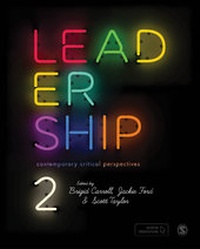
Leadership
Contemporary Critical Perspectives
2nd Edition
Published on 5. April 2019
Book
Paperback/Softback
384 pages
978-1-5264-2582-9 (ISBN)
Description
Written from a global and critical perspective with a diverse range of cases and examples throughout, this is an inspiring read for developing leaders operating within global and multicultural work settings.
'Power' is taken as central theme for this book, opening up discussion about issues that are often neglected in leadership texts i.e. fairness, equity, justice, resistance, conflict, emancipation, oppression, rationality, politics, globalization, the natural environment, and knowledge.
New to this edition:
A new prologue: 'An Unconventional History of Leadership Studies'
A new epilogue on 'Embodied Leadership, Ethics, and its Affects' written by David Knights, one of the authors of Embodied Research Methods (pub April 2019)
3 new topical integrative case studies, based on current events: Jacinda Ardern's pregnancy when PM; #MeToo; and Suma Foods co-operative
Updated research and pedagogical features throughout, including the 'Leadership on Screen' feature
The book is complemented by a range of online resources including PowerPoint slides, videos of the book's authors providing an overview of the chapter and discussing why the topic is important, access to journal articles discussed in the book, and links to additional relevant material.
'Power' is taken as central theme for this book, opening up discussion about issues that are often neglected in leadership texts i.e. fairness, equity, justice, resistance, conflict, emancipation, oppression, rationality, politics, globalization, the natural environment, and knowledge.
New to this edition:
A new prologue: 'An Unconventional History of Leadership Studies'
A new epilogue on 'Embodied Leadership, Ethics, and its Affects' written by David Knights, one of the authors of Embodied Research Methods (pub April 2019)
3 new topical integrative case studies, based on current events: Jacinda Ardern's pregnancy when PM; #MeToo; and Suma Foods co-operative
Updated research and pedagogical features throughout, including the 'Leadership on Screen' feature
The book is complemented by a range of online resources including PowerPoint slides, videos of the book's authors providing an overview of the chapter and discussing why the topic is important, access to journal articles discussed in the book, and links to additional relevant material.
Reviews / Votes
Smart, provocative, and sometimes irreverent, this book provokes students and practitioners to think realistically about the nature of leadership and how it emerges and functions. Readers will discover how context, history, and factors such as gender, race, and ethnicity, shape the way that leadership manifests itself in organizations and society. -- Professor Joanne B. Ciulla "Mainstream leadership research remains mired in a hopeless infatuation with overblown images of heroic leadership. Leadership in 'the real world' is much more complex than that. Each chapter in this immensely wise and well-written book shows us how to think differently about leadership. A compelling read." -- Professor Dennis Tourish "Finally a book on leadership that I can use in graduate as well as executive teaching - and enjoy myself! It's equally informative, reflexive, provoking and entertaining: pedagogical without losing edge. On top of that the authors have made it really easy to teach from as it's full of reflexive exercises and relevant case studies." -- Professor Sara Louise MuhrMore details
Edition
2nd Revised edition
Language
English
Place of publication
London
United Kingdom
Target group
College/higher education
Professional and scholarly
Edition type
Revised edition
Dimensions
Height: 232 mm
Width: 186 mm
Weight
678 gr
ISBN-13
978-1-5264-2582-9 (9781526425829)
Copyright in bibliographic data and cover images is held by Nielsen Book Services Limited or by the publishers or by their respective licensors: all rights reserved.
Schweitzer Classification
Other editions
New editions
Book
11/2022
3rd Edition
SAGE Publications Ltd
€138.80
Shipment within 15-20 days
Previous edition
Book
05/2015
1st Edition
SAGE Publications Ltd
€73.22
Article exhausted; check for reprint
Persons
Brigid Carroll is a Professor in the Department of Management and International Business and holds the Fletcher Building Employee Educational Fund Chair in Leadership at the University of Auckland in New Zealand. She teaches broadly in the area of leadership, organizational theory and qualitative research methods at undergraduate, postgraduate and executive level and does extensive cross sector leadership development work with corporate, community, professional, and youth organisations. Ongoing research themes revolve around identity work, power, responsibility and resistance, leadership development, distributed and collective leadership, cross system governance and discursive/ narrative approaches. Ultimately Brigid is interested in leadership as a discourse, identity, and practice and in exploring how it is constructed and shaped between people, spaces, and artefacts in different organisational contexts. She has published in Organization Studies, Human Relations, AMLE, Management Learning and Leadership and has co-edited three books on Leadership.
Jackie Ford is Professor of Leadership and Organization studies at Durham University Business School, UK.
Dr. Scott Taylor is Associate Professor of Leadership & Organization Studies at Birmingham Business School, University of Birmingham, UK. He has researched and taught at a number of British universities, and visited universities in New Zealand, Australia, India, Sweden, and Saudi Arabia. Scott has published research in a range of peer-reviewed journals and books, focusing on spirituality at work, work/life balance, and gender discrimination. He has served as Associate Editor of Organization, Section Editor for Journal of Business Ethics, and co-chair of the Critical Management Studies Division, Academy of Management. All of Scott's research is qualitative, interpretive, and sociological, to understand the human experience of work, management, and workplaces. He is currently working with colleagues to prepare the third edition of Leadership: Contemporary critical perspectives (Sage, 2021), a textbook that emphasises the need to approach leadership as complex practice-in-context.
Jackie Ford is Professor of Leadership and Organization studies at Durham University Business School, UK.
Dr. Scott Taylor is Associate Professor of Leadership & Organization Studies at Birmingham Business School, University of Birmingham, UK. He has researched and taught at a number of British universities, and visited universities in New Zealand, Australia, India, Sweden, and Saudi Arabia. Scott has published research in a range of peer-reviewed journals and books, focusing on spirituality at work, work/life balance, and gender discrimination. He has served as Associate Editor of Organization, Section Editor for Journal of Business Ethics, and co-chair of the Critical Management Studies Division, Academy of Management. All of Scott's research is qualitative, interpretive, and sociological, to understand the human experience of work, management, and workplaces. He is currently working with colleagues to prepare the third edition of Leadership: Contemporary critical perspectives (Sage, 2021), a textbook that emphasises the need to approach leadership as complex practice-in-context.
Content
Table Of Contents
Prologue: An Unconventional History of Leadership Studies - Suze Wilson
Part I: Classical Theories of Leadership
Chapter 1: Leadership, Management and Headship: Power, Emotion and Authority in Organizations - Donna Ladkin
Chapter 2: Trait Theories of Leaders and Leadership: From Ancient Greece to Twenty-first-century Neuroscience - Scott Taylor
Chapter 3: Leading through Contingencies - John Cullen
Chapter 4: Transformational Leadership: Secularized Theology? - Helen Delaney and Sverre Spoelstra
Part II: Leading in Context - Suze Wilson
Chapter 5: Leadership Learning and Development - Brigid Carroll
Chapter 6: Leadership, Governance and Strategy - Annie Pye
Chapter 7: Difference and Leadership - Amanda Sinclair and Michelle Evans
Chapter 8: Studying Followers - Nancy Harding
PART III: Contemporary Perspectives
Chapter 9: Leadership and Process - Simon Kelly
Chapter 10: Relational Leadership - Lucia Crevani
Chapter 11: Leadership without Leaders: Understanding Anarchist Organizing through the Lens of Critical Leadership Studies - Neil Sutherland
Chapter 12: Leadership, Post-structuralism and the Performative Turn - Jackie Ford
Chapter 13: Seeing Leadership: Becoming Sophisticated Consumers of Leadership - Owain Smolovic-Jones and Brad Jackson
Epilogue: Embodied Leadership, Ethics and its Affects - David Knights
References
Index
Prologue: An Unconventional History of Leadership Studies - Suze Wilson
Part I: Classical Theories of Leadership
Chapter 1: Leadership, Management and Headship: Power, Emotion and Authority in Organizations - Donna Ladkin
Chapter 2: Trait Theories of Leaders and Leadership: From Ancient Greece to Twenty-first-century Neuroscience - Scott Taylor
Chapter 3: Leading through Contingencies - John Cullen
Chapter 4: Transformational Leadership: Secularized Theology? - Helen Delaney and Sverre Spoelstra
Part II: Leading in Context - Suze Wilson
Chapter 5: Leadership Learning and Development - Brigid Carroll
Chapter 6: Leadership, Governance and Strategy - Annie Pye
Chapter 7: Difference and Leadership - Amanda Sinclair and Michelle Evans
Chapter 8: Studying Followers - Nancy Harding
PART III: Contemporary Perspectives
Chapter 9: Leadership and Process - Simon Kelly
Chapter 10: Relational Leadership - Lucia Crevani
Chapter 11: Leadership without Leaders: Understanding Anarchist Organizing through the Lens of Critical Leadership Studies - Neil Sutherland
Chapter 12: Leadership, Post-structuralism and the Performative Turn - Jackie Ford
Chapter 13: Seeing Leadership: Becoming Sophisticated Consumers of Leadership - Owain Smolovic-Jones and Brad Jackson
Epilogue: Embodied Leadership, Ethics and its Affects - David Knights
References
Index