

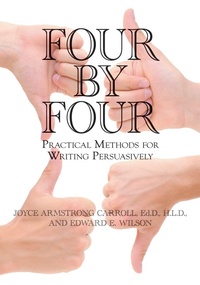
Four by Four
Practical Methods for Writing Persuasively
Published on 23. February 2012
Book
Paperback/Softback
84 pages
978-1-59884-950-9 (ISBN)
Description
Geared toward English and social studies teachers as well as school librarians, this book provides a clear and concise way to approach the teaching of persuasive writing-and to develop the skills students need to excel on high stakes tests as well.
In Four by Four: Practical Methods for Writing Persuasively, well-known authors and teachers of writing Joyce Armstrong Carroll and Edward E. Wilson provide a practical guide to teaching students how to write persuasively. Organized in four chapters, each containing four sections, the text opens with a history of rhetoric that serves as a logical preface to the persuasive writing basics, guides, and patterns presented in the remainder of the book.
It covers topics such as the Carroll/Wilson Inquiry Schemata as a data collection technique for persuasive writing, planning and organizing a persuasive paper, strategies for efficient editing, and writing the conclusion. Appropriate for educators who work with fourth-grade through college-level students in English and social studies, this guidebook spotlights the research process, a 21st-century skill that teachers should teach collaboratively with their school librarians.
In Four by Four: Practical Methods for Writing Persuasively, well-known authors and teachers of writing Joyce Armstrong Carroll and Edward E. Wilson provide a practical guide to teaching students how to write persuasively. Organized in four chapters, each containing four sections, the text opens with a history of rhetoric that serves as a logical preface to the persuasive writing basics, guides, and patterns presented in the remainder of the book.
It covers topics such as the Carroll/Wilson Inquiry Schemata as a data collection technique for persuasive writing, planning and organizing a persuasive paper, strategies for efficient editing, and writing the conclusion. Appropriate for educators who work with fourth-grade through college-level students in English and social studies, this guidebook spotlights the research process, a 21st-century skill that teachers should teach collaboratively with their school librarians.
Reviews / Votes
The writing is very clear and ably supported by numerous models and lesson plans. Those who do not teach but are interested in persuasive writing can apply the concepts to themselves, so while aimed at teachers, others can gain considerable clarity about and learn new methods for applying persuasive writing. . . . This work is recommended for English teachers of English where persuasive writing is on the curriculum. * Australian Library Journal * Although very brief, this guide offers an interesting overview and creative suggestions for the teaching and learning of persuasive writing. * ARBA *More details
Language
English
Place of publication
United States
Publishing group
Bloomsbury Publishing Plc
Target group
Primary & secondary/elementary & high school
Dimensions
Height: 254 mm
Width: 178 mm
Thickness: 5 mm
Weight
177 gr
ISBN-13
978-1-59884-950-9 (9781598849509)
Copyright in bibliographic data and cover images is held by Nielsen Book Services Limited or by the publishers or by their respective licensors: all rights reserved.
Schweitzer Classification
Other editions
Additional editions
Joyce Armstrong Carroll | Edward E. Wilson | New Jersey Writing Project
Four by Four
Practical Methods for Writing Persuasively
E-Book
02/2012
1st Edition
Libraries Unlimited Inc
€25.49
Available for download
Joyce Armstrong Carroll | Edward E. Wilson | New Jersey Writing Project
Four by Four
Practical Methods for Writing Persuasively
E-Book
02/2012
1st Edition
Libraries Unlimited Inc
€25.49
Available for download
Persons
Joyce Armstrong Carroll, EdD, HLD, is codirector of Abydos Learning International, formerly the New Jersey Writing Project in Texas (NJWPT), with Edward E. Wilson.
Edward E. Wilson is codirector of Abydos Learning International, formerly the New Jersey Writing Project in Texas (NJWPT), with Joyce Armstrong Carroll.
Edward E. Wilson is codirector of Abydos Learning International, formerly the New Jersey Writing Project in Texas (NJWPT), with Joyce Armstrong Carroll.
Content
Introduction
Chapter 1: Four Historical Influences on Persuasion
* The Greeks, * The Romans, * Thinkers of the Nineteenth and Twentieth Centuries, * Present-day Persuasion: A Commentary, * Model, * Application,
Chapter 2: The Four Basics of the Persuasive Essay
* Length, * Rhetorical Stance, * Organization, * Structure, * Model, * Application,
Chapter 3: Four Guides for Writing Persuasively
* Guide One: Find the Topic, * Guide Two: Craft the Thesis Statement, * Guide Three: Defend It, * Guide Four: End It, * Model, * Application,
Chapter 4: Four Patterns for Teaching the Persuasive Essay
* Fourteen-day Implementation Model, * Pattern One: Equal Arguments, * Pattern Two: Strawman, * Subpattern Strawman Plus, * Pattern Three: Concession, * Pattern Four: Nestorian Order,
Appendix A: A Suggested Mnemonic Device for Students to Remember the Major Rhetoricians or a Quick Guide for Debaters
Appendix B: Registers of Language Defined
Appendix C: Persuasive Theses
Appendix D: The Major Fallacies
References
Index
Chapter 1: Four Historical Influences on Persuasion
* The Greeks, * The Romans, * Thinkers of the Nineteenth and Twentieth Centuries, * Present-day Persuasion: A Commentary, * Model, * Application,
Chapter 2: The Four Basics of the Persuasive Essay
* Length, * Rhetorical Stance, * Organization, * Structure, * Model, * Application,
Chapter 3: Four Guides for Writing Persuasively
* Guide One: Find the Topic, * Guide Two: Craft the Thesis Statement, * Guide Three: Defend It, * Guide Four: End It, * Model, * Application,
Chapter 4: Four Patterns for Teaching the Persuasive Essay
* Fourteen-day Implementation Model, * Pattern One: Equal Arguments, * Pattern Two: Strawman, * Subpattern Strawman Plus, * Pattern Three: Concession, * Pattern Four: Nestorian Order,
Appendix A: A Suggested Mnemonic Device for Students to Remember the Major Rhetoricians or a Quick Guide for Debaters
Appendix B: Registers of Language Defined
Appendix C: Persuasive Theses
Appendix D: The Major Fallacies
References
Index