

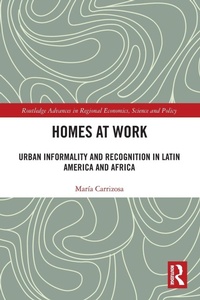
Homes at Work
Urban Informality and Recognition in Latin America and Africa
1st Edition
Published on 28. November 2024
Book
Paperback/Softback
230 pages
978-1-032-28625-9 (ISBN)
Description
Following the outbreak of the COVID-19 pandemic, working from home became a global phenomenon, yet before 2020, it was a relatively understudied practice. But in informal settlements, the definition of "home" and "employment" is completely intertwined, which is why there is so much to learn from them. For over half a century, mainstream theoretical approaches to urban informality, dominated by development economics, often fail to see this economic and spatial phenomenon jointly. Labor studies tend to be space-blind and spatial studies often disregard informal employment. Profoundly interdisciplinary, this work connects scholarship in development, public policy, labor studies, and feminist economics, with that in urban studies, planning, housing, architecture, and visual studies.
The book walks the reader behind the closed doors of working homes that make the fabric, both social and economic, of most cities. It applies a visual methodology to reveal their "space-use intensity" and quantify the extent to which houses in informal settlements fill their inner pores with economic activity and community services. The research also revisits urban formalization policies in Latin America and Africa, to uncover a fallacious politics of recognition. It ultimately argues for a recognition continuum: an approach to urban informality that is more practical and fairer.
The book is of interest to development economists, urban scholars, public policy specialists, time-use researchers, and architects working on housing, employment generation, urban livelihoods, gender studies, and related topics.
The book walks the reader behind the closed doors of working homes that make the fabric, both social and economic, of most cities. It applies a visual methodology to reveal their "space-use intensity" and quantify the extent to which houses in informal settlements fill their inner pores with economic activity and community services. The research also revisits urban formalization policies in Latin America and Africa, to uncover a fallacious politics of recognition. It ultimately argues for a recognition continuum: an approach to urban informality that is more practical and fairer.
The book is of interest to development economists, urban scholars, public policy specialists, time-use researchers, and architects working on housing, employment generation, urban livelihoods, gender studies, and related topics.
More details
Series
Language
English
Place of publication
London
United Kingdom
Publishing group
Taylor & Francis Ltd
Target group
College/higher education
Professional and scholarly
Academic and Postgraduate
Illustrations
5 s/w Tabellen, 80 farbige Abbildungen, 37 Farbfotos bzw. farbige Rasterbilder, 43 farbige Zeichnungen
5 Tables, black and white; 43 Line drawings, color; 37 Halftones, color; 80 Illustrations, color
Dimensions
Height: 234 mm
Width: 156 mm
Thickness: 14 mm
Weight
386 gr
ISBN-13
978-1-032-28625-9 (9781032286259)
Copyright in bibliographic data and cover images is held by Nielsen Book Services Limited or by the publishers or by their respective licensors: all rights reserved.
Schweitzer Classification
Other editions
Additional editions
E-Book
05/2023
1st Edition
Routledge
€55.49
Available for download
E-Book
05/2023
1st Edition
Routledge
€55.49
Available for download
Book
05/2023
1st Edition
Routledge
€214.80
Shipment within 10-20 days
Person
Maria Carrizosa is Associate Director of Global Housing Policy at Habitat for Humanity International.
Content
1. Introduction 2. Urban informality: mainstream theories and visible alternatives 3. Space-use intensity in informal settlements in Bogota 4. The politics of urban formalization in Bogota 5. Space-use intensity and urban formalization in African cities 6. Conclusion