

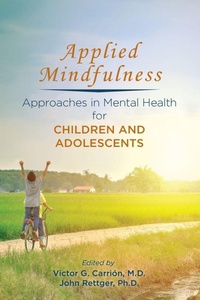
Applied Mindfulness
Approaches in Mental Health for Children and Adolescents
Published on 12. April 2019
Book
Paperback/Softback
394 pages
978-1-61537-212-6 (ISBN)
Description
Applied Mindfulness: Approaches in Mental Health for
Children and Adolescents starts from the premise that mental health
clinicians must have their own mindfulness practice before teaching the
tenets and techniques of mindfulness to others, including young people. To
that end, the book offers readers clear instructions on how to first
practice mindfulness in their own lives and then extend their personal
practice outward to others. Once this knowledge is internalized, the
clinician can focus on mindfulness in terms of its application to specific
clinical diagnoses, such as anxiety and depression,
attention-deficit/hyperactivity disorder, and substance abuse. Because many
mental health professionals work in multiple settings, such as in schools,
in clinics, and online, the contributors, representing a wide range of
creative and authoritative voices, explain how to skillfully tailor
mindfulness interventions for effective application across diverse contexts.
Drs. Carrion and Rettger, as Director of the Stanford Early Life Stress and
Pediatric Anxiety Program (SELSPAP) and Director of SELSPAP's Mindfulness
Program, respectively, have been engaged in ongoing community-based work
delivering mindfulness and yoga programming to underserved youth and their
helpers. This expertise is evident in their eloquent yet down-to-earth
editing.
The volume offers clinicians everything they need to begin
their mindfulness journey, including the following:
* Introductory knowledge on how to get started with a meditation
practice. Specific mindfulness scripts are provided throughout the book to
foster development of the reader's own practice. In addition, there are
audio practices and clear written descriptions of practices to offer support
for those learning to meditate, internalize mindfulness practices, and then
adapt these skills for clinical practice.
* A developmental and
ecological approach to implementing mindfulness. The book offers insight
into integrating mindfulness across many settings, platforms, and
applications, and includes chapters on mindfulness online, at home, and in
school, as well as chapters on incorporating nature into mindfulness
practice and the relationship between mindfulness and creativity.
*
Material on specific clinical populations, including immigrant youth and
incarcerated youth. A special chapter is devoted to trauma-informed yoga,
which has been shown to be an effective therapeutic intervention for youth
who have been incarcerated.
* Comprehensive information on the current
state of youth mindfulness research, which prepares readers to discuss these
topics knowledgeably with colleagues and patients.
Like ripples in
water, the benefits of mindfulness spread outward, from clinicians to
patients, families, schools, and communities. Applied Mindfulness:
Approaches in Mental Health for Children and Adolescents is the
first step toward stress reduction, peace, and compassion for a new
generation.
Children and Adolescents starts from the premise that mental health
clinicians must have their own mindfulness practice before teaching the
tenets and techniques of mindfulness to others, including young people. To
that end, the book offers readers clear instructions on how to first
practice mindfulness in their own lives and then extend their personal
practice outward to others. Once this knowledge is internalized, the
clinician can focus on mindfulness in terms of its application to specific
clinical diagnoses, such as anxiety and depression,
attention-deficit/hyperactivity disorder, and substance abuse. Because many
mental health professionals work in multiple settings, such as in schools,
in clinics, and online, the contributors, representing a wide range of
creative and authoritative voices, explain how to skillfully tailor
mindfulness interventions for effective application across diverse contexts.
Drs. Carrion and Rettger, as Director of the Stanford Early Life Stress and
Pediatric Anxiety Program (SELSPAP) and Director of SELSPAP's Mindfulness
Program, respectively, have been engaged in ongoing community-based work
delivering mindfulness and yoga programming to underserved youth and their
helpers. This expertise is evident in their eloquent yet down-to-earth
editing.
The volume offers clinicians everything they need to begin
their mindfulness journey, including the following:
* Introductory knowledge on how to get started with a meditation
practice. Specific mindfulness scripts are provided throughout the book to
foster development of the reader's own practice. In addition, there are
audio practices and clear written descriptions of practices to offer support
for those learning to meditate, internalize mindfulness practices, and then
adapt these skills for clinical practice.
* A developmental and
ecological approach to implementing mindfulness. The book offers insight
into integrating mindfulness across many settings, platforms, and
applications, and includes chapters on mindfulness online, at home, and in
school, as well as chapters on incorporating nature into mindfulness
practice and the relationship between mindfulness and creativity.
*
Material on specific clinical populations, including immigrant youth and
incarcerated youth. A special chapter is devoted to trauma-informed yoga,
which has been shown to be an effective therapeutic intervention for youth
who have been incarcerated.
* Comprehensive information on the current
state of youth mindfulness research, which prepares readers to discuss these
topics knowledgeably with colleagues and patients.
Like ripples in
water, the benefits of mindfulness spread outward, from clinicians to
patients, families, schools, and communities. Applied Mindfulness:
Approaches in Mental Health for Children and Adolescents is the
first step toward stress reduction, peace, and compassion for a new
generation.
More details
Language
English
Place of publication
VA
United States
Target group
Professional and scholarly
US School Grade: College Graduate Student and over
Product notice
Paperback (trade)
Illustrations
5 Figures; 17 Tables, unspecified
Dimensions
Height: 229 mm
Width: 152 mm
Weight
640 gr
ISBN-13
978-1-61537-212-6 (9781615372126)
Copyright in bibliographic data and cover images is held by Nielsen Book Services Limited or by the publishers or by their respective licensors: all rights reserved.
Schweitzer Classification
Other editions
Additional editions
Victor G. Carrión | John Rettger
Applied Mindfulness
Approaches in Mental Health for Children and Adolescents
E-Book
02/2019
American Psychiatric Association Publishing
€46.49
Available for download
Persons
Victor G. Carrion, M.D., is John A. Turner, M.D.
Endowed Chair of Child and Adolescent Psychiatry; Professor and Vice-Chair,
Department of Psychiatry and Behavioral Sciences; and Director, Early Life
Stress and Pediatric Anxiety Program, at Stanford University.
John
P. Rettger, Ph.D., is Mindfulness Program Director, Early Life
Stress and Pediatric Anxiety Program, School of Medicine, at Stanford
University.
Endowed Chair of Child and Adolescent Psychiatry; Professor and Vice-Chair,
Department of Psychiatry and Behavioral Sciences; and Director, Early Life
Stress and Pediatric Anxiety Program, at Stanford University.
John
P. Rettger, Ph.D., is Mindfulness Program Director, Early Life
Stress and Pediatric Anxiety Program, School of Medicine, at Stanford
University.
Content
Part I: Introduction to Mindfulness
Chapter 1.
Developing a Personal Mindfulness Practice
Chapter 2. Mindful
Self-Compassion
Chapter 3. State of the Research on Youth
Mindfulness
Chapter 4. Measuring Mindfulness
Part II: Mindfulness
Application to Specific Clinical Diagnoses
Chapter 5. Anxiety and
Depression
Chapter 6. Attention-Deficit/Hyperactivity
Disorder
Chapter 7. Grief and Loss
Chapter 8. Substance
Abuse
Chapter 9. Autism Spectrum Disorders
Part III: Mindfulness
Application to Specific Clinical Populations
Chapter 10. Immigrant
Youth
Chapter 11. Incarcerated Youth
Chapter 12. Trauma-Informed
Yoga With Incarcerated Youth
Part IV: Mindfulness Settings
Chapter
13. Mindfulness at Home
Chapter 14. Mindfulness in Schools
Chapter
15. Mindfulness Nature Practices
Chapter 16. Mindful Movement in
Schools
Chapter 17. Mindfulness and Technology
Chapter 18.
Mindfulness and Creativity
Chapter 1.
Developing a Personal Mindfulness Practice
Chapter 2. Mindful
Self-Compassion
Chapter 3. State of the Research on Youth
Mindfulness
Chapter 4. Measuring Mindfulness
Part II: Mindfulness
Application to Specific Clinical Diagnoses
Chapter 5. Anxiety and
Depression
Chapter 6. Attention-Deficit/Hyperactivity
Disorder
Chapter 7. Grief and Loss
Chapter 8. Substance
Abuse
Chapter 9. Autism Spectrum Disorders
Part III: Mindfulness
Application to Specific Clinical Populations
Chapter 10. Immigrant
Youth
Chapter 11. Incarcerated Youth
Chapter 12. Trauma-Informed
Yoga With Incarcerated Youth
Part IV: Mindfulness Settings
Chapter
13. Mindfulness at Home
Chapter 14. Mindfulness in Schools
Chapter
15. Mindfulness Nature Practices
Chapter 16. Mindful Movement in
Schools
Chapter 17. Mindfulness and Technology
Chapter 18.
Mindfulness and Creativity