

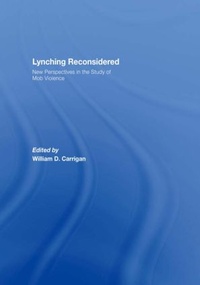
Lynching Reconsidered
New Perspectives in the Study of Mob Violence
1st Edition
Published on 23. November 2007
Book
Hardback
240 pages
978-0-415-36676-2 (ISBN)
Description
The history of lynching and mob violence has become a subject of considerable scholarly and public interest in recent years. Popular works by James Allen, Philip Dray, and Leon Litwack have stimulated new interest in the subject. A generation of new scholars, sparked by these works and earlier monographs, are in the process of both enriching and challenging the traditional narrative of lynching in the United States.
This volume contains essays by ten scholars at the forefront of the movement to broaden and deepen our understanding of mob violence in the United States. These essays range from the Reconstruction to World War Two, analyze lynching in multiple regions of the United States, and employ a wide range of methodological approaches.
The authors explore neglected topics such as: lynching in the Mid-Atlantic, lynching in Wisconsin, lynching photography, mob violence against southern white women, black lynch mobs, grassroots resistance to racial violence by African Americans, nineteenth century white southerners who opposed lynching, and the creation of 'lynching narratives' by southern white newspapers.
This book was first published as a special issue of American Nineteenth Century History
This volume contains essays by ten scholars at the forefront of the movement to broaden and deepen our understanding of mob violence in the United States. These essays range from the Reconstruction to World War Two, analyze lynching in multiple regions of the United States, and employ a wide range of methodological approaches.
The authors explore neglected topics such as: lynching in the Mid-Atlantic, lynching in Wisconsin, lynching photography, mob violence against southern white women, black lynch mobs, grassroots resistance to racial violence by African Americans, nineteenth century white southerners who opposed lynching, and the creation of 'lynching narratives' by southern white newspapers.
This book was first published as a special issue of American Nineteenth Century History
More details
Language
English
Place of publication
London
United Kingdom
Publishing group
Taylor & Francis Ltd
Target group
College/higher education
Postgraduate and Undergraduate
Dimensions
Height: 246 mm
Width: 174 mm
Weight
589 gr
ISBN-13
978-0-415-36676-2 (9780415366762)
Copyright in bibliographic data and cover images is held by Nielsen Book Services Limited or by the publishers or by their respective licensors: all rights reserved.
Schweitzer Classification
Other editions
Additional editions
Book
02/2015
1st Edition
Routledge
€77.03
Shipment within 10-20 days
E-Book
02/2014
1st Edition
Routledge
€64.49
Available for download
E-Book
02/2014
1st Edition
Routledge
€64.49
Available for download
Person
WILLIAM D. CARRIGAN IS ASSOCIATE PROFESSOR OF HISTORY AT ROWAN UNIVERSITY IN GLASSBORO, NEW JERSEY. HIS FIRST BOOK WAS THE MAKING OF A LYNCHING CULTURE: VIOLENCE AND VIGILANTISM IN CENTRAL TEXAS, 1836-1916. HE IS CURRENTLY AT WORK WITH CLIVE WEBB ON A STUDY OF MOB VIOLENCE AGAINST MEXICANS IN THE UNITED STATES.
Content
(1)Introduction (William D. Carrigan, Rowan University). (2) Wisconsin's Last Decade of Lynching, 1881-1891. (Michael J. Pfeifer, The Evergreen State College) (3) Lynching in the Mid-Atlantic, 1882-1940. (Janice Barrow, University of Delaware) (4) Lynch Law Reversed: The Rape of Lula Sherman, the Lynching of Manse Waldrop, and the Debate over Lynching in the 1880s. (Bruce E. Baker, Royal Holloway, University of London) (5) Raw, Quivering Flesh': John G. Cashman's 'Pornographic' Constitutionalism Designed to Produce an 'Aversion and Detestation', 1883-1904. ( Christopher Waldrep, San Francisco State University) (6) Resolving the Paradox of Our Lynching Fixation: Reconsidering racialized violence in the American South after slavery. (Kidada E. Williams, University of Michigan) (7) 'Warranted Lynchings': Narratives of Lynchings in Southern white Supremacy. (Susan Jean, Columbia University) (8) Lynching Photography and the Visual Reproduction of White Supremacy (Amy Louise Wood, Illinois State University Conclusion (W. Fitzhugh Brundage, University of North Carolina at Chapel Hill)