

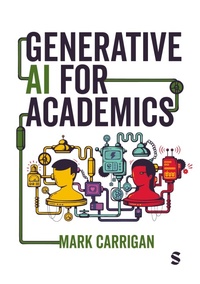
Generative AI for Academics
1st Edition
Published on 18. December 2024
Book
Paperback/Softback
192 pages
978-1-5296-9039-2 (ISBN)
Description
This is your indispensable guide to navigating the rise of generative AI as an academic. It thoughtfully explores rapidly evolving AI capabilities reshaping higher education, examining challenges and ethical dilemmas across the sector.
It provides useful strategies for using generative AI in your scholarly work while upholding professional standards. This practical guidance addresses four core areas of academic work:
Thinking: How to use generative AI to augment individual and collaborative scholarly thinking that can assist in developing novel ideas and advancing impactful projects
Collaborating: Explore how generative AI can be used as a research assistant, coordinating teams and enhancing scholarly cooperation
Communicating: Cautioning against over-reliance, examine how generative AI can relieve communication burdens while maintaining professionalism and etiquette
Engaging: thoughtful and practical frameworks are offered for using these developments to support online engagement without sacrificing scholarly principles
Dr Mark Carrigan is a digital sociologist, author and Senior Lecturer in Education at the University of Manchester, where he is co-lead of the Digital Education Manchester group.
***Unlock exclusive, time-limited access to our custom GPT, designed to deepen your engagement, when you purchase a copy of the book***
It provides useful strategies for using generative AI in your scholarly work while upholding professional standards. This practical guidance addresses four core areas of academic work:
Thinking: How to use generative AI to augment individual and collaborative scholarly thinking that can assist in developing novel ideas and advancing impactful projects
Collaborating: Explore how generative AI can be used as a research assistant, coordinating teams and enhancing scholarly cooperation
Communicating: Cautioning against over-reliance, examine how generative AI can relieve communication burdens while maintaining professionalism and etiquette
Engaging: thoughtful and practical frameworks are offered for using these developments to support online engagement without sacrificing scholarly principles
Dr Mark Carrigan is a digital sociologist, author and Senior Lecturer in Education at the University of Manchester, where he is co-lead of the Digital Education Manchester group.
***Unlock exclusive, time-limited access to our custom GPT, designed to deepen your engagement, when you purchase a copy of the book***
Reviews / Votes
Carrigan outlines ways for academics to use LLMs in their work - including, but not limited to, their writing. I especially appreciate Carrigan's argument that the way to go is to find ways to think with LLMs rather than using LLMs as a substitute for thought. (...) Among the uses for LLMs Carrigan explores are "rubberducking" (explaining your ideas to an LLM to test and polish your ability to explain them, just as you might talk your ideas out to a friend, or your cat, or a rubber duck); If you're currently anti-LLM, challenge yourself by reading Carrigan. -- Stephen B. Heard * https://bit.ly/40XWAlI * As a PhD student researching the impact of GenAI on university students (while also a new professor), it felt like this book was written for me. Carrigan immediately identified the scariest part of GenAI - its ability to dismantle the trusting relationships between faculty and students. By (at least partially) embracing AI in higher education, Carrigan shows we can simplify our workload to produce better quality work and enhance our means of thinking and engaging. This thought-provoking work increased my optimism about our future with GenAI. Highly recommended for all educators! -- Five-star review from Illysa * Amazon customer review at https://bit.ly/42PhUMT * This book offers a very thorough and thoughtful consideration of the use of generative AI, particularly ChatGPT and Claude, in academia. It successfully balances intellectually rigorous debate with practical tips and guidance. It will be especially valuable for those unfamiliar with using these tools, while even more experienced users are likely to pick up some new ideas and benefit from engaging with the broader ethical and practical discussions. I particularly appreciated the emphasis on treating these programmes as conversation partners rather than replacements for our own intellectual labour, and the encouragement to use them critically and alongside other forms of academic work.-- Dr Emma Craddock Generative AI for Academics is not a guide for use, giving advice on better prompts or more engaging output, but a guide for refection, aiming to make the use of GenAI 'routine without it becoming thoughtless' (Carrigan 2025: 31). -- Milan Stuermer * https://doi.org/10.1007/s42438-025-00580-x * A brisk, sensible map for using LLMs in scholarly life. It avoids both hype and doom, treating generative AI as a set of tools that demand judgment, not blind adoption. The tone is practical and reflective-ideal for faculty, PIs, and grad students who need shared language and guardrails.
The book shines in how it organizes academic work (Thinking, Collaborating, Communicating, Engaging), then pairs each with concrete practices (rubber-ducking, draft refinement, critical oversight). It isn't a prompt cookbook or a windy manifesto; it's a clear framework for responsible use, culture-setting, and policy discussions in departments and labs. -- Bruno Goncalves * https://data4sci.substack.com/p/top-10-books-we-read-in-2025 * By reframing generative AI as a dialogue partner and urging scholars to share their reflective practices, Carrigan offers academics across disciplines a way to navigate the uncertainty of higher education today. -- Tom Redshaw * https://journals.sagepub.com/doi/abs/10.1177/00380385251401413 * The book serves as both a guide and a safeguard. It acknowledges the undeniable efficiency of AI tools while insisting that genuine learning depends on sustained reflection and human agency. Carrigan's quiet insistence throughout the book is that technology does not diminish the value of intellectual effort. If anything, it raises the stakes. It demands that we become more conscious of how and why we think, not less. Right now, with these tools proliferating faster than our ability to think critically about them, that might be the most important thing any book about AI can say. -- Donghan Xie (M.S.Ed. LST'27) * https://aiedpenngse.substack.com/p/book-review-generative-ai-for-academics *
More details
Edition
1. Auflage
Language
English
Place of publication
London
United Kingdom
Target group
College/higher education
Professional and scholarly
Dimensions
Height: 242 mm
Width: 170 mm
Thickness: 13 mm
Weight
379 gr
ISBN-13
978-1-5296-9039-2 (9781529690392)
Copyright in bibliographic data and cover images is held by Nielsen Book Services Limited or by the publishers or by their respective licensors: all rights reserved.
Schweitzer Classification
Other editions
Additional editions
Mark Carrigan
Generative AI for Academics
Book
12/2024
1st Edition
SAGE Publications Ltd
€127.90
Shipment within 3-4 weeks
Mark Carrigan
Generative AI for Academics
E-Book
12/2024
1st Edition
SAGE Publications Ltd
€52.99
Available for download
Person
Dr Mark Carrigan FRSA FHEA is a Senior Lecturer in Education at the University of Manchester where he is co-lead of the Digital Education Manchester group. Trained as a philosopher and sociologist, his research aims to bridge fundamental questions of social ontology with practical and policy interventions to support the effective use of emerging technologies within education. He has written or edited nine books, including Social Media for Academics, published by Sage and now in its second edition.
Content
Chapter 1 Generative AI and Universities
Chapter 2 Generative AI and Reflexivity
Chapter 3 The Ethics of Generative AI
Chapter 4 Thinking
Chapter 5 Collaborating
Chapter 6 Communication
Chapter 7 Engagement
Chapter 8 Academic Futures
Chapter 2 Generative AI and Reflexivity
Chapter 3 The Ethics of Generative AI
Chapter 4 Thinking
Chapter 5 Collaborating
Chapter 6 Communication
Chapter 7 Engagement
Chapter 8 Academic Futures