

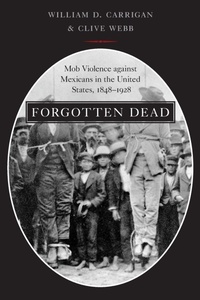
Forgotten Dead
Mob Violence against Mexicans in the United States, 1848-1928
Published on 9. February 2017
Book
Paperback/Softback
322 pages
978-0-19-061069-2 (ISBN)
Description
Mob violence in the United States is usually associated with the southern lynch mobs who terrorized African Americans during the Jim Crow era. In Forgotten Dead, William D. Carrigan and Clive Webb uncover a comparatively neglected chapter in the story of American racial violence, the lynching of persons of Mexican origin or descent. Over eight decades lynch mobs murdered hundreds of Mexicans, mostly in the American Southwest. Racial prejudice, a lack of respect for local courts, and economic competition all fueled the actions of the mob. Sometimes ordinary citizens committed these acts because of the alleged failure of the criminal justice system; other times the culprits were law enforcement officers themselves. Violence also occurred against the backdrop of continuing tensions along the border between the United States and Mexico aggravated by criminal raids, military escalation, and political revolution.
Based on Spanish and English archival documents from both sides of the border, Forgotten Dead explores through detailed case studies the characteristics and causes of mob violence against Mexicans across time and place. It also relates the numerous acts of resistance by Mexicans, including armed self-defense, crusading journalism, and lobbying by diplomats who pressured the United States to honor its rhetorical commitment to democracy. Finally, it contains the first-ever inventory of Mexican victims of mob violence in the United States.
Carrigan and Webb assess how Mexican lynching victims came in the minds of many Americans to be the "forgotten dead" and provide a timely account of Latinos' historical struggle for recognition of civil and human rights.
Based on Spanish and English archival documents from both sides of the border, Forgotten Dead explores through detailed case studies the characteristics and causes of mob violence against Mexicans across time and place. It also relates the numerous acts of resistance by Mexicans, including armed self-defense, crusading journalism, and lobbying by diplomats who pressured the United States to honor its rhetorical commitment to democracy. Finally, it contains the first-ever inventory of Mexican victims of mob violence in the United States.
Carrigan and Webb assess how Mexican lynching victims came in the minds of many Americans to be the "forgotten dead" and provide a timely account of Latinos' historical struggle for recognition of civil and human rights.
Reviews / Votes
Forgotten Dead packs a mighty wallop into a small package. Combining extensive research with crafeully crafted generalizations, the book reveals the origins, extent, importance, and legacy of mob violence against Mexicans. * Western Historical Quarterly * Carrigan and Webb present a unique and pioneering set of empirical findings. ... There are few scholarly books whose most basic findings not only shake up a particular field, but also reframe a burning social issue in a way that any concerned citizen can understand. This is one such book. * Journal of Latin American and Caribbean Anthropology * This is an important book. For one, it skillfully reminds historians that mob violence occurred throughout the United States and was not just a southern problem. Carrigan and Webb's effective use of comparative analysis is a reminder that comparative history does not solely consist of comparing two nations, but can be used to great effect to compare the experience of two groups over a period of time. Carrigan and Webb also deserve commendation for their archival work and for their skillful use of nontraditional sources to discuss mob violence. * H-Net * Forgotten Dead is a well-written and thoroughly researched account. ... [The] issues regarding the causes of the rise and decline of anti-Mexican mob violence are well documented and well argued. * Southwestern Historical Quarterly * A monumental act of recovery, Forgotten Dead returns to light the long erased Mexican victims of America's lynching violence. Showing how these racial attacks were not just standard acts of Western violence, Carrigan and Webb document the acts of murderous violence and their motivations but also how communities fought back * through arms, through defense groups, and by mobilizing diplomatic forces in Mexico. Forgotten Dead is absolutely essential reading for those wishing to better understand the wider spectrum of American racial violence and the deep roots of America's current anti-Latino madness. Scholars of the West and the Border and Mexican American/Chicano experience will also find in this book a powerful ally.Junot Diaz, author of The Brief Wondrous Life of Oscar Wao* Forgotten Dead is one of the most important works ever published on the sad history of lynching in the United States. Carrigan and Webb's conclusions will transform how we think about and remember the history not only of lynching but also of Mexicans in the United States. They have, in short, produced a landmark book. * W. Fitzhugh Brundage, author of Lynching in the New South: Georgia and Virginia, 1880-1930
* All of us who study American violence and race relations are indebted to Carrigan and Webb for laying out, for the first time, the contours and scope of mob violence against Mexicans and Mexican Americans. Like the better-known studies of anti-black violence, this path-breaking work will be an indispensable source for scholars and citizens alike who reckon with the legacies of this grim history. * Benjamin H. Johnson, University of Wisconsin-Milwaukee
* Forgotten Dead fills a huge hole in the historiography of violence toward Mexicans in the United States. This book is more than just a document on lynching but a detailed look on the epistemology of violence toward Mexicans. * Rodolfo F. Acuna, author of Corridors of Migration: Odyssey of Mexican Laborers, 1600-1933
*
More details
Language
English
Place of publication
New York
United States
Target group
College/higher education
Illustrations
6 illus.
Dimensions
Height: 234 mm
Width: 156 mm
Thickness: 19 mm
Weight
550 gr
ISBN-13
978-0-19-061069-2 (9780190610692)
Copyright in bibliographic data and cover images is held by Nielsen Book Services Limited or by the publishers or by their respective licensors: all rights reserved.
Schweitzer Classification
Other editions
Additional editions
William D. Carrigan | Clive Webb
Forgotten Dead
Mob Violence against Mexicans in the United States, 1848-1928
Book
05/2013
Oxford University Press Inc
€82.00
Shipment within 15-20 days
William D. Carrigan | Clive Webb
Forgotten Dead
Mob Violence against Mexicans in the United States, 1848-1928
E-Book
04/2013
1st Edition
OUP eBook
€20.99
Available for download
Persons
William D. Carrigan is Professor of History at Rowan University and the author of The Making of a Lynching Culture: Violence and Vigilantism in Central Texas, 1836-1916, the editor of Lynching Reconsidered: New Directions in the Study of Mob Violence, and the co-editor of Swift to Wrath: Lynching in Global Historical Perspective.
Clive Webb is Professor of Modern American History at the University of Sussex, the author of Fight against Fear: Southern Jews and Black Civil Rights and Rabble Rousers: The American Far Right in the Civil Rights Era, and the editor of Massive Resistance: Southern Opposition of the Second Reconstruction.
Clive Webb is Professor of Modern American History at the University of Sussex, the author of Fight against Fear: Southern Jews and Black Civil Rights and Rabble Rousers: The American Far Right in the Civil Rights Era, and the editor of Massive Resistance: Southern Opposition of the Second Reconstruction.
Content
Acknowledgments
Note on Terms
Introduction
1. Manifest Destiny and Mob Violence against Mexicans
2. Judge Lynch on the Border
3. Mexican Resistance to Mob Violence
4. Diplomatic Protest and the Decline of Mob Violence
Conclusion: Remembering the Forgotten Dead
Appendix A: Confirmed Cases of Mob Violence against Persons of Mexican Origin and Descent in the United States, 1848-1928
Appendix B: Unconfirmed Cases of Mob Violence against Persons of Mexican Origin and Descent in the United States, 1848-1928
Notes
Index
Note on Terms
Introduction
1. Manifest Destiny and Mob Violence against Mexicans
2. Judge Lynch on the Border
3. Mexican Resistance to Mob Violence
4. Diplomatic Protest and the Decline of Mob Violence
Conclusion: Remembering the Forgotten Dead
Appendix A: Confirmed Cases of Mob Violence against Persons of Mexican Origin and Descent in the United States, 1848-1928
Appendix B: Unconfirmed Cases of Mob Violence against Persons of Mexican Origin and Descent in the United States, 1848-1928
Notes
Index