

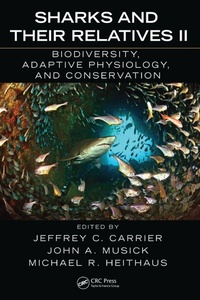
Sharks and Their Relatives II
Biodiversity, Adaptive Physiology, and Conservation
1st Edition
Published on 9. March 2010
Book
Hardback
746 pages
978-1-4200-8047-6 (ISBN)
Description
Expanding the coverage of its preceding volume (2004), this new book considers how elasmobranch fishes, the sharks, skates, rays, and chimaeras' successfully survive in the wide range of habitats in which they live. It examines the particular suitability of integrated sensory systems and the resultant perception of their surroundings. This resource also discusses the stresses and behaviors that prevent elasmobranchs from inhabiting some oceanic realms and the adaptations that allow many other elasmobranch species to exploit virtually all aquatic realms, from marine and freshwater habitats, to tropical and Arctic waters.
More details
Series
Language
English
Place of publication
Bosa Roca
United States
Publishing group
Taylor & Francis Inc
Target group
Professional and scholarly
Professional
Product notice
Paper over boards
Illustrations
107 s/w Abbildungen, 49 s/w Tabellen
49 Tables, black and white; 107 Illustrations, black and white
Dimensions
Height: 260 mm
Width: 183 mm
Thickness: 44 mm
Weight
1573 gr
ISBN-13
978-1-4200-8047-6 (9781420080476)
Copyright in bibliographic data and cover images is held by Nielsen Book Services Limited or by the publishers or by their respective licensors: all rights reserved.
Schweitzer Classification
Other editions
Additional editions
Jeffrey C. Carrier | John A. Musick | Michael R. Heithaus
Sharks and Their Relatives II
Biodiversity, Adaptive Physiology, and Conservation
E-Book
03/2010
1st Edition
CRC Press
€73.99
Available for download
Jeffrey C. Carrier | John A. Musick | Michael R. Heithaus
Sharks and Their Relatives II
Biodiversity, Adaptive Physiology, and Conservation
E-Book
03/2010
1st Edition
CRC Press
€73.99
Available for download
Persons
Under the editorial guidance of Jeffrey C. Carrier, Ph.D., John A. (Jack) Musick, Ph.D., and Michael R. Heithaus, Ph.D., this book includes much of the team's original research along with keen insights from their combined nearly 80 years of teaching in higher academia. Dr. Carrier's current research is focused on the reproductive biology and mating behaviors of nurse sharks in a long-term study from an isolated region of the Florida Keys. Dr. Musick has published more than 150 scientific papers and co-authored or edited 16 books focused on the ecology and conservation of sharks, other marine fishes, and sea turtles. Dr. Musick served as co-chair of the IUCN Shark Specialist Group for nine years, and is currently the vice chair for science. Dr. Heithaus' current work is centered on predator-prey interactions and the factors influencing behavioral decisions, especially of large marine taxa including marine mammals, sharks and rays, and sea turtles.
Content
Chondrichthyan Biodiversity: Ecosystems and Distribution of Fauna: Epipelagic Oceanic Elasmobranchs. Deepwater Chondrichthyans. Chondrichthyans of High Latitude Seas. Elasmobranchs of Tropical Marine Ecosystems. Biology of the South American Potamotrygonid Stingrays. Life History Strategies of Batoids. Adaptive Physiology: Ontogenetic Shifts in Movements and Habitat Use. Tracking and Analysis Techniques for Understanding Free-Ranging Shark Movements and Behavior. Sensory Adaptations to the Environment: Electroreceptors as a Case Study. Molecular Insights into Elasmobranch Reproductive Behavior for Conservation and Management. Physiological Responses to Stress in Sharks. Pollutant Exposure and Effects in Sharks and Their Relatives. Conservation: Factors Contributing to Shark Attacks on Humans: A Volusia County, Florida, Case Study. Shark Control: Methods, Efficacy, and Ecological Impact. DNA Forensic Applications in Shark Management and Conservation. Unraveling the Ecological Importance of Elasmobranchs. Life Histories, Population Dynamics, and Extinction Risks in Chondrichthyans.