

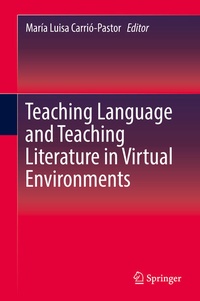
Teaching Language and Teaching Literature in Virtual Environments
Published on 27. September 2018
Book
Hardback
XXI, 293 pages
978-981-13-1357-8 (ISBN)
Description
This book sheds new light on language and literature teaching, and offers examples of teaching language in virtual environments. Providing an overview of virtual environments for teaching, it also includes chapters devoted to methodology design for second language teaching in these environments. Further it describes tools for second/ foreign language teaching and proposals for specific second language teaching in virtual environments. Lastly, it presents experiments on literature teaching in virtual environments and discusses the future of technology in education. With interdisciplinary appeal, the book is a particularly valuable resource for scholars with an interest in technology, language teaching and literature teaching.
More details
Edition
2019 ed.
Language
English
Place of publication
Singapore
Singapore
Target group
Professional and scholarly
Illustrations
12 s/w Abbildungen, 38 farbige Abbildungen
XXI, 293 p. 50 illus., 38 illus. in color.
Dimensions
Height: 241 mm
Width: 160 mm
Thickness: 23 mm
Weight
641 gr
ISBN-13
978-981-13-1357-8 (9789811313578)
DOI
10.1007/978-981-13-1358-5
Schweitzer Classification
Other editions
Additional editions
María Luisa Carrió-Pastor
Teaching Language and Teaching Literature in Virtual Environments
Book
01/2019
Springer
€85.59
Shipment within 15-20 days
María Luisa Carrió-Pastor
Teaching Language and Teaching Literature in Virtual Environments
E-Book
09/2018
1st Edition
Springer
€85.59
Available for download
Person
María Luisa Carrió-Pastor
is a professor of English Linguistics. She currently works at Departamento de Lingüística Aplicada, Universitat Politècnica de València. Her area of interest is the use of technology in second language teaching.
Content
Section 1. Methodology Design for Second Language Teaching in Virtual Environments.- Chapter 1. Using Technology for Second Language Vocabulary Learning.- Chapter 2. Practicing the Oral Production Skills in E-learning Contexts: Is It Still An Achilles' Heel?.- Chapter 3. Language Learning in the Virtual Wild.- Chapter 4. Best Practices in the Use of Augmented and Virtual Reality Technologies for SLA: Design, Implementation, and Feedback.- Chapter 5. Integrating "Talk Abroad" into Intermediate Foreign Language Courses: Building Learner Autonomy and Engagement Through Video Conversations with Native Speakers.- Chapter 6. How to Assess L2 Prior Knowledge in Virtual Environments? A Case Study in Higher Education.- Section 2. Tools for Second/ Foreign Language Teaching in Virtual Environments.- Chapter 7. Teaching English by Skype: Theoretical and Practical Considerations.- Chapter 8. Fragment and Language Teaching.- Chapter 9. Self-assessing Soft Skills Through Tele-collaboration.- Chapter10. Mobile Assisted Language Learning Innovations in L1/L2 Self-learning: the Case of the Catalan Language.- Chapter 11. Formal vs. Informal E-Tandem Learning Models: A Comparative Analysis of Two Online Videoconferencing Options for Conversational Practice with Native Speakers.- Chapter 12. How to "Gamify" Moodle Language Teaching and Learning?.- Section 3. Specific Second Language Teaching in Virtual Environments.- Chapter 13. Computer-Assisted Language Tool in a Virtual Environment: Maritime English Training and Assessment through the SMCP Training App.- Chapter 14. Tools for Teaching English as a Specific Language with Collaborative Networks.- Chapter 15. Teacher Training for CLIL in Higher Education through Blended Learning.- Chapter 16. Project-based Learning in a Virtual Classroom: the Case of English for Tourism Communication.- Chapter 17. University Language Teachers' Digital Identities, Presence, and Access, in Online Teaching Environments in Sweden.- Section 4. Literature Teaching in Virtual Environments.- Chapter 18. Digital Storytelling and Book Trailers: New Methodological Possibilities of Research and Innovation in Contemporary Literary Education.- Chapter 19. Poetry in a Virtual Environment: From Students' Reluctance to Their Acquiescence.- Chapter 20. Reflexion, Analysis and Language Practice: From Individual Critical Thinking to Collaborative Learning Using Blogs in a Literature Class.- Concluding Remarks: What is the Future of Technology and Education?