

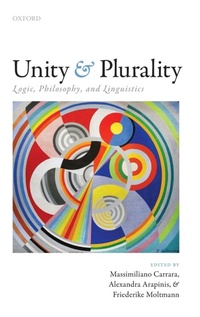
Unity and Plurality
Logic, Philosophy, and Linguistics
Published on 17. March 2016
Book
Hardback
276 pages
978-0-19-871632-7 (ISBN)
Description
Unity and Plurality presents novel ways of thinking about plurality while casting new light on the interconnections among the logical, philosophical, and linguistic aspects of plurals. The volume brings together new work on the logic and ontology of plurality and on the semantics of plurals in natural language. Plural reference, the view that definite plurals such as 'the students' refer to several entities at once (the individual students), is an approach favoured by logicians and philosophers, who take sentences with plurals ('the students gathered') not to be committed to entities beyond individuals, entities such as classes, sums, or sets. By contrast, linguistic semantics has been dominated by a singularist approach to plurals, taking the semantic value of a definite plural such as 'the students' to be a mereological sum or set. Moreover, semantics has been dominated by a particular ontological view of plurality, that of extensional mereology. This volume aims to build a bridge between the two traditions and to show the fruitfulness of nonstandard mereological approaches. A team of leading experts investigates new perspectives that arise from plural logic and non-standard mereology and explore novel applications to natural language phenomena.
Reviews / Votes
Unity and Plurality successfully shows the importance of dealing with the phenomenon of plurals in logic, philosophy, and linguistics. It covers many of the fundamental debates concerning plurals and it provides accessible tools to venture further in those debates. * Riccardo Baratella, The Philosophical Quarterly * there is much to be learned from Unity & Plurality. The specialist in any of the fields represented will find thought-provoking developments but will also catch a glimpse of other disciplines involved in the study of plurals. The book stimulates fascinating comparisons, too. For instance, that pluralist approaches have found their way more easily into philosophy and philosophical logic -- rather than natural language semantics -- may be in itself food for thought. * Lorenzo Azzano, Dialectica * Going beyond possible individuals, this promising line of research will also seek to take into account perspectivization and the role of the cognitive agent in determining what counts in a context as a plurality or a multitudeHow knowledge and subjectivity enter the realm of plurality is a question to which the papers in the book lead, thus renewing the debate in a long-standing tradition that, since Plato, has still not entirely grasped what pluralities are and can be. * Notre Dame Philosophical Review *More details
Language
English
Place of publication
Oxford
United Kingdom
Target group
College/higher education
Professional and scholarly
Dimensions
Height: 240 mm
Width: 161 mm
Thickness: 19 mm
Weight
581 gr
ISBN-13
978-0-19-871632-7 (9780198716327)
Copyright in bibliographic data and cover images is held by Nielsen Book Services Limited or by the publishers or by their respective licensors: all rights reserved.
Schweitzer Classification
Other editions
Additional editions
Massimiliano Carrara | Alexandra Arapinis | Friederike Moltmann
Unity and Plurality
Logic, Philosophy, and Linguistics
E-Book
03/2016
1st Edition
OUP eBook
€42.99
Available for download
Persons
Massimiliano Carrara is Associate professor of Logic and Philosophy of Language at the University of Padua (Italy). He is also Principal investigator of the COGITO Research centre in Philosophy, University of Bologna. He has been visiting professor at Columbia University (New York), at the ILLC (Institute for Logic, Language, and Computation), UVA (Amsterdam), at the Department of Philosophy, Delft, University of Technology, at the School of Philosophy of the University of Melbourne, and at the at the LOA-CNR (Trento, Italy). His main research interests are in logic, philosophy of logic, applied logic, and metaphysics.
Alexandra Arapinis is Marie Curie Post-doctoral fellow at the Laboratory for Applied Ontology in Trento. She has received a PhD in Philosophy from Sorbonne University (Paris).
Friederike Moltmann is research director at the Centre National de la Recherche Scientifique (CNRS) in France and senior visiting fellow in the philosophy department at New York University. Her research is in philosophy and linguistic semantics and especially the interface between the two. She is author of Parts and Wholes in Semantics (OUP, 1997) and Abstract Objects and the Semantics of Natural Language (OUP 2013).
Alexandra Arapinis is Marie Curie Post-doctoral fellow at the Laboratory for Applied Ontology in Trento. She has received a PhD in Philosophy from Sorbonne University (Paris).
Friederike Moltmann is research director at the Centre National de la Recherche Scientifique (CNRS) in France and senior visiting fellow in the philosophy department at New York University. Her research is in philosophy and linguistic semantics and especially the interface between the two. She is author of Parts and Wholes in Semantics (OUP, 1997) and Abstract Objects and the Semantics of Natural Language (OUP 2013).
Content
PART I. PLURALITIES IN LOGIC; PART II. PLURALITIES IN SEMANTICS