

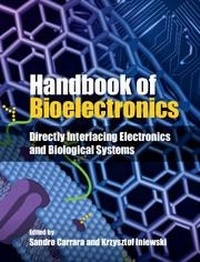
Handbook of Bioelectronics
Directly Interfacing Electronics and Biological Systems
Will be published approx. on 6. August 2015
Book
Hardback
588 pages
978-1-107-04083-0 (ISBN)
Description
This wide-ranging summary of bioelectronics provides the state of the art in electronics integrated and interfaced with biological systems in one single book. It is a perfect reference for those involved in developing future distributed diagnostic devices, from smart bio-phones that will monitor our health status to new electronic devices serving our bodies and embedded in our clothes or under our skin. All chapters are written by pioneers and authorities in the key branches of bioelectronics and provide examples of real-word applications and step-by-step design details. Through expert guidance, you will learn how to design complex circuits whilst cutting design time and cost and avoiding mistakes, misunderstandings, and pitfalls. An exhaustive set of recently developed devices is also covered, providing the implementation details and inspiration for innovating new solutions and devices. This all-inclusive reference is ideal for researchers in electronics, bio/nanotechnology, and applied physics, as well as circuit and system-level designers in industry.
Reviews / Votes
'This book, edited by outstanding scientists, will be a great addition to any library, as it provides a valuable source of information regarding bioelectronics-related topics. The topics provided are relevant and timely, and of broad interest for students as well as seasoned scientists.' Ali Khademhosseini, Harvard Medical School 'This work provides real-world applications and even step-by-step design details.' Venkat Subramaniam, Biz IndiaMore details
Language
English
Place of publication
Cambridge
United Kingdom
Target group
Professional and scholarly
Product notice
sewn/stitched
Cloth over boards
Illustrations
Worked examples or Exercises; 33 Tables, black and white; 470 Line drawings, unspecified
Dimensions
Height: 253 mm
Width: 191 mm
Thickness: 29 mm
Weight
1424 gr
ISBN-13
978-1-107-04083-0 (9781107040830)
Copyright in bibliographic data and cover images is held by Nielsen Book Services Limited or by the publishers or by their respective licensors: all rights reserved.
Schweitzer Classification
Other editions
Additional editions
E-Book
08/2015
Cambridge University Press
€194.99
Available for download
Sandro Carrara | Krzysztof Iniewski
Handbook of Bioelectronics
Directly Interfacing Electronics and Biological Systems
E-Book
08/2015
Cambridge University Press
€218.99
Available for download
Persons
Sandro Carrara is a Lecturer and Senior Scientist at the EPFL in Lausanne, Switzerland. He is former Professor of Optical and Microelectronics Biosensors in the Department of Electrical Engineering and Biophysics at the University of Genoa, Italy. He is Founder and Editor-in-Chief of the journal BioNanoScience, Topical Editor of the IEEE Sensors Journal, and Associate Editor of IEEE Transactions on Biomedical Circuits and Systems. Krzysztof Iniewseki is R&D Manager at Redlen Technologies Inc., a start-up company in Vancouver, Canada. He is also an Executive Director of CMOS Emerging Technologies, Inc. In his career, he has held numerous faculty and management positions at the University of Toronto, the University of Alberta, Simon Fraser University, and PMC-Sierra Inc.
Content
1. What is bioelectronics?; Part I. Electronic Components: 2. Molecular components for electronics; 3. Nano-gaps based devices; 4. Organic thin-film transistors for biological applications; 5. Protein-based transistors; 6. Single molecule bioelectronics; 7. Biomemory device composed of recombinant protein variants; Part II. Biosensors: 8. Biosensors; 9. CNT and proteins for biosensors in personalized therapy; 10. CMOS nanowire biosensing systems; 11. Cell-array biosensors; 12. Pulse radar sensor for contactless respiratory rate monitoring; 13. MagCMOS; 14. Metamorphic neural interfaces with insects for remote controlled biobots; Part III. Fuel Cells: 15. Biological fuel cells; 16. Advances and applications of biofuel cells; 17. Switchable electrodes and biofuel cells logically controlled by chemical and biochemical signals; Part IV. Biomimetic Systems: 18. Biomimetic systems; 19. Epidermial electronics: flexible electronics for biomedical applications; 20. Bioelectronics brain using memristive polymer statistical systems; 21. Electronic design of synthetic genetic networks; Part V. Bionics: 22. Bionics; 23. Bio-electronics interfaces for artificially driven human movements; 24. The bionic eye: a review of multi-electrode arrays; 25. CMOS technologies for retinal prosthesis; 26. Restoration of sight with photovoltaic retinal prosthesis; Part VI. Brain Interfaces: 27. Brain-machine interfaces; 28. ECG technology for the brain-machine interface; 29. Reducing the implant footprint: low-area neural recording; 30. Electrical stimulation; 31. Miniaturized implantable UWB antennas optimized for wireless brain machine interfaces; 32. Intracranial epilepsy monitoring using a wireless neural recording system; 33. Low power building blocks for neural recording systems; 34. CMOS circuits for intracells brain-machine interfaces; Part VII. Lab-on-a-Chip: 35. Lab-on-a-chip; 36. CMOS spectrally-multiplexed FRET contact imaging microsystem for DNA analysis; 37. CMOS electrochemical biosensors: instrumentation and integration; 38. Digital microfluidic biochips: towards hardware/software co-design and cyberphysical system integration; 39. CMOS based biomolecular sensor system-on-chip; Part VIII. Future Perspectives: 40. Future perspective in bioelectronics; 41. Real-time activity energy expenditure estimation for embedded ambulatory systems; 42. Innovative electronic systems for health management; 43. Linking the cyber and the biological world: the ensemble is the function; 44. Conclusion: personal electronics and distributed theragnostics.