

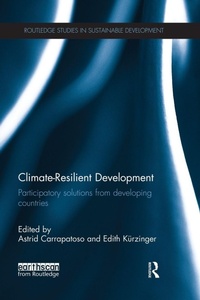
Climate-Resilient Development
Participatory solutions from developing countries
1st Edition
Published on 9. June 2015
Book
Paperback/Softback
320 pages
978-1-138-92844-2 (ISBN)
Description
The concept of resilience currently infuses policy debates and public discourse, and is promoted as a normative concept in climate policy making by governments, non-governmental organizations, and think-tanks.
This book critically discusses climate-resilient development in the context of current deficiencies of multilateral climate management strategies and processes. It analyses innovative climate policy options at national, (inter-)regional, and local levels from a mainly Southern perspective, thus contributing to the topical debate on alternative climate governance and resilient development models. Case studies from Africa, Asia, and Latin America give a ground-level view of how ideas from resilience could be used to inform and guide more radical development and particularly how these ideas might help to rethink the notion of 'progress' in the light of environmental, social, economic, and cultural changes at multiple scales, from local to global. It integrates theory and practice with the aim of providing practical solutions to improve, complement, or, where necessary, reasonably bypass the UNFCCC process through a bottom-up approach which can effectively tap unused climate-resilient development potentials at the local, national, and regional levels.
This innovative book gives students and researchers in environmental and development studies as well as policy makers and practitioners a valuable analysis of climate change mitigation and adaptation options in the absence of effective multilateral provisions.
This book critically discusses climate-resilient development in the context of current deficiencies of multilateral climate management strategies and processes. It analyses innovative climate policy options at national, (inter-)regional, and local levels from a mainly Southern perspective, thus contributing to the topical debate on alternative climate governance and resilient development models. Case studies from Africa, Asia, and Latin America give a ground-level view of how ideas from resilience could be used to inform and guide more radical development and particularly how these ideas might help to rethink the notion of 'progress' in the light of environmental, social, economic, and cultural changes at multiple scales, from local to global. It integrates theory and practice with the aim of providing practical solutions to improve, complement, or, where necessary, reasonably bypass the UNFCCC process through a bottom-up approach which can effectively tap unused climate-resilient development potentials at the local, national, and regional levels.
This innovative book gives students and researchers in environmental and development studies as well as policy makers and practitioners a valuable analysis of climate change mitigation and adaptation options in the absence of effective multilateral provisions.
Reviews / Votes
"...the book offers a variety of highly empirical and broad thinking chapters that offer both localized examples and expansive visions of climate-resilient development. It offers valuable information for students and analysts seeking examples of climate-related challenges. --London School of Economics and Political ScienceMore details
Series
Language
English
Place of publication
London
United Kingdom
Publishing group
Taylor & Francis Ltd
Target group
College/higher education
Dimensions
Height: 234 mm
Width: 156 mm
Thickness: 17 mm
Weight
488 gr
ISBN-13
978-1-138-92844-2 (9781138928442)
Copyright in bibliographic data and cover images is held by Nielsen Book Services Limited or by the publishers or by their respective licensors: all rights reserved.
Schweitzer Classification
Other editions
Additional editions
Astrid Carrapatoso | Edith Kuerzinger
Climate-Resilient Development
Participatory solutions from developing countries
E-Book
10/2013
1st Edition
Routledge
€58.99
Available for download
Astrid Carrapatoso | Edith Kuerzinger
Climate-Resilient Development
Participatory solutions from developing countries
E-Book
10/2013
1st Edition
Routledge
€59.49
Available for download
Astrid Carrapatoso | Edith Kuerzinger
Climate-Resilient Development
Participatory solutions from developing countries
Book
09/2013
1st Edition
Routledge
€198.00
Shipment within 15-20 days
Persons
Astrid Carrapatoso is Assistant Professor at the Department of Political Science at the Albert-Ludwigs-University Freiburg, Germany.
Edith Kuerzinger is a freelance consultant, coach and trainer on sustainability issues with a background in development research (German Development Institute - DIE), development policy (Federal Ministry for Economic Cooperation and Development - BMZ) and project management (GTZ).
Edith Kuerzinger is a freelance consultant, coach and trainer on sustainability issues with a background in development research (German Development Institute - DIE), development policy (Federal Ministry for Economic Cooperation and Development - BMZ) and project management (GTZ).
Content
Part I: Introduction 1. Why This Book? Why Now? 2. Finding a Panacea? An Introduction into Climate-Resilient Development Part II: The Contribution of Local, Regional, and National Approaches to Climate-Resilient Development, or What Good Practices Can Be Disseminated or Mainstreamed? 3. Shaping Strategies: Factors and Actors in Climate Change Adaptation, 4. Climate Change Adaptation: International Policy and Field Reality in Benin, 5. Building Community-Based Institutions in the Western Orissa Rural Livelihoods Project (WORLP) for Green Development), 6.How Good Are Good Practices? Demystifying Community-Based Disaster Risk Management in Mozambique 7.Making a Difference through Integrated Natural Resource Management Programmes (INRM): The Role of KNUST University in Ghana Part III: Climate-Resilient Development, Innovation, and Best Practice - How to Reform and Bypass Inefficiencies in the International Climate Regime 8.Green Gold versus Black Gold - Climate Change, Development and the Yasuni-ITT Initiative: An Alternative Way Forward? 9. Developing Economies in the Current Climate Change Regime - New Prospects for Resilience and Sustainability? The Case of CDM Projects in Asia 10. Does the Right Hand Know What the Left Hand is Doing? Similar Problem, Opposing Remedies - A Comparison of the Montreal Protocol and UNFCCC 11.Interregional Climate Cooperation: EU-China Relations as a Success Story? 12. How to Bypass Multilateral Gridlocks - Resilient Climate Change Management and Efficient Multi-Level Climate Politics Bottom-up Part IV: The Way Forward to Climate-Resilient Development 12.Conclusions for Research and Policy Agendas