

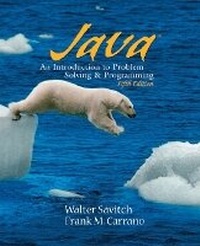
Java
Introduction to Problem Solving and Programming
5th Edition
Published on 28. April 2008
Book
Paperback/Softback
928 pages
978-0-13-607225-6 (ISBN)
Description
For introductory Computer Science courses using Java (CS1with Java), and other introductory programming courses in departments of Computer Science, Computer Engineering, Computer Information Systems, Management Information Systems, Information Technology, and Business.
Trusted authors Savitch and Carrano examine problem solving and programming techniques with Java. Students are introduced to object-oriented programming and important concepts such as design, testing and debugging, programming style, interfaces inheritance, and exception handling. The Java coverage is a concise, accessible introduction that covers key language features. Objects are covered thoroughly and early in the text, with an emphasis on application programs over applets. Revised throughout for enhanced clarity, the Fifth Edition has been entirely redesigned with a more accessible feel.
Supplements available on the Companion Web site
VideoNotes: Pearson's new visual tool designed for teaching students key programming concepts and techniques. These short step-by-step videos demonstrate how to solve problems from design through coding. VideoNotes allow for self-paced instruction with easy navigation including the ability to select, play, rewind, fast-forward, and stop within each VideoNote exercise. Margin icons in your textbook let you know when a VideoNotes video is available for a particular concept or homework problem.
Power Point Lecture Slides
Selected Solutions to text exercises
An accompanying hard copy Lab Manual with source code
Trusted authors Savitch and Carrano examine problem solving and programming techniques with Java. Students are introduced to object-oriented programming and important concepts such as design, testing and debugging, programming style, interfaces inheritance, and exception handling. The Java coverage is a concise, accessible introduction that covers key language features. Objects are covered thoroughly and early in the text, with an emphasis on application programs over applets. Revised throughout for enhanced clarity, the Fifth Edition has been entirely redesigned with a more accessible feel.
Supplements available on the Companion Web site
VideoNotes: Pearson's new visual tool designed for teaching students key programming concepts and techniques. These short step-by-step videos demonstrate how to solve problems from design through coding. VideoNotes allow for self-paced instruction with easy navigation including the ability to select, play, rewind, fast-forward, and stop within each VideoNote exercise. Margin icons in your textbook let you know when a VideoNotes video is available for a particular concept or homework problem.
Power Point Lecture Slides
Selected Solutions to text exercises
An accompanying hard copy Lab Manual with source code
More details
Edition
5th edition
Language
English
Place of publication
United States
Publishing group
Pearson Education (US)
Target group
College/higher education
Dimensions
Height: 235 mm
Width: 191 mm
ISBN-13
978-0-13-607225-6 (9780136072256)
Copyright in bibliographic data and cover images is held by Nielsen Book Services Limited or by the publishers or by their respective licensors: all rights reserved.
Schweitzer Classification
Other editions
New editions
Walter Savitch
Java
An Introduction to Problem Solving and Programming plus MyProgrammingLab with Pearson eText -- Access Card Pac
Book
11/2012
6th Edition
Pearson
€121.88
Article is exhausted; no reprint
Book
04/2011
6th Edition
Pearson
€110.17
Article exhausted; check for reprint
Persons
Frank M. Carrano is Professor Emeritus of Computer Science at the University of Rhode Island. He received his Ph.D. degree in Computer Science from Syracuse University in 1969. His interests include data structures, computer science education, social issues in computing, and numerical computation. Professor Carrano is particularly interested in the design and delivery of undergraduate courses in computer science. He has authored several well-known computer science textbooks for undergraduates.
Walter Savitch received his Ph.D. degree in Mathematics from the University of California at Berkeley in 1969. Since that time he has been on the faculty at the University of California at San Diego and is currently a Professor of Computer Science and director of the Interdisciplinary Ph.D. Program in Cognitive Science. Professor Savitch's research areas include complexity theory, formal language theory, computational linguistics, and the development of computer science education materials. In addition to writing numerous research articles and involvement in other editorial projects, he has written a number of well-known computer science textbooks, including Pascal, Ada, and C++ CS1 and CS2 textbooks.
Walter Savitch received his Ph.D. degree in Mathematics from the University of California at Berkeley in 1969. Since that time he has been on the faculty at the University of California at San Diego and is currently a Professor of Computer Science and director of the Interdisciplinary Ph.D. Program in Cognitive Science. Professor Savitch's research areas include complexity theory, formal language theory, computational linguistics, and the development of computer science education materials. In addition to writing numerous research articles and involvement in other editorial projects, he has written a number of well-known computer science textbooks, including Pascal, Ada, and C++ CS1 and CS2 textbooks.
Content
Chapter 1 Introduction to Computers and Java
Chapter 2 Basic Computation
Chapter 3 Flow of Control: Branching
Chapter 4 Flow of Control: Loops
Chapter 5 Defining Classes and Methods
Chapter 6 More About Objects and Methods
Chapter 7 Arrays
Chapter 8 Polymorphism and Inheritance
Chapter 9 Exception Handling
Chapter 10 Streams and File I/O
Chapter 11 Recursion
Chapter 12 Dynamic Data Structures and Generics
Chapter 13 Window Interfaces Using Swing
Chapter 14 Applets and HTML
Chapter 15 More Swing
Appendix 1 Getting and Installing Java
Appendix 2 Running Applets
Appendix 3 Protected and Package Modifiers
Appendix 4 The DecimalFormat Class
Appendix 5 The Iterator Interface
Appendix 6 Cloning
Appendix 7 Javadoc
Appendix 8 The JOptionPane Class
Appendix 9 Differences between C++ and Java
Glossary
Index
Chapter 2 Basic Computation
Chapter 3 Flow of Control: Branching
Chapter 4 Flow of Control: Loops
Chapter 5 Defining Classes and Methods
Chapter 6 More About Objects and Methods
Chapter 7 Arrays
Chapter 8 Polymorphism and Inheritance
Chapter 9 Exception Handling
Chapter 10 Streams and File I/O
Chapter 11 Recursion
Chapter 12 Dynamic Data Structures and Generics
Chapter 13 Window Interfaces Using Swing
Chapter 14 Applets and HTML
Chapter 15 More Swing
Appendix 1 Getting and Installing Java
Appendix 2 Running Applets
Appendix 3 Protected and Package Modifiers
Appendix 4 The DecimalFormat Class
Appendix 5 The Iterator Interface
Appendix 6 Cloning
Appendix 7 Javadoc
Appendix 8 The JOptionPane Class
Appendix 9 Differences between C++ and Java
Glossary
Index