

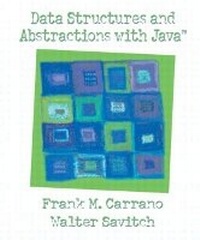
Data Structures and Abstractions with Java
Published on 17. February 2003
Book
Paperback/Softback
864 pages
978-0-13-017489-5 (ISBN)
Description
For one-semester Introductory courses or two-semester courses in data structures (CS-2) in the departments of Computer Science, Computer Engineering, Business, and Management Information Systems.
This highly anticipated innovative book by two of the leading CS-1/CS-2 authors focuses the design specification and implementation of ADTs. This book was created from the ground up with objects and Java in mind and shows students how to use and implement key data organizations. Its unique object oriented presentation divides the material into short bite size segments that are organized into small chapters. This makes learning easier for the student and allows for teaching flexibility.
This highly anticipated innovative book by two of the leading CS-1/CS-2 authors focuses the design specification and implementation of ADTs. This book was created from the ground up with objects and Java in mind and shows students how to use and implement key data organizations. Its unique object oriented presentation divides the material into short bite size segments that are organized into small chapters. This makes learning easier for the student and allows for teaching flexibility.
Reviews / Votes
"Clear, clean presentation of the concepts. Very careful explanations for an often confusing topic." - Bob Holloway, University of Wisconsin"Technically, the writing is very Java savvy. It is very important that we exploit the neat Java features to improve code engineering. The text does that very nicely." - Bina Ramamurthy, SUNY Buffalo
"Good class design is often elusive for students. I think that the way the authors emphasize class design with an eye toward future superclasses is an excellent approach." - Dennis Brylow, Purdue University
More details
Language
English
Place of publication
United States
Publishing group
Pearson Education (US)
Target group
College/higher education
Dimensions
Height: 262 mm
Width: 211 mm
Thickness: 38 mm
Weight
1772 gr
ISBN-13
978-0-13-017489-5 (9780130174895)
Copyright in bibliographic data and cover images is held by Nielsen Book Services Limited or by the publishers or by their respective licensors: all rights reserved.
Schweitzer Classification
Other editions
New editions
Book
10/2006
2nd Edition
Pearson
€74.27
Article is exhausted; no reprint
Persons
Frank M. Carrano is a professor emeritus of computer science at the University of Rhode Island. He received the Ph.D. degree in computer science from Syracuse University in 1969. His interests include data structures, computer science education, social issues in computing, and numerical computation. Professor Carrano is particularly interested in the design and delivery of undergraduate courses in computer science. He has authored several well-known computer science textbooks for undergraduates.
Walter Savitchreceived the Ph.D. degree in Mathematics from the University of California at Berkeley in 1969. Since that time he has been on the faculty at the University of California at San Diego and is currently a Professor of Computer Science and director of the Interdisciplinary Ph.D. Program in Cognitive Science. Professor Savitch's research areas include complexity theory, formal language theory, computational linguistics, and the development of computer science education materials. In addition to writing numerous research articles and involvement in other editorial projects, he has written a number of well-known computer science textbooks, including Pascal, Ada, and C++ CS1 and CS2 textbooks.
Walter Savitchreceived the Ph.D. degree in Mathematics from the University of California at Berkeley in 1969. Since that time he has been on the faculty at the University of California at San Diego and is currently a Professor of Computer Science and director of the Interdisciplinary Ph.D. Program in Cognitive Science. Professor Savitch's research areas include complexity theory, formal language theory, computational linguistics, and the development of computer science education materials. In addition to writing numerous research articles and involvement in other editorial projects, he has written a number of well-known computer science textbooks, including Pascal, Ada, and C++ CS1 and CS2 textbooks.
Content
Introduction.
1. Java Classes.
2. Creating Classes from Other Classes.
3. Designing Classes.
4. Lists.
5. List Implementations That Use Arrays.
6. List Implementations That Link Data.
7. Iterators.
8. Java's Iterator Interfaces.
9. The Efficiency of Algorithms.
10. Recursion.
11. An Introduction to Sorting.
12. Faster Sorting Methods.
13. Sorted Lists.
14. Inheritance and Lists.
15. Mutable, Immutable, and Cloneable Objects.
16. Searching.
17. Dictionaries.
18. Dictionary Implementations.
19. Hashing as a Dictionary Implementation.
20. Stacks.
21. Stack Implementations.
22. Queues, Deques, and Priority Queues.
23. Queue, Deque, and Priority Queue Implementations.
24. Trees.
25. Tree Implementations.
26. A Binary Search Tree Implementation.
27. A Heap Implementation.
28. Balanced Search Trees.
29. Graphs.
30. Graph Implementations.
Appendix A: Java Essentials.
Appendix B: Exception Handling.
Appendix C: File I/O.
Appendix D: Documentation and Programming Style.
Appendix E: Java Resources.
Appendix F: Answers to Self-Test Questions.
Inside covers (end papers).
Reserved Words.
Operator Precedence.
Unicode Character Codes.
1. Java Classes.
2. Creating Classes from Other Classes.
3. Designing Classes.
4. Lists.
5. List Implementations That Use Arrays.
6. List Implementations That Link Data.
7. Iterators.
8. Java's Iterator Interfaces.
9. The Efficiency of Algorithms.
10. Recursion.
11. An Introduction to Sorting.
12. Faster Sorting Methods.
13. Sorted Lists.
14. Inheritance and Lists.
15. Mutable, Immutable, and Cloneable Objects.
16. Searching.
17. Dictionaries.
18. Dictionary Implementations.
19. Hashing as a Dictionary Implementation.
20. Stacks.
21. Stack Implementations.
22. Queues, Deques, and Priority Queues.
23. Queue, Deque, and Priority Queue Implementations.
24. Trees.
25. Tree Implementations.
26. A Binary Search Tree Implementation.
27. A Heap Implementation.
28. Balanced Search Trees.
29. Graphs.
30. Graph Implementations.
Appendix A: Java Essentials.
Appendix B: Exception Handling.
Appendix C: File I/O.
Appendix D: Documentation and Programming Style.
Appendix E: Java Resources.
Appendix F: Answers to Self-Test Questions.
Inside covers (end papers).
Reserved Words.
Operator Precedence.
Unicode Character Codes.