

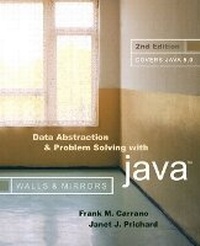
Data Abstraction and Problem Solving with Java
United States Edition
2nd Edition
Published on 25. November 2005
Book
Paperback/Softback
912 pages
978-0-321-30428-5 (ISBN)
Description
The second edition, in Java, of the classic Walls and Mirrors approach to programming designs solutions to problems using both data abstraction (the walls) and recursion (the Mirrors). Data Abstraction and Problem Solving with Java: Walls and Mirrors, 2e provides a focus on the important concepts of data abstraction and data structures in a way that beginning students find accessible. The book has a student-friendly pedagogical approach, that carefully accounts for the strengths and weaknesses of the Java language. This second edition includes more material on the Java language and increased focus on object-oriented programming ideas.
More details
Edition
2nd edition
Language
English
Place of publication
United States
Publishing group
Pearson Education (US)
Target group
College/higher education
Dimensions
Height: 189 mm
Width: 231 mm
Thickness: 27 mm
Weight
1292 gr
ISBN-13
978-0-321-30428-5 (9780321304285)
Copyright in bibliographic data and cover images is held by Nielsen Book Services Limited or by the publishers or by their respective licensors: all rights reserved.
Schweitzer Classification
Other editions
New editions
Book
04/2011
3rd Edition
Pearson
€206.73
Article exhausted; check different version
Previous edition
Frank M. Carrano | Janet Prichard
Data Abstraction and Problem Solving with Java, Walls and Mirrors, Updated Edition
Book
09/2003
Pearson
€85.41
Article exhausted; check for reprint
Content
PART ONE - Problem-Solving Techniques
1 Review of Java Fundamentals
1.1 Program Structure
1.2 Language Basics
1.3 Selection Statements
1.4 Iteration Statements
1.5 Useful Java Classes
1.6 Java Exceptions
1.7 Text Input and Output
1.8 File Input and Output
2 Principles of Programming and Software Engineering
2.1 Problem Solving and Software Engineering
2.2 Achieving an Object-Oriented Design
2.3 A Summary of Key Issues in Programming
3 Recursion: The Mirrors
3.1 Recursive Solutions
3.2 Counting Things
3.3 Searching an Array
3.4 Organizing Data
3.5 Recursion and Efficiency
4 Data Abstraction: The Walls
4.1 Abstract Data Types
4.2 Specifying ADTs
4.3 Implementing ADTs
5 Linked Lists
5.1 Preliminaries
5.2 Programming with Linked Lists
5.3 Variations of the Linked List
5.4 Application: Maintaining an Inventory
5.5 The Java Collections Framework
PART TWO - Problem Solving with Abstract Data Types
6 Recursion as a Problem-Solving Technique
6.1 Backtracking
6.2 Defining Languages
6.3 The Relationship Between Recursion and Mathematical Induction
7 Stacks
7.1 The Abstract Data Type Stack
7.2 Simple Applications of the ADT Stack
7.3 Implementations of the ADT Stack
7.4 Application: Algebraic Expressions
7.5 Application: A Search Problem
7.6 The Relationship Between Stacks and Recursion
8 Queues
8.1 The Abstract Data Type Queue
8.2 Simple Applications of the ADT Queue
8.3 Implementations of the ADT Queue
8.4 A Summary of Position-Oriented ADTs
8.5 Application: Simulation
9 Advanced Java Topics
9.1 Inheritance Revisited
9.2 Dynamic Binding and Abstract Classes
9.3 The ADTs List and Sorted List Revisited
9.4 Java Generics
9.5 Iterators
10 Algorithm Efficiency and Sorting
10.1 Measuring the Efficiency of Algorithms
10.2 Sorting Algorithms and Their EfficiencySelection Sort
11 Trees
11.1 Terminology
11.2 The ADT Binary Tree
11.3 The ADT Binary Search Tree
11.4 General Trees
12 Tables and Priority Queues
12.1 The ADT Table
12.2 The ADT Priority Queue: A Variation of the ADT Table
12.3 Tables and Priority Queues in the JCF
13 Advanced Implementations of Tables
13.1 Balanced Search Trees
13.2 Hashing
13.3 Data with Multiple Organizations
14 Graphs
14.1 Terminology
14.2 Graphs as ADTs
14.3 Graph Traversals
14.4 Applications of Graphs
15 External Methods
15.1 A Look at External Storage
15.2 Sorting Data in an External File
15.3 External Tables
APPENDICES
A A Comparison of Java to C++
B Unicode Character Codes (ASCII Subset)
C Java Resources
D Mathematical Induction 828
Glossary
Answers to Self-Test Exercises
Index
1 Review of Java Fundamentals
1.1 Program Structure
1.2 Language Basics
1.3 Selection Statements
1.4 Iteration Statements
1.5 Useful Java Classes
1.6 Java Exceptions
1.7 Text Input and Output
1.8 File Input and Output
2 Principles of Programming and Software Engineering
2.1 Problem Solving and Software Engineering
2.2 Achieving an Object-Oriented Design
2.3 A Summary of Key Issues in Programming
3 Recursion: The Mirrors
3.1 Recursive Solutions
3.2 Counting Things
3.3 Searching an Array
3.4 Organizing Data
3.5 Recursion and Efficiency
4 Data Abstraction: The Walls
4.1 Abstract Data Types
4.2 Specifying ADTs
4.3 Implementing ADTs
5 Linked Lists
5.1 Preliminaries
5.2 Programming with Linked Lists
5.3 Variations of the Linked List
5.4 Application: Maintaining an Inventory
5.5 The Java Collections Framework
PART TWO - Problem Solving with Abstract Data Types
6 Recursion as a Problem-Solving Technique
6.1 Backtracking
6.2 Defining Languages
6.3 The Relationship Between Recursion and Mathematical Induction
7 Stacks
7.1 The Abstract Data Type Stack
7.2 Simple Applications of the ADT Stack
7.3 Implementations of the ADT Stack
7.4 Application: Algebraic Expressions
7.5 Application: A Search Problem
7.6 The Relationship Between Stacks and Recursion
8 Queues
8.1 The Abstract Data Type Queue
8.2 Simple Applications of the ADT Queue
8.3 Implementations of the ADT Queue
8.4 A Summary of Position-Oriented ADTs
8.5 Application: Simulation
9 Advanced Java Topics
9.1 Inheritance Revisited
9.2 Dynamic Binding and Abstract Classes
9.3 The ADTs List and Sorted List Revisited
9.4 Java Generics
9.5 Iterators
10 Algorithm Efficiency and Sorting
10.1 Measuring the Efficiency of Algorithms
10.2 Sorting Algorithms and Their EfficiencySelection Sort
11 Trees
11.1 Terminology
11.2 The ADT Binary Tree
11.3 The ADT Binary Search Tree
11.4 General Trees
12 Tables and Priority Queues
12.1 The ADT Table
12.2 The ADT Priority Queue: A Variation of the ADT Table
12.3 Tables and Priority Queues in the JCF
13 Advanced Implementations of Tables
13.1 Balanced Search Trees
13.2 Hashing
13.3 Data with Multiple Organizations
14 Graphs
14.1 Terminology
14.2 Graphs as ADTs
14.3 Graph Traversals
14.4 Applications of Graphs
15 External Methods
15.1 A Look at External Storage
15.2 Sorting Data in an External File
15.3 External Tables
APPENDICES
A A Comparison of Java to C++
B Unicode Character Codes (ASCII Subset)
C Java Resources
D Mathematical Induction 828
Glossary
Answers to Self-Test Exercises
Index