

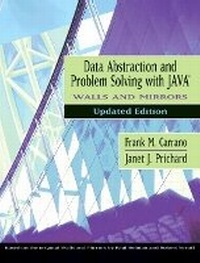
Data Abstraction and Problem Solving with Java, Walls and Mirrors, Updated Edition
Published on 10. September 2003
Book
Paperback/Softback
806 pages
978-0-321-19717-7 (ISBN)
Description
This book is an update of the classic "Walls and Mirrors" approach to programming, which instills the use of both abstraction (the walls) and recursion (the mirrors) to design solutions to problems. Data Abstraction and Problem Solving with Java: Walls and Mirrors provides a focus on the important concepts of data abstraction and data structures in a manner accessible to students at the introductory level. The book carefully accounts for the strengths and weaknesses of the Java language and is committed to a pedagogical approach that makes the material student friendly. The focus of this book is data abstraction, as well as key object-oriented concepts, including encapsulation, inheritance, and polymorphism.
More details
Language
English
Place of publication
United States
Publishing group
Pearson Education (US)
Target group
College/higher education
Dimensions
Height: 262 mm
Width: 212 mm
Thickness: 36 mm
Weight
1656 gr
ISBN-13
978-0-321-19717-7 (9780321197177)
Copyright in bibliographic data and cover images is held by Nielsen Book Services Limited or by the publishers or by their respective licensors: all rights reserved.
Schweitzer Classification
Other editions
New editions
Frank M. Carrano | Janet Prichard
Data Abstraction and Problem Solving with Java
United States Edition
Book
11/2005
2nd Edition
Pearson
€81.70
Article exhausted; check for reprint
Content
I. PROBLEM-SOLVING TECHNIQUES.
1. Principles of Programming and Software Engineering.
2. Recursion: The Mirrors.
3. Data Abstraction: The Walls.
4. Linked Lists.
5. Recursion as a Problem-Solving Technique.
II. PROBLEM SOLVING WITH ABSTRACT DATA TYPES.
6. Stacks.
7. Queues.
8. Class Relationships.
9. Algorithm Efficiency and Sorting.
10. Trees.
11. Tables and Priority Queues.
12. Advanced Implementation of Tables.
13. Graphs.
14. External Methods.
Appendix A: Review of Java Fundamentals.
Appendix B: Unicode Character Codes.
Appendix C: Java Resources on the WWW.
Appendix D: Mathematical Induction.
1. Principles of Programming and Software Engineering.
2. Recursion: The Mirrors.
3. Data Abstraction: The Walls.
4. Linked Lists.
5. Recursion as a Problem-Solving Technique.
II. PROBLEM SOLVING WITH ABSTRACT DATA TYPES.
6. Stacks.
7. Queues.
8. Class Relationships.
9. Algorithm Efficiency and Sorting.
10. Trees.
11. Tables and Priority Queues.
12. Advanced Implementation of Tables.
13. Graphs.
14. External Methods.
Appendix A: Review of Java Fundamentals.
Appendix B: Unicode Character Codes.
Appendix C: Java Resources on the WWW.
Appendix D: Mathematical Induction.