

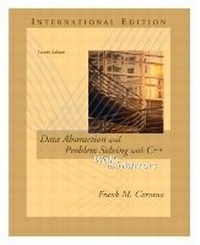
Data Abstraction and Problem Solving with C++
Walls and Mirrors: International Edition
4th Edition
Published on 6. May 2004
Book
Paperback/Softback
992 pages
978-0-321-26980-5 (ISBN)
Description
This classic book has been revised to further enhance its focus on data abstraction and data structures using C++. In this new edition, the clarity of the C++ language is enhanced, along with coverage of the latest C++ features, including stronger use of the Standard Template Library. This edition continues with Frank Carrano's lucid writing style, widespread use of examples, and flexible coverage of important topics.
More details
Edition
4th edition
Language
English
Place of publication
United States
Publishing group
Pearson Education (US)
Target group
Professional and scholarly
Dimensions
Height: 249 mm
Width: 204 mm
Thickness: 36 mm
Weight
1714 gr
ISBN-13
978-0-321-26980-5 (9780321269805)
Copyright in bibliographic data and cover images is held by Nielsen Book Services Limited or by the publishers or by their respective licensors: all rights reserved.
Schweitzer Classification
Other editions
New editions
Book
08/2006
5th Edition
Pearson
€86.65
Article is exhausted; no reprint
Content
Preface.
Chapter Dependency Chart.
I. PROBLEM-SOLVING TECHNIQUES.
1. Principles of Programming and Software Engineering.
Problem Solving and Software Engineering.
Achieving A Modular Design.
A Summary of Key Issues in Programming.
2. Recursion: The Mirrors.
Recursive Solutions.
Counting Things.
Searching An Array.
Organizing Data.
Recursion And Efficiency.
3. Data Abstraction: The Walls.
Abstract Data Types.
Specifying ADTs.
Implementing ADTs.
4. Linked Lists.
Preliminaries.
Programming with Linked Lists.
Variations of the Linked List 206.
Application: Maintaining an Inventory.
The C++ Standard Template Library.
5. Recursion as a Problem-Solving Technique.
Backtracking.
Defining Languages.
The Relationship between Recursion and Mathematical Induction.
II. PROBLEM SOLVING WITH ABSTRACT DATA TYPES.
6. Stacks.
The Abstract Data Type Stack.
Simple Applications Of The ADT Stack.
Implementations Of The ADT Stack.
Application: Algebraic Expressions.
Application: A Search Problem.
The Relationship between Stacks and Recursion.
7. Queues.
The Abstract Data Type Queue.
Simple Applications of the ADT Queue.
Implementations of the ADT Queue.
A Summary Of Position-Oriented ADTs.
Application: Simulation.
8. Advanced C++ Topics.
Inheritance Revisited.
Virtual Functions and Late Binding.
Friends.
The ADTs List and Sorted List Revisited.
Class Templates.
Overloaded Operators.
Iterators.
9. Algorithm Efficiency and Sorting.
Measuring the Efficiency of Algorithms.
Sorting Algorithms and Their Efficiency.
10. Trees.
Terminology.
The ADT Binary Tree.
The ADT Binary Search Tree.
General Trees.
11. Tables and Priority Queues.
The ADT Table.
The ADT Priority Queue: A Variation of the ADT Table.
12. Advanced Implementations of Tables.
Balanced Search Trees.
Hashing.
Data with Multiple Organizations.
13. Graphs.
Terminology.
Graphs as ADTs.
Graph Traversals.
Applications of Graphs.
14. External Methods.
A Look at External Storage.
Sorting Data in an External File.
External Tables.
Appendices.
A. Review Of C++ Fundamentals.
B. Ascii Character.
C. C++ Header Files And Standard Functions.
D. Mathematical Induction.
E. Standard Template Library.
Glossary.
Answers to Self-Test Exercises.
Index.
Chapter Dependency Chart.
I. PROBLEM-SOLVING TECHNIQUES.
1. Principles of Programming and Software Engineering.
Problem Solving and Software Engineering.
Achieving A Modular Design.
A Summary of Key Issues in Programming.
2. Recursion: The Mirrors.
Recursive Solutions.
Counting Things.
Searching An Array.
Organizing Data.
Recursion And Efficiency.
3. Data Abstraction: The Walls.
Abstract Data Types.
Specifying ADTs.
Implementing ADTs.
4. Linked Lists.
Preliminaries.
Programming with Linked Lists.
Variations of the Linked List 206.
Application: Maintaining an Inventory.
The C++ Standard Template Library.
5. Recursion as a Problem-Solving Technique.
Backtracking.
Defining Languages.
The Relationship between Recursion and Mathematical Induction.
II. PROBLEM SOLVING WITH ABSTRACT DATA TYPES.
6. Stacks.
The Abstract Data Type Stack.
Simple Applications Of The ADT Stack.
Implementations Of The ADT Stack.
Application: Algebraic Expressions.
Application: A Search Problem.
The Relationship between Stacks and Recursion.
7. Queues.
The Abstract Data Type Queue.
Simple Applications of the ADT Queue.
Implementations of the ADT Queue.
A Summary Of Position-Oriented ADTs.
Application: Simulation.
8. Advanced C++ Topics.
Inheritance Revisited.
Virtual Functions and Late Binding.
Friends.
The ADTs List and Sorted List Revisited.
Class Templates.
Overloaded Operators.
Iterators.
9. Algorithm Efficiency and Sorting.
Measuring the Efficiency of Algorithms.
Sorting Algorithms and Their Efficiency.
10. Trees.
Terminology.
The ADT Binary Tree.
The ADT Binary Search Tree.
General Trees.
11. Tables and Priority Queues.
The ADT Table.
The ADT Priority Queue: A Variation of the ADT Table.
12. Advanced Implementations of Tables.
Balanced Search Trees.
Hashing.
Data with Multiple Organizations.
13. Graphs.
Terminology.
Graphs as ADTs.
Graph Traversals.
Applications of Graphs.
14. External Methods.
A Look at External Storage.
Sorting Data in an External File.
External Tables.
Appendices.
A. Review Of C++ Fundamentals.
B. Ascii Character.
C. C++ Header Files And Standard Functions.
D. Mathematical Induction.
E. Standard Template Library.
Glossary.
Answers to Self-Test Exercises.
Index.