

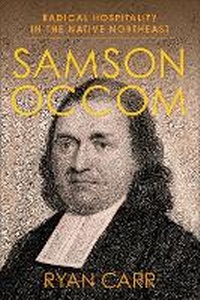
Samson Occom
Radical Hospitality in the Native Northeast
Published on 14. November 2023
Book
Paperback/Softback
352 pages
978-0-231-21033-1 (ISBN)
Description
The Mohegan-Brothertown minister Samson Occom (1723-1792) was a prominent political and religious leader of the Indigenous peoples of present-day New York and New England, among whom he is still revered today. An international celebrity in his day, Occom rose to fame as the first Native person to be ordained a minister in the New England colonies. In the 1770s, he helped found the nation of Brothertown, where Coastal Algonquian families seeking respite from colonialism built a new life on land given to them by the Oneida Nation. Occom was a highly productive author, probably the most prolific Native American writer prior to the late nineteenth century. Most of Occom's writings, however, have been overlooked, partly because many of them are about Christian themes that seem unrelated to Native life.
In this groundbreaking book, Ryan Carr argues that Occom's writings were deeply rooted in Indigenous traditions of hospitality, diplomacy, and openness to strangers. From Occom's point of view, evangelical Christianity was not a foreign culture; it was a new opportunity to practice his people's ancestral customs. Carr demonstrates Occom's originality as a religious thinker, showing how his commitment to Native sovereignty shaped his reading of the Bible. By emphasizing the Native sources of Occom's evangelicalism, this book offers new ways to understand the relations of Northeast Native traditions to Christianity, colonialism, and Indigenous self-determination.
In this groundbreaking book, Ryan Carr argues that Occom's writings were deeply rooted in Indigenous traditions of hospitality, diplomacy, and openness to strangers. From Occom's point of view, evangelical Christianity was not a foreign culture; it was a new opportunity to practice his people's ancestral customs. Carr demonstrates Occom's originality as a religious thinker, showing how his commitment to Native sovereignty shaped his reading of the Bible. By emphasizing the Native sources of Occom's evangelicalism, this book offers new ways to understand the relations of Northeast Native traditions to Christianity, colonialism, and Indigenous self-determination.
Reviews / Votes
Carr has merged sophisticated interpretation with accessible, graceful writing...Highly recommended. * Choice * Ryan Carr's provocative new book on Samsom Occom brings a literary/religious studies perspective to the career of the famous eighteenth-century Mohegan minister. * The American Literary History Review * I found this book intriguing and enlightening. ... We are smack in the last half of the 18th century, and our guide is not a white male colonist, but rather a native one, trying to save his civilization. I found this a thrilling chance to see this world through Occom's lens. * East Hampton Star * In Samson Occom, Ryan Carr makes the powerfully argued case for expanding our interpretive practices regarding Occom through consideration of his work on its own terms-ones that respect what we can know of Occom's purposes and perspectives. Through careful and broadly considered historical research, Carr creates an impressive network of connected histories through which to situate Occom as a thinker, writer, and leader. -- Robert Warrior, coauthor of <i>American Indian Literary Nationalism</i> Ryan Carr has produced a strikingly fresh account of Samson Occom's rendering of Christianity as a tool to maneuver the catastrophe of settler colonialism by centering Indigenous community. He subtly narrates how Occom used language to traverse vast distances in practicing radical hospitality and to elicit ancient notions of sacredness. -- Jean M. O'Brien, coeditor of <i>Allotment Stories: Indigenous Land Relations Under Settler Siege</i> In this magnificent contribution to Native literary history and early American studies, Ryan Carr reconstructs Samson Occom in a way that keeps his complicated humanity, well, complicated, especially when considering Occom as a religious thinker and public intellectual. This book is original, erudite, edifying, and beautifully written. I recommend it highly. -- Scott Richard Lyons, author of <i>X-Marks: Native Signatures of Assent</i>More details
Series
Language
English
Place of publication
New York
United States
Target group
Professional and scholarly
Product notice
Paperback (trade)
Illustrations
9 b&w illustrations
Dimensions
Height: 229 mm
Width: 152 mm
ISBN-13
978-0-231-21033-1 (9780231210331)
Copyright in bibliographic data and cover images is held by Nielsen Book Services Limited or by the publishers or by their respective licensors: all rights reserved.
Schweitzer Classification
Other editions
Additional editions
E-Book
11/2023
1st Edition
Columbia University Press
€33.99
Available for download
Persons
Ryan Carr is a lecturer in English and comparative literature, American studies, and the Core Curriculum at Columbia University.
Megan Fulopp and Amy Besaw Medford are members of the Brothertown Indian Nation. Fulopp is a researcher who manages Brothertown-related projects, including the web-based "Life of the Brothertown Indians," and Medford is a research affiliate with the Project on Indigenous Governance and Development at the Harvard Kennedy School.
Megan Fulopp and Amy Besaw Medford are members of the Brothertown Indian Nation. Fulopp is a researcher who manages Brothertown-related projects, including the web-based "Life of the Brothertown Indians," and Medford is a research affiliate with the Project on Indigenous Governance and Development at the Harvard Kennedy School.
Content
Foreword by Amy Medford and Megan Fulopp
Acknowledgments
Introduction, on the Occasion of Samson Occom's Three Hundredth Birthday
Part I
1. "Asylum for Strangers": An Approach to Occom's Traditionalism
2. Occom Obviously: Literary Studies and the Problem of Indigenous Knowledge
Part II
3. A Theology of Land and Peoplehood
4. Piety and Placemaking: Styles of Strangerhood Among Occom and His Kin
Part III
5. Seft at Last: Occom's 1768 Autobiography in Native Space
6. "Time to Awake": Occom on Perception, Alienation, and "Pure Religion"
Conclusion: "Good Enthusiasm"
Appendix: Unpublished Letters by Susanna Wheatley and Samson Occom
Notes
Bibliography
Index
Acknowledgments
Introduction, on the Occasion of Samson Occom's Three Hundredth Birthday
Part I
1. "Asylum for Strangers": An Approach to Occom's Traditionalism
2. Occom Obviously: Literary Studies and the Problem of Indigenous Knowledge
Part II
3. A Theology of Land and Peoplehood
4. Piety and Placemaking: Styles of Strangerhood Among Occom and His Kin
Part III
5. Seft at Last: Occom's 1768 Autobiography in Native Space
6. "Time to Awake": Occom on Perception, Alienation, and "Pure Religion"
Conclusion: "Good Enthusiasm"
Appendix: Unpublished Letters by Susanna Wheatley and Samson Occom
Notes
Bibliography
Index