

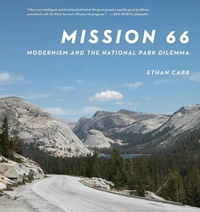
Mission 66
Modernism and the National Park Dilemma
Published on 7. February 2022
Book
Paperback/Softback
424 pages
978-1-952620-33-1 (ISBN)
Description
"an intelligent and level-headed look at the great promise and the great problems associated with the Park Service's Mission 66 program." (Ken Burns, filmmaker)
Winner Elisabeth Blair MacDougall Book Award, Society of Architectural Historians
Winner J. B. Jackson Book Prize, Foundation for Landscape Studies
In the years following World War II, Americans visited the national parks in unprecedented numbers, yet Congress held funding at prewar levels and park conditions steadily declined. Elimination of the Civilian Conservation Corps and other New Deal programs further reduced the ability of the federal government to keep pace with the wear and tear on park facilities.
To address the problem, in 1956 a ten-year, billion-dollar initiative titled “Mission 66” was launched, timed to be completed in 1966, the fiftieth anniversary of the National Park Service. The program covered more than one hundred visitor centers (a building type invented by Mission 66 planners), expanded campgrounds, innumerable comfort stations and other public facilities, new and wider roads, parking lots, maintenance buildings, and hundreds of employee residences. During this transformation, the park system also acquired new seashores, recreation areas, and historical parks, agency uniforms were modernized, and the arrowhead logo became a ubiquitous symbol. To a significant degree, the national park system and the National Park Service as we know them today are products of the Mission 66 era.
Mission 66 was controversial at the time, and it continues to incite debate over the policies it represented. Hastening the advent of the modern environmental movement, it transformed the Sierra Club from a regional mountaineering club into a national advocacy organization. But Mission 66 was also the last systemwide, planned development campaign to accommodate increased numbers of automotive tourists. Whatever our judgment of Mission 66, we still use the roads, visitor centers, and other facilities the program built.
Ethan Carr's book examines the significance of the Mission 66 program and explores the influence of midcentury modernism on landscape design and park planning. Environmental and park historians, architectural and landscape historians, and all who care about our national parks will enjoy this copiously illustrated history of a critical period in the development of the national park system.
Winner Elisabeth Blair MacDougall Book Award, Society of Architectural Historians
Winner J. B. Jackson Book Prize, Foundation for Landscape Studies
In the years following World War II, Americans visited the national parks in unprecedented numbers, yet Congress held funding at prewar levels and park conditions steadily declined. Elimination of the Civilian Conservation Corps and other New Deal programs further reduced the ability of the federal government to keep pace with the wear and tear on park facilities.
To address the problem, in 1956 a ten-year, billion-dollar initiative titled “Mission 66” was launched, timed to be completed in 1966, the fiftieth anniversary of the National Park Service. The program covered more than one hundred visitor centers (a building type invented by Mission 66 planners), expanded campgrounds, innumerable comfort stations and other public facilities, new and wider roads, parking lots, maintenance buildings, and hundreds of employee residences. During this transformation, the park system also acquired new seashores, recreation areas, and historical parks, agency uniforms were modernized, and the arrowhead logo became a ubiquitous symbol. To a significant degree, the national park system and the National Park Service as we know them today are products of the Mission 66 era.
Mission 66 was controversial at the time, and it continues to incite debate over the policies it represented. Hastening the advent of the modern environmental movement, it transformed the Sierra Club from a regional mountaineering club into a national advocacy organization. But Mission 66 was also the last systemwide, planned development campaign to accommodate increased numbers of automotive tourists. Whatever our judgment of Mission 66, we still use the roads, visitor centers, and other facilities the program built.
Ethan Carr's book examines the significance of the Mission 66 program and explores the influence of midcentury modernism on landscape design and park planning. Environmental and park historians, architectural and landscape historians, and all who care about our national parks will enjoy this copiously illustrated history of a critical period in the development of the national park system.
More details
Language
English
Place of publication
United States
Product notice
Paperback (trade)
Unsewn / adhesive bound
Illustrations
201 Halftones, black and white; 25 Illustrations, black and white
Dimensions
Height: 254 mm
Width: 244 mm
Thickness: 33 mm
Weight
1429 gr
ISBN-13
978-1-952620-33-1 (9781952620331)
Copyright in bibliographic data and cover images is held by Nielsen Book Services Limited or by the publishers or by their respective licensors: all rights reserved.
Schweitzer Classification
Person
By Ethan Carr
Content
Preface ix Acknowledgments xiii
Introduction: “The People Who Use the Parks” 3
Part I: Mission 66: Planning
1: Newton Drury and the “Dilemma of Our Parks” 19
2: Conrad Wirth and Postwar “Recreational Planning” 39
3: Planning Principles and the “MISSION 66 Prospectus” 63
4: Public Policy and “Our Heritage” 103
Part II: Mission 66: Design
5: Architecture 127
6: Preservation and Interpretation 175
7: Landscape Architecture 199
Part III: Mission 66: Construction
8: Concessions and Controversy 227
9: Park Roads and Wilderness 255
10: “Parks for America” 291
Conclusion: “The Capacity to Provide Enjoyment” 333
Notes 343
Bibliography 375
Index 385
Introduction: “The People Who Use the Parks” 3
Part I: Mission 66: Planning
1: Newton Drury and the “Dilemma of Our Parks” 19
2: Conrad Wirth and Postwar “Recreational Planning” 39
3: Planning Principles and the “MISSION 66 Prospectus” 63
4: Public Policy and “Our Heritage” 103
Part II: Mission 66: Design
5: Architecture 127
6: Preservation and Interpretation 175
7: Landscape Architecture 199
Part III: Mission 66: Construction
8: Concessions and Controversy 227
9: Park Roads and Wilderness 255
10: “Parks for America” 291
Conclusion: “The Capacity to Provide Enjoyment” 333
Notes 343
Bibliography 375
Index 385