

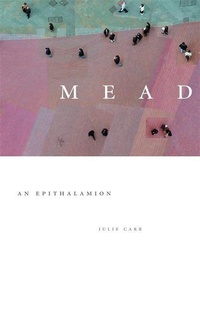
Mead
An Epithalamion
Published on 11. October 2004
Book
Paperback/Softback
120 pages
978-0-8203-2684-9 (ISBN)
Description
The central subject in Julie Carr's debut poem collection is marriage. Intimacy is examined, not only in terms of the erotic, the quotidian, and the contractual, but also in terms of the intertextual: the pact between reader and writer and the blending of texts that results. Motherhood also figures as a kind of marriage-a bond that includes affective, legal, and sensual elements.
Using a variety of poetic structures-prose poems, stanzaic forms, concrete poems, fractured lyrics, direct dialogue, and discursive modes-Carr simultaneously embraces and breaks from the expected and the known, revealing the precarious balance between our desire for narrative, sequence, drama, and resolution, on the one hand, and rupture, fragment, and fracturing, on the other.
Using a variety of poetic structures-prose poems, stanzaic forms, concrete poems, fractured lyrics, direct dialogue, and discursive modes-Carr simultaneously embraces and breaks from the expected and the known, revealing the precarious balance between our desire for narrative, sequence, drama, and resolution, on the one hand, and rupture, fragment, and fracturing, on the other.
Reviews / Votes
With 'face upon face rising out of the,' Julie Carr's stunning book-length epithalamion cracks open marriage and motherhood as if they were geodes, exposing the dazzle within, 'a spark / in the draft of the burning.' Its fierce lyricism both fractures and binds together, so that the outside and the inside take hands. This is a song well worth hearing again and again: 'Now all ring you ah.' -- Reginald Shepherd * author of <i>Otherhood: Poems</i> * Carr illuminates the marriage of the inner and outer worlds, often taking detours from sense and always taking them to interesting places, always landing somewhere deeply felt. -- Cole Swensen * author of <i>Goest</i> * Mead charts the vicissitudes of a marriage or a mind or the sentence. Change and flux govern each turn in this collection of domestic moments. Carr emerges us so completely into the dailiness of this form that even when it is threatened by the fantasy of dissolution we understand fantasy to be just another interruption defining the familial self. The representational language that governs the text becomes the necessary choice to prevent the obliteration of that self. -- Claudia Rankine * author of <i>Plot</i> * Mead's taut and intensely felt family romance stands in contrast to any easy family mythology imbedded in American culture. -- <i>Indiana Review</i> Carr conducts poetic form as if it were choreography. . . . [Mead] radiates with a clean beauty. -- <i>Poetry Project Newsletter</i> Carr is fantastic at pushing language to the edge of everyday usage, disrupting it just enough to make us see it anew, yet still follow what she is saying. . . . Mead is an astonishing, accomplished work that consistently surprised and delighted me. -- <i>Stride Magazine</i> In Mead, 'engender' is an anagram for 'endanger,' and the poet demonstrates that to be fearless is to inhabit one's fear with ardor. Be prepared, then, for this fierce and loving poetry. Carr avers that 'measure becomes 'direction, determined. Its function being to conjoin and so dissolve opposing forces.' Mead wrestles with these forces, taut on the continuum between terror and curiosity. The renewed proportion of Carr's measure makes a golden tightrope on which I gladly walk. -- Elizabeth Robinson * author of <i>Apprehend</i> *More details
Series
Language
English
Place of publication
Georgia
United States
Product notice
Paperback (trade)
Dimensions
Height: 216 mm
Width: 139 mm
Thickness: 9 mm
Weight
154 gr
ISBN-13
978-0-8203-2684-9 (9780820326849)
Copyright in bibliographic data and cover images is held by Nielsen Book Services Limited or by the publishers or by their respective licensors: all rights reserved.
Schweitzer Classification
Person
JULIE CARR is a Ph.D. candidate in English at the University of California, Berkeley. She is the recipient of a Grolier Poetry Prize and an Eisner Award in Poetry. Carr's work has appeared in journals such as the Boston Review, New England Review, Epoch, American Letters and Commentary, and TriQuarterly.