

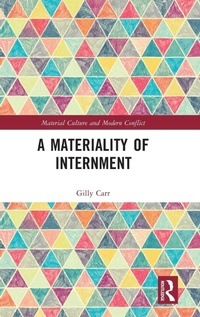
A Materiality of Internment
1st Edition
Published on 7. August 2024
Book
Hardback
300 pages
978-1-032-25915-4 (ISBN)
Description
More than two thousand people from the British Channel Islands were deported to and interned in Germany during the Second World War, making up as many as 60% of all interned British citizens in occupied territory during this period.
This book carries out an in-depth analysis of artwork, objects, oral testimonies, archives, poetry, letters, diaries and memoirs gathered from the internees and drawing from around one hundred collections. The work is based on over 15 years of research and interviews with more than 65 former internees, and explores analytical themes and narratives of placemaking, resistance, communities, food and cooking. It also proposes new concepts and categories to help us understand objects that distinguish the experience of internment.
This book will be of great value for scholars and museum professionals, as well as postgraduate students in the field of Conflict Archaeology and scholars of the Second World War. Cumulatively, this materiality comprises one of the major surviving assemblages of internees to emerge from the war, comparable in size, quality and importance with that from other theatres of war.
This book carries out an in-depth analysis of artwork, objects, oral testimonies, archives, poetry, letters, diaries and memoirs gathered from the internees and drawing from around one hundred collections. The work is based on over 15 years of research and interviews with more than 65 former internees, and explores analytical themes and narratives of placemaking, resistance, communities, food and cooking. It also proposes new concepts and categories to help us understand objects that distinguish the experience of internment.
This book will be of great value for scholars and museum professionals, as well as postgraduate students in the field of Conflict Archaeology and scholars of the Second World War. Cumulatively, this materiality comprises one of the major surviving assemblages of internees to emerge from the war, comparable in size, quality and importance with that from other theatres of war.
More details
Series
Language
English
Place of publication
London
United Kingdom
Publishing group
Taylor & Francis Ltd
Target group
College/higher education
Postgraduate
Illustrations
3 s/w Tabellen, 69 s/w Abbildungen, 69 s/w Photographien bzw. Rasterbilder
3 Tables, black and white; 69 Halftones, black and white; 69 Illustrations, black and white
Dimensions
Height: 240 mm
Width: 161 mm
Thickness: 22 mm
Weight
655 gr
ISBN-13
978-1-032-25915-4 (9781032259154)
Copyright in bibliographic data and cover images is held by Nielsen Book Services Limited or by the publishers or by their respective licensors: all rights reserved.
Schweitzer Classification
Other editions
Additional editions
Gilly Carr
A Materiality of Internment
Book
05/2026
1st Edition
Routledge
€57.50
Shipment within 10-20 days
Gilly Carr
A Materiality of Internment
E-Book
08/2024
1st Edition
Routledge
€60.49
Available for download
Gilly Carr
A Materiality of Internment
E-Book
08/2024
1st Edition
Routledge
€60.49
Available for download
Person
Dr Gilly Carr is Professor of Conflict Archaeology and Holocaust Heritage at the University of Cambridge and a Fellow of St Catharine's College. She publishes in the fields of archaeology, heritage studies, Holocaust studies and history and is also the author of seven monographs, including Victims of Nazi Persecution in the Channel Islands.
Content
1. Introduction: A materiality of internment 2. A history of the deportation of Channel Islanders 3. Dorsten: A lack of materiality 4. The material help of American friends in the French transit and internment camp of Royallieu, Compiegne 5. A materiality of placemaking and campscapes 6. A materiality of resistance? 7. An intimate materiality 8. A materiality of community 9. A materiality of aftermath: from liberation to compensation, 1945-1995 10. Reconciliation, a materiality of post-internment and conclusion