

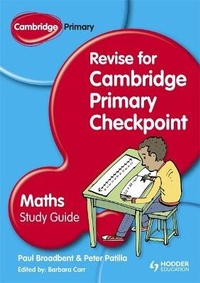
Cambridge Primary Revise for Primary Checkpoint Mathematics Study Guide
Published on 28. June 2013
Book
Paperback/Softback
96 pages
978-1-4441-7829-6 (ISBN)
Description
Boost learner confidence ahead of the Cambridge Primary Checkpoint tests with invaluable support and practical, ready-to-use revision activities.
This Study Guide supports revision in preparation for the Cambridge Primary Checkpoint test at the end of Stage 6. It contains revision activities for all the strands of the Cambridge Primary Maths curriculum: Number, Geometry, Measure and Handling data, with opportunities for Problem solving embedded throughout. It can be used independently for homework or additional practice, or alongside the Teacher's Guide in the classroom.
- Includes helpful revision tips, key facts and engaging questions, and fun challenge activities for those working towards high-end scores
- Boosts learners' confidence prior to taking the Cambridge Primary Checkpoint test with review tests to check progress
- Works as a useful revision tool for the Cambridge Primary Checkpoint test, including a useful glossary
Endorsed by Cambridge Assessment International Education
This Study Guide supports revision in preparation for the Cambridge Primary Checkpoint test at the end of Stage 6. It contains revision activities for all the strands of the Cambridge Primary Maths curriculum: Number, Geometry, Measure and Handling data, with opportunities for Problem solving embedded throughout. It can be used independently for homework or additional practice, or alongside the Teacher's Guide in the classroom.
- Includes helpful revision tips, key facts and engaging questions, and fun challenge activities for those working towards high-end scores
- Boosts learners' confidence prior to taking the Cambridge Primary Checkpoint test with review tests to check progress
- Works as a useful revision tool for the Cambridge Primary Checkpoint test, including a useful glossary
Endorsed by Cambridge Assessment International Education
More details
Language
English
Place of publication
United Kingdom
Publishing group
Hachette Learning
Target group
Primary & secondary/elementary & high school
Interest Age: From 5 to 12 years
Dimensions
Height: 296 mm
Width: 208 mm
Thickness: 8 mm
Weight
309 gr
ISBN-13
978-1-4441-7829-6 (9781444178296)
Copyright in bibliographic data and cover images is held by Nielsen Book Services Limited or by the publishers or by their respective licensors: all rights reserved.
Schweitzer Classification
Other editions
New editions
Book
08/2022
Hodder Education
€17.50
Shipment within 10-20 days
Persons
Paul Broadbent is a full-time writer of Maths books and a consultant. Peter Patilla has written a huge number of books and articles related to Maths education. Barbara Carr is a Maths consultant specialising in ensuring all children achieve basic Maths skills.
Content
: About this Study Guide
: Number
: Numbers and the number system
: Place value
: Multiplying and dividing numbers by 10, 100 and 1000
: Comparing, ordering, estimating and rounding numbers
: Recognising and extending number sequences
: Odd and even numbers
: Exploring multiples and factors
: Square and prime numbers
: Fractions
: Fractions, decimals and percentages
: Money and percentages
: Decimals and money
: Ratio and proportion
: Calculation
: Understanding operations and relationships
: Mental strategies: using known facts to derive new facts
: Mental strategies: using doubling and halving
: Mental strategies: addition and subtraction
: Mental strategies: multiplication and division
: Understanding brackets and the order of operations
: Written methods: addition
: Written methods: subtraction
: Written methods: multiplication
: Written methods: division
: Calculator methods
: How much can you remember? Test 1
: Geometry
: Shapes and geometric reasoning
: Properties of 2D shapes and geometric reasoning
: Properties of 3D shapes, nets and geometric reasoning
: Angles, lines and symmetry
: Position and movement
: Transformations of shapes and co-ordinates
: How much can you remember? Test 2
: Measure
: Length, mass and capacity
: Standard units of measure and conversions
: Reading from a scale
: Time
: Units for measuring time
: Telling the time and the passage of time
: Area and perimeter
: Calculating perimeter and area of shapes
: How much can you remember? Test 3
: Handling data
: Organising, categorising and representing data
: Sorting and classifying data
: Discrete data: Venn and Carroll diagrams
: Discrete data: bar charts, pictograms and pie charts
: Statistics: mean, mode, median and range
: Continuous data: line graphs and conversion charts
: Probability
: The language of probability
: How much can you remember? Test 4
: Glossary
: Number
: Numbers and the number system
: Place value
: Multiplying and dividing numbers by 10, 100 and 1000
: Comparing, ordering, estimating and rounding numbers
: Recognising and extending number sequences
: Odd and even numbers
: Exploring multiples and factors
: Square and prime numbers
: Fractions
: Fractions, decimals and percentages
: Money and percentages
: Decimals and money
: Ratio and proportion
: Calculation
: Understanding operations and relationships
: Mental strategies: using known facts to derive new facts
: Mental strategies: using doubling and halving
: Mental strategies: addition and subtraction
: Mental strategies: multiplication and division
: Understanding brackets and the order of operations
: Written methods: addition
: Written methods: subtraction
: Written methods: multiplication
: Written methods: division
: Calculator methods
: How much can you remember? Test 1
: Geometry
: Shapes and geometric reasoning
: Properties of 2D shapes and geometric reasoning
: Properties of 3D shapes, nets and geometric reasoning
: Angles, lines and symmetry
: Position and movement
: Transformations of shapes and co-ordinates
: How much can you remember? Test 2
: Measure
: Length, mass and capacity
: Standard units of measure and conversions
: Reading from a scale
: Time
: Units for measuring time
: Telling the time and the passage of time
: Area and perimeter
: Calculating perimeter and area of shapes
: How much can you remember? Test 3
: Handling data
: Organising, categorising and representing data
: Sorting and classifying data
: Discrete data: Venn and Carroll diagrams
: Discrete data: bar charts, pictograms and pie charts
: Statistics: mean, mode, median and range
: Continuous data: line graphs and conversion charts
: Probability
: The language of probability
: How much can you remember? Test 4
: Glossary