

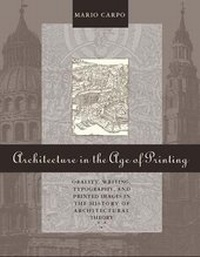
Architecture in the Age of Printing
Orality, Writing, Typography, and Printed Images in the History of Architectural Theory
Published on 27. June 2001
Book
Hardback
254 pages
978-0-262-03288-9 (ISBN)
Description
A history of the influence of communication technologies on Western architectural theory.
The discipline of architecture depends on the transmission in space and time of accumulated experiences, concepts, rules, and models. From the invention of the alphabet to the development of ASCII code for electronic communication, the process of recording and transmitting this body of knowledge has reflected the dominant information technologies of each period. In this book Mario Carpo discusses the communications media used by Western architects, from classical antiquity to modern classicism, showing how each medium related to specific forms of architectural thinking.
Carpo highlights the significance of the invention of movable type and mechanically reproduced images. He argues that Renaissance architectural theory, particularly the system of the five architectural orders, was consciously developed in response to the formats and potential of the new printed media. Carpo contrasts architecture in the age of printing with what preceded it: Vitruvian theory and the manuscript format, oral transmission in the Middle Ages, and the fifteenth-century transition from script to print. He also suggests that the basic principles of "typographic" architecture thrived in the Western world as long as print remained our main information technology. The shift from printed to digital representations, he points out, will again alter the course of architecture.
The discipline of architecture depends on the transmission in space and time of accumulated experiences, concepts, rules, and models. From the invention of the alphabet to the development of ASCII code for electronic communication, the process of recording and transmitting this body of knowledge has reflected the dominant information technologies of each period. In this book Mario Carpo discusses the communications media used by Western architects, from classical antiquity to modern classicism, showing how each medium related to specific forms of architectural thinking.
Carpo highlights the significance of the invention of movable type and mechanically reproduced images. He argues that Renaissance architectural theory, particularly the system of the five architectural orders, was consciously developed in response to the formats and potential of the new printed media. Carpo contrasts architecture in the age of printing with what preceded it: Vitruvian theory and the manuscript format, oral transmission in the Middle Ages, and the fifteenth-century transition from script to print. He also suggests that the basic principles of "typographic" architecture thrived in the Western world as long as print remained our main information technology. The shift from printed to digital representations, he points out, will again alter the course of architecture.
More details
Series
Language
English
Place of publication
Cambridge, Mass.
United States
Publishing group
MIT Press Ltd
Target group
Interest Age: From 18 years
Illustrations
27 illus.
Dimensions
Height: 229 mm
Width: 178 mm
Thickness: 13 mm
Weight
744 gr
ISBN-13
978-0-262-03288-9 (9780262032889)
Copyright in bibliographic data and cover images is held by Nielsen Book Services Limited or by the publishers or by their respective licensors: all rights reserved.
Schweitzer Classification
Other editions
Additional editions
Mario Carpo
Architecture in the Age of Printing
Orality, Writing, Typography, and Printed Images in the History of Architectural Theory
Book
02/2017
MIT Press
€27.30
Article exhausted; check different version
Persons
Mario Carpo is Associate Professor of Architectural History in the French Schools of Architecture, Professor at the Georgia Institute of Technology, and Vincent Scully Visiting Professor of Architectural History at the School of Architecture of Yale University. He is the author of Architecture in the Age of Printing: Orality, Writing, Typography, and Printed Images in the History of Architectural Theory (MIT Press, 2001) and other books.