

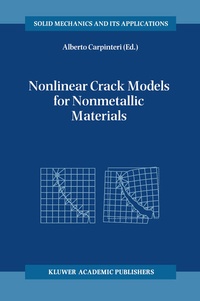
Nonlinear Crack Models for Nonmetallic Materials
Published on 16. October 2012
Book
Paperback/Softback
XI, 309 pages
978-94-010-5977-0 (ISBN)
Description
In this volume a survey of the most relevant nonlinear crack models is provided, with the purpose of analyzing the nonlinear mechanical effects occurring at the tip of macrocracks in quasi-brittle materials - such as concrete, rocks, ceramics, polymers, high-strength metallic alloys - and in brittle-matrix fibre-reinforced composites. Such local effects, as, for example, plastic deformation, yielding, strain-hardening, strain-softening, mechanical damage, matrix microcracking, aggregate debonding, fibre bridging, fibre slippage, crazing, and so on, are properly described through different simplified models, representing the peculiarities of the phenomena involved. The models are introduced and described separately and then compared in the last part of the book.
This volume will be of interest to students, professionals and researchers in the field of nonlinear fracture mechanics.
This volume will be of interest to students, professionals and researchers in the field of nonlinear fracture mechanics.
More details
Series
Edition
Softcover reprint of the original 1st ed. 1999
Language
English
Place of publication
Dordrecht
Netherlands
Target group
Professional and scholarly
Research
Illustrations
XI, 309 p.
Dimensions
Height: 240 mm
Width: 160 mm
Thickness: 19 mm
Weight
532 gr
ISBN-13
978-94-010-5977-0 (9789401059770)
DOI
10.1007/978-94-011-4700-2
Schweitzer Classification
Other editions
Additional editions
Alberto Carpinteri
Nonlinear Crack Models for Nonmetallic Materials
E-Book
12/2012
Springer
€149.79
Available for download
Alberto Carpinteri
Nonlinear Crack Models for Nonmetallic Materials
Book
06/1999
Kluwer Academic Publishers
€160.49
Shipment within 15-20 days
Content
1. Introduction.- 1.1. Preliminary Remarks.- 1.2. Irwin's Plastic Zone.- 1.3. Dugdale-Barenblatt Cohesive Zone.- 1.4. Stability of a Bridged Crack.- 1.5. Microcracked Zone ahead of a Macrocrack Tip.- 1.6. Final Remarks and Bibliographical Guide of the Author's Contributions to the Subject of the Volume.- 1.7. References.- 2. The Damage Crack Model.- 2.1. Introduction.- 2.2. Strain Energy Density Criterion.- 2.3. Mode I Problems.- 2.4. Mixed Mode Problems.- 2.5. Size Effects on Strength and Ductility.- 2.6. References.- 3. The Cohesive Crack Model.- 3.1. Introduction.- 3.2. Basic Concepts of the Cohesive Crack Model.- 3.3. Mode I Problems.- 3.4. Mixed Mode Problems.- 3.5. References.- 4. The Bridged Crack Model.- 4.1. Introduction.- 4.2. The Discontinuous Bridged Crack Model (Single Reinforcement).- 4.3. The Discontinuous Bridged Crack Model (n Reinforcements).- 4.4. The Continuous Bridged Crack Model.- 4.5. Applications of the Bridged Crack Model in Structural Analyses.- 4.6. References.- 5. The Microcrack-Interacting Model.- 5.1. Introduction.- 5.2. Microcracking in Brittle Solids.- 5.3. A Semi-analytical and Numerical Approach to Crack Interaction Problems.- 5.4. A LEFM Mesoscopic Approach to Macrocrack-Microcrack Interaction Problems.- 5.5. Small-Scale Microcracking in the Process Zone.- 5.6. An Energy Approach to Interactive Phenomena.- 5.7. A Statistical Approach to Microcracking.- 5.8. References.- 6. Comparisons and Conclusions.- 6.1. Preliminary Remarks.- 6.2. Cohesive Crack Model versus Damage Crack Model.- 6.3. Bridged Crack Model versus Cohesive Crack Model.- 6.4. Evolutive Analysis of Multicracked Bodies.- 6.5. References.