

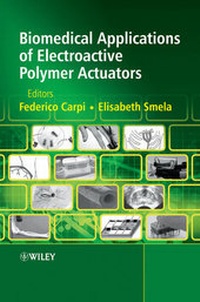
Biomedical Applications of Electroactive Polymer Actuators
Published on 17. April 2009
Book
Hardback
496 pages
978-0-470-77305-5 (ISBN)
Unfortunately, price unknown
Article exhausted; check different version
Description
Giving fundamental information on one of the most promising families of smart materials, electroactive polymers (EAP) this exciting new titles focuses on the several biomedical applications made possible by these types of materials and their related actuation technologies. Each chapter provides a description of the specific EAP material and device configuration used, material processing, device assembling and testing, along with a description of the biomedical application.
Edited by well-respected academics in the field of electroactive polymers with contributions from renowned international experts, this is an excellent resource for industrial and academic research scientists, engineers, technicians and graduate students working with polymer actuators or in the fields of polymer science.
More details
Other editions
Additional editions
Federico Carpi | Elisabeth Smela
Biomedical Applications of Electroactive Polymer Actuators
E-Book
04/2009
Wiley
€143.99
Available for download
Persons
Dr. Ing. Federico Carpi is a postdoctoral researcher at the Interdepartmental Research Center, E. Piaggio, at the University of Pisa (Italy). He gained his degree and PhD at the University of Pisa. His main research interests include the design, the study, the development, the fabrication and the characterization of innovative electromechanical devices based on electroactive polymer (EAP) materials. Dr. Carpi is also founder and co-coordinator for the European Scientific Network for Artificial Muscles.
Elisabeth Smela is an Associate Professor in the Department of Mechanical Engineering at the University of Maryland (USA). She received her BS in physics from MIT and completed her PhD in electrical engineering at the University of Pennsylvania in 1992. She then worked at Linkoeping University in Sweden and at Riso National Lab in Denmark developing microfabricated conjugated polymer devices. In 1999 she joined the start-up company Santa Fe Science and Technology in New Mexico as Vice President of Research and Development. She joined the faculty of the Department of Mechanical Engineering at the University of Maryland in September 2000. She was awarded the Presidential Early Career Award for Scientists and Engineers (PECASE) in 2004 for research in dielectric elastomer actuators for microrobotics. She also received the DuPont Young Professor Award in 2003, the engineering school's Kent Teaching Award for Junior Faculty in 2004, and the university's Outstanding Invention of 2004. Her research interests are in polymer MEMS and bioMEMS, and more generally in combining organic materials with conventional inorganic materials to make new micro-scale devices.
Elisabeth Smela is an Associate Professor in the Department of Mechanical Engineering at the University of Maryland (USA). She received her BS in physics from MIT and completed her PhD in electrical engineering at the University of Pennsylvania in 1992. She then worked at Linkoeping University in Sweden and at Riso National Lab in Denmark developing microfabricated conjugated polymer devices. In 1999 she joined the start-up company Santa Fe Science and Technology in New Mexico as Vice President of Research and Development. She joined the faculty of the Department of Mechanical Engineering at the University of Maryland in September 2000. She was awarded the Presidential Early Career Award for Scientists and Engineers (PECASE) in 2004 for research in dielectric elastomer actuators for microrobotics. She also received the DuPont Young Professor Award in 2003, the engineering school's Kent Teaching Award for Junior Faculty in 2004, and the university's Outstanding Invention of 2004. Her research interests are in polymer MEMS and bioMEMS, and more generally in combining organic materials with conventional inorganic materials to make new micro-scale devices.
Content
Preface.
List of Contributors.
Introduction.
Polymer Gels.
1. Polymer Gel Actuators: Fundamentals (Paul Calvert).
References.
2. Bioresponsive Hydrogels for Biomedical Applications (Tom McDonald, Alison Patrick, Richard Williams, Brian G. Cousins and Rein V. Ulijn).
References.
3. Stimuli-Responsive and 'Active' Polymers in Drug Delivery (Aram Omar Saeed, Jóhannes Páll Magn£sson, Beverley Twaites and Cameron Alexander).
References.
4. Thermally Driven Hydrogel Actuator for Controllable Flow Rate Pump in Long-Term Drug Delivery (Piero Chiarelli and Pietro Ragni).
References.
Ionic Polymer-Metal Composites (IPMC).
5. IPMC actuators: Fundamentals (Kinji Asaka and Keisuke Oguro).
References.
6. Active Micro-Catheter and Biomedical Soft Devices Based on IPMC Actuators (Kinji Asaka and Keisuke Oguro).
References.
7. Implantable Heart-Assist and Compression Devices Employing Active Network of Electrically-Controllable Ionic Polymeric Metal Nanocomposites (Mohsen Shahinpoor).
References.
8. IPMC Based Tactile Displays for Pressure and Texture Presentation on a Human Finger (Masashi Konyo and Satoshi Tadokoro).
References.
9. IPMC Assisted Infusion Micropumps (Il-Seok Park, Sonia Vohnout, Mark Banister, Sangki Lee, Sang-Mun Kim and Kwang J. Kim).
References.
Conjugated Polymers.
10. Conjugated Polymer Actuators: Fundamentals (Geoffrey M. Spinks, Gursel Alici, Scott McGovern, Binbin Xi and Gordon G. Wallace).
References.
11. Steerable Catheters (Tina Shoa, John D. Madden, Nigel R. Munce and Victor X. D. Yang).
References.
12. Microfabricated Conjugated Polymer Actuators for Microvalves, Cell Biology and Microrobotics (Elisabeth Smela).
References.
13. Actuated Pins for Braille Displays (Geoffrey M. Spinks and Gordon G. Wallace).
Acknowledgements.
References.
14. Nanostructured Conducting Polymer Biomaterials and Their Applications in Controlled Drug Delivery (Mohammad Reza Abidian and David C. Martin).
Acknowledgements.
References.
15. Integrated Oral Drug Delivery System with Valve Based on Polypyrrole (Thorsten Göttsche and Stefan Haeberle).
Acknowledgements.
References.
Piezoelectric and Electrostrictive Polymers.
16. Piezoelectric and Electrostrictive Polymer Actuators: Fundamentals (Zhimin Li and Zhongyang Cheng).
References.
17. Miniature High Frequency Focused Ultrasonic Transducers for Minimally Invasive Imaging Procedures (Aaron Fleischman, Sushma Srivanas, Chaitanya Chandrana and Shuvo Roy).
References.
18. Catheters for Thrombosis Sample in Blood Vessels Using Piezoelectric Polymer Fibers (Yoshiro Tajitsu).
References.
19. Piezoelectric Polyvinylidene Fluoride (PVDF) in Biomedical Ultrasound Exposimetry (Gerald R. Harris).
References.
Dielectric Elastomers.
20. Dielectric Elastomer Actuators: Fundamentals (Roy Kornbluh, Richard Heydt and Ron Pelrine).
References.
21. Biomedical Applications of Dielectric Elastomer Actuators (John S. Bashkin, Roy Kornbluh, Harsha Prahlad and Annjoe Wong-Foy).
References.
22. MRI Compatible Device for Robotic Assisted Interventions to Prostate Cancer (Jean-Sébastien Plante, Lauren Devita, Kenjiro Tadakuma and Steven Dubowsky).
Acknowledgements.
References.
23. A Braille Display System for the Visually Disabled Using a Polymer Based Soft Actuator (Hyouk Ryeol Choi, Ig Mo Koo, Kwangmok Jung, Se-gon Roh, Ja Choon Koo, Jae-do Nam and Young Kwan Lee).
References.
24. Dynamic Splint-Like Hand Orthosis For Finger Rehabilitation (Federico Carpi, Andrea Mannini and Danilo De Rossi).
References.
Index.