

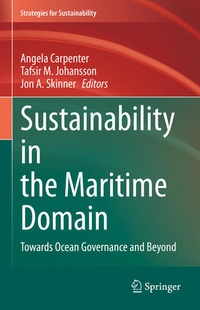
Sustainability in the Maritime Domain
Towards Ocean Governance and Beyond
Published on 30. May 2021
Book
Hardback
XVIII, 525 pages
978-3-030-69324-4 (ISBN)
Description
This volume explores options for a sustainable maritime domain, including maritime transportation, such as, Maritime Spatial Planning (MSP), maritime education and training, maritime traffic and advisory systems, maritime security. Other activities in the maritime domain covered in the book include small-scale fisheries and sustainable fisheries, and greening the blue economy. The book aims to provide the building blocks needed for a framework for good ocean governance; a framework that will serve through the next decade and, and hopefully, well beyond the 2030 milepost of the UN Agenda for Sustainable Development. In short, this book brings together the problems of the current world and sustainable solutions that are in the development process and will eventually materialize in the not so distant future. Additionally, the book presents a trans-disciplinary analysis of integral sustainable maritime transportation solutions and crucial issues relevant to good ocean governance that have recently been discussed at different national, regional and international fora, highlighting ongoing work to develop and support governance systems that facilitate industry requirements, and meet the needs of coastal states and indigenous peoples, of researchers, of spatial planners, and of other sectors dependent on the oceans.
The book will be of interest to researchers across many disciplines, especially those that are engaged in cross-sectoral research and developments in the maritime transport sector and across the wider maritime domain. To this end, the book covers areas including natural and social sciences, geographical studies, spatial planning, maritime security and gender studies, as they relate to transport and the wider maritime sector. In addition, the book explores frameworks for sustainable ocean governance being developed under the UN's Agenda for Sustainable Development to 2030. It will also look beyond the 2030 milepost under that Agenda, and will be of use to national and international policymakers and practitioners, government actors at the EU and other regional and national levels and to researchers of ocean governance, sustainability and management, and maritime transport.
The book will be of interest to researchers across many disciplines, especially those that are engaged in cross-sectoral research and developments in the maritime transport sector and across the wider maritime domain. To this end, the book covers areas including natural and social sciences, geographical studies, spatial planning, maritime security and gender studies, as they relate to transport and the wider maritime sector. In addition, the book explores frameworks for sustainable ocean governance being developed under the UN's Agenda for Sustainable Development to 2030. It will also look beyond the 2030 milepost under that Agenda, and will be of use to national and international policymakers and practitioners, government actors at the EU and other regional and national levels and to researchers of ocean governance, sustainability and management, and maritime transport.
More details
Product info
Book
Series
Edition
1st ed. 2021
Language
English
Place of publication
Cham
Switzerland
Publishing group
Springer International Publishing
Target group
Professional and scholarly
Illustrations
38 s/w Abbildungen, 34 farbige Tabellen
XVIII, 525 p. 38 illus.
Dimensions
Height: 241 mm
Width: 160 mm
Thickness: 35 mm
Weight
975 gr
ISBN-13
978-3-030-69324-4 (9783030693244)
DOI
10.1007/978-3-030-69325-1
Schweitzer Classification
Other editions
Additional editions
Angela Carpenter | Tafsir M. Johansson | Jon A. Skinner
Sustainability in the Maritime Domain
Towards Ocean Governance and Beyond
Book
05/2022
Springer
€149.79
Shipment within 7-9 days
Angela Carpenter | Tafsir M. Johansson | Jon A. Skinner
Sustainability in the Maritime Domain
Towards Ocean Governance and Beyond
E-Book
05/2021
1st Edition
Springer
€139.09
Available for download
Persons
Dr. Angela Carpenter is an Affiliate and External Consultant with the Faculty of Engineering and Sustainable Development at the University of Gävle, undertaking work in the area of sustainable seaports and port-city collaborations. She also undertakes research on sustainability in EU seaports and sustainable business practices in ports, and on maritime environmental governance and policy.
Dr. Tafsir M. Johansson is an Associate Research Officer at the World Maritime University, Sasakawa Global Ocean Institute. His duties include ocean governance and ocean policy research and teaching, and developing innovative statistical and mathematical models to better assess drivers and indicators relevant to ocean research agenda.
Dr. Jon A. Skinner teaches at the University of Alaska, and is a private contractor and consultant on maritime issues for the World Maritime University. He completed his PhD in 2016 on the strategic impact of Russian energy ambitions int he Arctic, and his long-term research is on geopolitical strategies in Polar regions, particularly from an energy and maritime perspective.
Dr. Tafsir M. Johansson is an Associate Research Officer at the World Maritime University, Sasakawa Global Ocean Institute. His duties include ocean governance and ocean policy research and teaching, and developing innovative statistical and mathematical models to better assess drivers and indicators relevant to ocean research agenda.
Dr. Jon A. Skinner teaches at the University of Alaska, and is a private contractor and consultant on maritime issues for the World Maritime University. He completed his PhD in 2016 on the strategic impact of Russian energy ambitions int he Arctic, and his long-term research is on geopolitical strategies in Polar regions, particularly from an energy and maritime perspective.
Content
Chapter1. Introducing Sustainability in the Maritime Domain.- Chapter2. Greening the Blue Economy: A Trans-disciplinary Analysis.- Chapter3. Regional Marine Spatial Planning: A Tool For Greening Blue Economy In The Bay Of Bengal.- Chapter4. Green Ports and Sustainable Shipping in the European context.- Chapter5. Maritime Transport and Sustainable Fisheries: Breaking the Silos.- Chapter6. Maritime Security: Adapting for Mid-century Challenges.- Chapter7. ISPS Code implementation: overkill and off-target.- Chapter8. Port and Maritime Security and Sustainability.- Chapter9. Governance of international sea borders: regional approaches and sustainable solutions for maritime surveillance in the Mediterranean Sea.- Chapter10. The applicability of the international and regional efforts to prevent oil pollution: comparative analysis between the Arabian Gulf Region and the North Sea.- Chapter11. Autonomous operations, digital technologies and implications for Maritime Education and Training.- Chapter12. Synergies Between the Obligations and Measures to Reduce Vessel-Source Underwater Noise and Greenhouse Gas Emissions.- Chapter13. Sustainable Maritime Labour Governance: The Role of Transformative Partnership in Seafarers' Welfare.- Chapter14. Underwater noise from shipping - a special case for the Arctic.- Chapter15. Canadian Ports Sustainability: A Strategic Response to Disruptive Paradigms such as COVID-19.- Chapter16. Lessons Learned from Robotics & AI in a Liability Context: A Sustainability Perspective.- Chapter17. The role of slow steaming in shipping and methods of CO2 reduction.- Chapter18. Maritime Governance & Small Island Developing States of the Wider Caribbean Region in the Era of Climate Change Adaptation.- Chapter19. Mind the gap: Women in the boardroom, on board and in the port.- Chapter20. Maritime Governance and International Maritime Organization instruments focused on sustainability in the light of United Nations' Sustainable Development Goals.- Chapter21. Putting the Pieces Together for Sustainable Shipping.- Chapter22. Conclusions: Connecting Sustainable Development Goals to the Maritime Domain.