

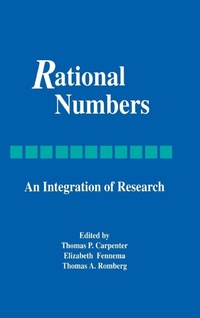
Rational Numbers
An Integration of Research
Published on 1. January 1993
Book
Hardback
396 pages
978-0-8058-1135-3 (ISBN)
Description
Until recently there had been relatively little integration of programs of research on teaching, learning, curriculum, and assessment. However, in the last few years it has become increasingly apparent that a more unified program of research is needed to acquire an understanding of teaching and learning in schools that will inform curriculum development and assessment. The chapters in this volume represent a first step toward an integration of research paradigms in one clearly specified mathematical domain.
Integrating a number of different research perspectives is a complex task, and ways must be found to reduce the complexity without sacrificing the integration. The research discussed in this volume is tied together because it deals with a common content strand. During the last ten years specific content domains have served as focal points for research on the development of mathematical concepts in children. The areas of addition and subtraction, algebra, rational numbers, and geometry are notable examples. Whether a similar organizational structure will prevail for programs of research that integrate the study of teaching, learning, curriculum, and assessment is an open question. The perspectives presented in this volume illustrate the potential for adopting this perspective.
Integrating a number of different research perspectives is a complex task, and ways must be found to reduce the complexity without sacrificing the integration. The research discussed in this volume is tied together because it deals with a common content strand. During the last ten years specific content domains have served as focal points for research on the development of mathematical concepts in children. The areas of addition and subtraction, algebra, rational numbers, and geometry are notable examples. Whether a similar organizational structure will prevail for programs of research that integrate the study of teaching, learning, curriculum, and assessment is an open question. The perspectives presented in this volume illustrate the potential for adopting this perspective.
Reviews / Votes
"...the chosen references exemplify the points well....[the volume] draws on relevant studies but stays focused on the goal of identifying and integrating issues...goes beyond the content, learning, and instruction focus found in earlier works....Mathematics educators...would certainly find this volume relevant. It would also interest researchers engaged in the careful study of teaching and learning within instructional settings....It is precisely in smoothing some of the sharp edges separating rational number issues in teaching, learning, assessment, and content that Rational Numbers: An Integration of Research makes its contribution."-Contemporay Psychology
More details
Series
Language
English
Place of publication
New York
United States
Publishing group
Taylor & Francis Inc
Target group
College/higher education
Professional and scholarly
Dimensions
Height: 235 mm
Width: 157 mm
Thickness: 26 mm
Weight
725 gr
ISBN-13
978-0-8058-1135-3 (9780805811353)
Copyright in bibliographic data and cover images is held by Nielsen Book Services Limited or by the publishers or by their respective licensors: all rights reserved.
Schweitzer Classification
Other editions
Additional editions
Thomas P. Carpenter | Elizabeth Fennema | Thomas A. Romberg
Rational Numbers
An Integration of Research
Book
12/2015
1st Edition
Routledge
€75.50
Shipment within 10-20 days
Thomas P. Carpenter | Elizabeth Fennema | Thomas A. Romberg
Rational Numbers
An Integration of Research
E-Book
10/2012
1st Edition
Routledge
€68.49
Available for download
Thomas P. Carpenter | Elizabeth Fennema | Thomas A. Romberg
Rational Numbers
An Integration of Research
E-Book
10/2012
1st Edition
Routledge
€68.49
Available for download
Persons
Thomas P. Carpenter, Elizabeth Fennema, Thomas A. Romberg
Content
Contents: Part I:Overview.T.P. Carpenter, E. Fennema, T.A. Romberg, Toward A Unified Discipline of Scientific Inquiry. Part II:Content Analyses of Rational Numbers.M.J. Behr, G. Harel, T. Post, R. Lesh, Rational Numbers: Toward a Semantic Analysis -- Emphasis on the Operator Construct. T.E. Kieren, Rational and Fractional Numbers: From Quotient Fields to Recursive Understanding. Part III:Students' Thinking.N.K. Mack, Learning Rational Numbers With Understanding: The Case of Informal Knowledge. L.B. Resnick, J.A. Singer, Protoquantitative Origins of Ratio Reasoning. S.J. Lamon, Ratio and Proportion: Children's Cognitive and Metacognitive Processes. Part IV:Teachers and Teaching.D.L. Ball, Halves, Pieces, and Twoths: Constructing and Using Representational Contexts in Teaching Fractions. C.A. Brown, A Critical Analysis of Teaching Rational Number. J.A. Hiebert, Benefits and Costs of Research That Links Teaching and Learning Mathematics. J.T. Sowder, N. Bezuk, L.K. Sowder, Using Principles From Cognitive Psychology to Guide Rational Number Instruction for Prospective Teachers. Part V:Assessment.S.P. Marshall, Assessment of Rational Number Understanding: A Schema-Based Approach. Part VI:Curriculum and Instruction.L. Streefland, Fractions: A Realistic Approach. T.R. Post, K.A. Cramer, M. Behr, R. Lesh, G. Harel, Curriculum Implications of Research on the Learning, Teaching, and Assessing of Rational Number Concepts.