

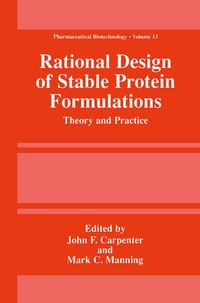
Rational Design of Stable Protein Formulations
Theory and Practice
Published on 30. April 2002
Book
Hardback
XVII, 206 pages
978-0-306-46741-7 (ISBN)
Description
Recombinant proteins and polypeptides continue to be the most important class of biotechnology-derived agents in today's pharmaceutical industry. Over the past few years, our fundamental understanding of how proteins degrade and how stabilizing agents work has made it possible to approach formulation of protein pharmaceuticals from a much more rational point of view.
This book describes the current level of understanding of protein instability and the strategies for stabilizing proteins under a variety of stressful conditions.
More details
Series
Edition
2002 ed.
Language
English
Place of publication
New York
United States
Publishing group
Springer Science+Business Media
Target group
Professional and scholarly
Research
Illustrations
XVII, 206 p.
Dimensions
Height: 241 mm
Width: 160 mm
Thickness: 17 mm
Weight
512 gr
ISBN-13
978-0-306-46741-7 (9780306467417)
DOI
10.1007/978-1-4615-0557-0
Schweitzer Classification
Other editions
Additional editions
John F. Carpenter | Mark C. Manning
Rational Design of Stable Protein Formulations
Theory and Practice
Book
10/2012
Springer
€160.49
Shipment within 7-9 days
Content
1 Practical Approaches to Protein Formulation Development.- Preparation for Formulation Development.- Preformulation Development.- Formulation Development.- Formulation in Commercial Product Development.- Appendix: List of Regulatory Documents.- References.- 2 Recombinant Production of Native Proteins from
Escherichia coli.- Distribution of Expressed Proteins.- Cell Washing and Lysis.- Purification of Soluble, Folded Proteins.- Purification and Refolding of Soluble, Misfolded Proteins.- Purification and Refolding of Proteins from Inclusion Bodies.- Refolding Mechanism.- Methods to Analyze Folded Structures.- References.- 3 Physical Stabilization of Proteins in Aqueous Solution.- Overview of Physical Stability.- Interactions of Excipients with Proteins.- Physical Factors Affecting Protein Stability.- Conclusions.- Appendix: Derivation of the Wyman Linkage Function and Application to the Timasheff Preferential Exclusion Mechanism.- References.- 4 Effects of Conformation on the Chemical Stability of Pharmaceutically Relevant Polypeptides.- Relationship Between Structure and Deamidation Rates.- Role of Structure in Protein Oxidation.- Summary.- References.- 5 Rational Design of Stable Lyophilized Protein Formulations: Theory and Practice.- Minimal Criteria for a Successful Lyophilized Formulation.- Rational Design of Stable Lyophiilized Formulations.- Acknowledgments.- References.- 6 Spray-Drying of Proteins.- Introduction: Why Spray-Dry a Protein?.- Developments in the Last 10 Years.- The Practice of Spray-Drying Proteins.- Concluding Remarks.- References.- Chapter7 Surfactant-Protein Interactions.- Proteins and Surfactants at Surfaces.- Protein-Surfactant Interactions in Solution.- Surfactant Effects on Protein Assembly State.- Surfactant Effects on Proteins During Freezing, Freeze-Drying and Reconstitution.- Enzymatic Degradation of Non-Ionic Surfactants.- Recommendations for Protein Formulation.- References.- 8 High Throughput Formulation: Strategies for Rapid Development of Stahle Protein Products.- Overall Structure of the HTF Approach.- Role of an Established Decision Tree for Formulation Design.- Use of Software and Databases to Assist in the HTF Process.- Essential Analytical Methods.- Stability Protocols.- Unified Strategy for HTF.- References.