

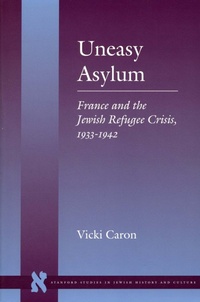
Uneasy Asylum
France and the Jewish Refugee Crisis, 1933-1942
Published on 1. September 2002
Book
Paperback/Softback
608 pages
978-0-8047-4377-8 (ISBN)
Description
This book, which draws on a rich array of primary sources and archival materials, offers the first major appraisal of French responses to the Jewish refugee crisis after the Nazi seizure of power in 1933. It explores French policies and attitudes toward Jewish refugees from three interrelated vantage points: government policy, public opinion, and the role of the French Jewish community.
The author demonstrates that Jewish refugees in France were not treated in the same manner as other foreigners, in part because of foreign policy considerations and in part because Jewish refugees had a distinctive socioeconomic profile. By examining the socioeconomic and political factors that informed French refugee policy in the 1930's, the author presents overwhelming evidence that Vichy's anti-Jewish measures were not merely the work of a few antisemitic zealots in the administration, nor did they stem solely from the desire of Marshal Petain's government to find scapegoats for the military defeat of 1940. Rather, they enjoyed widespread popular support, not only from far-right organizations but also from a host of middle-class professional associations and their members (doctors, lawyers, merchants, and artisans) who perceived Jews as a competitive threat.
The author also sheds new light on Jewish political behavior in the 1930s. She demonstrates that the French Jewish community was sharply divided over the proper approach to the refugee crisis. While some Jewish leaders pressed for a hard-line policy, others worked assiduously to provide the refugees relief and to persuade the government to pursue a more liberal refugee policy. Thus the author refutes claims that the native French Jewish elite was overwhelmingly unsympathetic to the refugees because of fear that an influx of refugees would provoke an antisemitic backlash.
While this book reveals the extent to which anti-refugee attitudes and policies in the 1930's paved the way for Vichy's anti-Jewish policies, it also highlights significant discontinuities between the refugee policies of the Third Republic and those of the Vichy regime.
The author demonstrates that Jewish refugees in France were not treated in the same manner as other foreigners, in part because of foreign policy considerations and in part because Jewish refugees had a distinctive socioeconomic profile. By examining the socioeconomic and political factors that informed French refugee policy in the 1930's, the author presents overwhelming evidence that Vichy's anti-Jewish measures were not merely the work of a few antisemitic zealots in the administration, nor did they stem solely from the desire of Marshal Petain's government to find scapegoats for the military defeat of 1940. Rather, they enjoyed widespread popular support, not only from far-right organizations but also from a host of middle-class professional associations and their members (doctors, lawyers, merchants, and artisans) who perceived Jews as a competitive threat.
The author also sheds new light on Jewish political behavior in the 1930s. She demonstrates that the French Jewish community was sharply divided over the proper approach to the refugee crisis. While some Jewish leaders pressed for a hard-line policy, others worked assiduously to provide the refugees relief and to persuade the government to pursue a more liberal refugee policy. Thus the author refutes claims that the native French Jewish elite was overwhelmingly unsympathetic to the refugees because of fear that an influx of refugees would provoke an antisemitic backlash.
While this book reveals the extent to which anti-refugee attitudes and policies in the 1930's paved the way for Vichy's anti-Jewish policies, it also highlights significant discontinuities between the refugee policies of the Third Republic and those of the Vichy regime.
Reviews / Votes
"Placed within the broad context of French and European history, this highly original, nuanced book is a valuable resource not only for specialists in the Third Republic but also for scholars of the 1930's, World War II, and the Holocaust." -Carol Fink,Ohio State UniversityMore details
Series
Edition
New edition
Language
English
Place of publication
Palo Alto
United States
Target group
Professional and scholarly
College/higher education
Edition type
New edition
Product notice
Paperback (trade)
Dimensions
Height: 229 mm
Width: 153 mm
Thickness: 37 mm
Weight
839 gr
ISBN-13
978-0-8047-4377-8 (9780804743778)
Copyright in bibliographic data and cover images is held by Nielsen Book Services Limited or by the publishers or by their respective licensors: all rights reserved.
Schweitzer Classification
Other editions
Additional editions

E-Book
05/1999
Stanford University Press
€49.49
Available for download
Previous edition
Book
05/1999
Stanford University Press
€86.96
No shipping information available
Person
Vicki Caron is Thomas and Diann Mann Chair of Modern Jewish Studies at Cornell University.
Content
1. Introduction 2. Refugee policy and middle-class protest during the Great Depression, 1933-36 3. The conservative crackdown of 1934-35 4. The great invasion I, 1933-36 5. Loyalties in conflict: French Jewry and the refugee crisis, 1933-May 1936 6. Refugee policy during the popular front era 7. Breaking the impasse: colonial and agricultural schemes during the popular front era 8. The deluge: from the Anschluss to Evian 9. The impact of appeasement 10. The crosscurrents of 1939 11. The missed opportunity: refugee policy in wartime 12. The great invasion II, 1936-40 13. The politics of frustration: the remaking of the Jewish relief effort, 1936-40 14. The path to Vichy: continuities and discontinuities in Jewish refugee policy 15. Conclusion.