

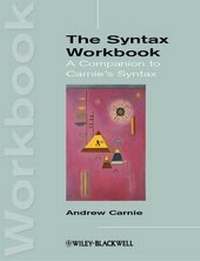
The Syntax Workbook
A Companion to Carnie's Syntax
Published on 2. November 2012
Book
Paperback/Softback
192 pages
978-1-118-34754-6 (ISBN)
Description
The Syntax Workbook was written as a response to the students and instructors who, over the years, have requested more problem sets that give greater experience in analyzing syntactic structure. Aligned chapter-by-chapter with Carnie's bestselling textbook, this workbook provides over 120 new exercises on all of the major topics in generative syntax.
* An all-new workbook to accompany the bestselling syntax textbook, Syntax: A Generative Introduction, which answers the need for a practical text in this field
* Features over 120 problem sets with answers, designed to give students greater experience of analyzing syntactic structure
* Exercises and topics covered includes phrase structure, the lexicon, Case theory, ellipsis, auxiliaries, movement, covert movement, locality conditions, VP shells, and control
* Supported by expanded online student and instructor resources, including extra chapters on HPSG, LFG and time-saving materials for lecturers, including problem sets, PowerPoint slides, and an instructors' manual
* Structured to reflect the style and chapter-by-chapter coverage of the textbook, but its practical, reader-friendly layout also makes it suitable for use as a stand-alone Workbook
* An all-new workbook to accompany the bestselling syntax textbook, Syntax: A Generative Introduction, which answers the need for a practical text in this field
* Features over 120 problem sets with answers, designed to give students greater experience of analyzing syntactic structure
* Exercises and topics covered includes phrase structure, the lexicon, Case theory, ellipsis, auxiliaries, movement, covert movement, locality conditions, VP shells, and control
* Supported by expanded online student and instructor resources, including extra chapters on HPSG, LFG and time-saving materials for lecturers, including problem sets, PowerPoint slides, and an instructors' manual
* Structured to reflect the style and chapter-by-chapter coverage of the textbook, but its practical, reader-friendly layout also makes it suitable for use as a stand-alone Workbook
More details
Series
Edition
1. Auflage
Language
English
Place of publication
Hoboken
United Kingdom
Publishing group
John Wiley and Sons Ltd
Target group
College/higher education
Dimensions
Height: 24.6 cm
Width: 18.8 cm
Thickness: 0.9 cm
Weight
328 gr
ISBN-13
978-1-118-34754-6 (9781118347546)
Schweitzer Classification
Other editions
New editions
Book
03/2021
Wiley
€43.00
Shipment within 15-20 days
Person
Andrew Carnie is Professor of Linguistics and Faculty Director in the Graduate College at the University of Arizona. He specializes in generative syntactic theory with an emphasis on constituency, VSO languages, copular constructions and Celtic languages. He is the author of numerous other publications, including Irish Nouns (2008), Constituent Structure (2010), Formal Approaches to Celtic Linguistics (2011), Modern Syntax (2011), and Syntax: A Generative Introduction, Third Edition (2013).
Content
Introduction: Welcome 1
Part 1 Preliminaries 3
1 Generative Grammar 5
2 Parts of Speech 13
3 Constituency, Trees, and Rules 20
4 Structural Relations 39
5 Binding Theory 46
Part 2 The Base 51
6 X-bar Theory 53
7 Extending X-bar Theory to Functional Categories 72
8 Constraining X-bar Theory: Theta Theory 84
9 Auxiliaries and Functional Categories 93
Part 3 Movement 107
10 Head-to-Head Movement 109
11 DP Movement 117
12 Wh -movement and Locality Constraints 127
13 A Unified Theory of Movement 145
Part 4 Advanced Topics 149
14 Expanded VPs 151
15 Raising, Control, and Empty Categories 157
16 Ellipsis 169
17 Advanced Topics in Binding Theory 174
18 Polysynthesis, Incorporation, and Non-configurationality 177
References 180
Index 182
Part 1 Preliminaries 3
1 Generative Grammar 5
2 Parts of Speech 13
3 Constituency, Trees, and Rules 20
4 Structural Relations 39
5 Binding Theory 46
Part 2 The Base 51
6 X-bar Theory 53
7 Extending X-bar Theory to Functional Categories 72
8 Constraining X-bar Theory: Theta Theory 84
9 Auxiliaries and Functional Categories 93
Part 3 Movement 107
10 Head-to-Head Movement 109
11 DP Movement 117
12 Wh -movement and Locality Constraints 127
13 A Unified Theory of Movement 145
Part 4 Advanced Topics 149
14 Expanded VPs 151
15 Raising, Control, and Empty Categories 157
16 Ellipsis 169
17 Advanced Topics in Binding Theory 174
18 Polysynthesis, Incorporation, and Non-configurationality 177
References 180
Index 182