

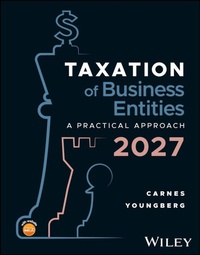
Taxation of Business Entities, with eBook Access Code
A Practical Approach, 2027
2nd Edition
Will be published approx. on 24. September 2026
Book
Paperback/Softback
1040 pages
978-1-394-44848-7 (ISBN)
Description
An innovative approach to understanding the federal income tax laws for business entities and developing tax-efficient strategies.
Presents the big picture to understanding the tax laws with a practice-based approach so students can develop critical thinking and problem-solving skills that prepare them to make effective decisions. Taxation of Business Entities, 2027 Edition introduces a comprehensive foundation for the income tax system, so students can understand why a law exists and how to apply the law to practical tax problems encountered by businesses. Professional skill-building exercises develop critical thinking and communication skills and the ability to identify and address ethical dilemmas, preparing students to be successful tax professionals.
WILEY ADVANTAGE
Incorporates Tax Planning Tips that focus on planning opportunities for corporations, S corporations, partnerships, and LLCs throughout, and a chapter on the choice of business entity
Includes specialized tax topics such as accounting for income taxes on financial statements, income taxation of trusts and estates, estate and gift taxation, state and local taxation, multinational taxation, and tax-exempt organizations
Practice opportunities are presented immediately following each learning objective, because students comprehend best by applying what they just learned
Creates a realistic environment to teach students how to apply their knowledge that will transfer to job-ready skills with Tax Form and Tax Return Problems that include actual tax source documents
Develops tax planning skills through Tax Planning Problems, Spotlight on the Tax Law, and Excel exercises that stimulate critical analysis and evaluation
Features applications and problems that focus on tax-planning skills, analytical skills, research skills, communication skills, and the ability to identify and address ethical dilemmas
Task-Based Simulation Problems similar to those used on the CPA Exam include realistic source documents such as Schedule K-1s, financial statements, invoices, and legal agreements that students use to solve problems
Prepares students for the advanced tax knowledge and skills that are tested on the TCP (Tax Compliance and Planning) CPA exam
Includes an extensive collection of additional resources, such as lesson plans, presentation slides, a Solutions Manual for instructors and practice quizzes, downloadable forms, test bank, and spreadsheets for students
AN INTERACTIVE, MULTIMEDIA LEARNING EXPERIENCE
This textbook includes access to an interactive, multimedia e-text. Icons throughout the print book signal corresponding digital content in the e-text.
Taxation of Business Entities integrates abundant video content developed by the authors to complement the text and engage readers more deeply.
Content Review Videos provide a detailed review of each learning objective in each chapter and help students learn key concepts and an understanding of tax laws, the big picture, and the Why behind it.
Provide confidence-building opportunities with a wide range of Practice Problems and author-created Solution Walkthrough Videos that give step-by-step instruction on how to complete problems like those in the text.
Downloadable Files appear throughout the E-Book, enabling students to see and work with tax forms.
Concept Check Questions at the end of each learning objective provide immediate feedback, helping readers monitor their understanding and mastery of the material.
Presents the big picture to understanding the tax laws with a practice-based approach so students can develop critical thinking and problem-solving skills that prepare them to make effective decisions. Taxation of Business Entities, 2027 Edition introduces a comprehensive foundation for the income tax system, so students can understand why a law exists and how to apply the law to practical tax problems encountered by businesses. Professional skill-building exercises develop critical thinking and communication skills and the ability to identify and address ethical dilemmas, preparing students to be successful tax professionals.
WILEY ADVANTAGE
Incorporates Tax Planning Tips that focus on planning opportunities for corporations, S corporations, partnerships, and LLCs throughout, and a chapter on the choice of business entity
Includes specialized tax topics such as accounting for income taxes on financial statements, income taxation of trusts and estates, estate and gift taxation, state and local taxation, multinational taxation, and tax-exempt organizations
Practice opportunities are presented immediately following each learning objective, because students comprehend best by applying what they just learned
Creates a realistic environment to teach students how to apply their knowledge that will transfer to job-ready skills with Tax Form and Tax Return Problems that include actual tax source documents
Develops tax planning skills through Tax Planning Problems, Spotlight on the Tax Law, and Excel exercises that stimulate critical analysis and evaluation
Features applications and problems that focus on tax-planning skills, analytical skills, research skills, communication skills, and the ability to identify and address ethical dilemmas
Task-Based Simulation Problems similar to those used on the CPA Exam include realistic source documents such as Schedule K-1s, financial statements, invoices, and legal agreements that students use to solve problems
Prepares students for the advanced tax knowledge and skills that are tested on the TCP (Tax Compliance and Planning) CPA exam
Includes an extensive collection of additional resources, such as lesson plans, presentation slides, a Solutions Manual for instructors and practice quizzes, downloadable forms, test bank, and spreadsheets for students
AN INTERACTIVE, MULTIMEDIA LEARNING EXPERIENCE
This textbook includes access to an interactive, multimedia e-text. Icons throughout the print book signal corresponding digital content in the e-text.
Taxation of Business Entities integrates abundant video content developed by the authors to complement the text and engage readers more deeply.
Content Review Videos provide a detailed review of each learning objective in each chapter and help students learn key concepts and an understanding of tax laws, the big picture, and the Why behind it.
Provide confidence-building opportunities with a wide range of Practice Problems and author-created Solution Walkthrough Videos that give step-by-step instruction on how to complete problems like those in the text.
Downloadable Files appear throughout the E-Book, enabling students to see and work with tax forms.
Concept Check Questions at the end of each learning objective provide immediate feedback, helping readers monitor their understanding and mastery of the material.
More details
Edition
2nd edition
Language
English
Place of publication
New York
United States
Target group
College/higher education
ISBN-13
978-1-394-44848-7 (9781394448487)
Copyright in bibliographic data and cover images is held by Nielsen Book Services Limited or by the publishers or by their respective licensors: all rights reserved.
Schweitzer Classification
Other editions
Previous edition
Gregory A. Carnes | Suzanne Youngberg
Taxation for Business Entities, with eBook Access Code
A Practical Approach
Book
approx. 12/2025
Wiley
€242.99
Not yet published
Persons
GREGORY A. CARNES serves as Raburn Eminent Scholar of Accounting at the University of North Alabama, and served as Dean of the Sanders College of Business and Technology for 11 years. Dr. Carnes is well known nationally as an academic leader, having served on the boards of numerous academic organizations. Dr. Carnes has authored tax material for CPA Review courses for more than 20 years and has delivered tax training for national accounting firms and approximately 20 accounting state societies. He has published approximately 30 articles in leading academic and professional journals.
SUZANNE YOUNGBERG joined the faculty at Northern Illinois University as a full-time member in 2000 and is currently teaching in the accounting graduate and undergraduate programs. Prior to joining NIU, she worked for five years in the tax department of a medium-sized public accounting firm and then maintained her own tax practice for 30 years specializing in individual and small business compliance and strategic tax planning. Suzanne received her Bachelor of Science in Accountancy from NIU and her Master of Science in Taxation from DePaul University.
SUZANNE YOUNGBERG joined the faculty at Northern Illinois University as a full-time member in 2000 and is currently teaching in the accounting graduate and undergraduate programs. Prior to joining NIU, she worked for five years in the tax department of a medium-sized public accounting firm and then maintained her own tax practice for 30 years specializing in individual and small business compliance and strategic tax planning. Suzanne received her Bachelor of Science in Accountancy from NIU and her Master of Science in Taxation from DePaul University.
Content
Table of Contents
DEDICATION III
BRIEF CONTENTS V
LEARNING THE BIG PICTURE OF TAX TO BE A VALUED
PROFESSIONAL VI
WHAT ARE OUR STORIES? VII
WHAT MAKES OUR APPROACH TO LEARNING TAX
DISTINCTIVE? IX
ASSESSMENT XIII
CONNECTING TO THE PROFESSION XV
AN INTERACTIVE, MULTIMEDIA LEARNING
EXPERIENCE XVII
PREPARING FOR THE CPA EXAM XVIII
FOR INSTRUCTORS XIX
ACKNOWLEDGMENTS XX
TABLE OF CONTENTS XXI
Part I Introduction to Business Entities
1 Basics of Business Entity
Taxation 1-1
1.1 Basics of Business Entity Taxation 1-6
Business Lifecycle 1-6
Legal Forms of Business 1-8
Tax Classifications for Businesses 1-9
1.2 Tax Compliance for Business Entities 1-10
Filing Requirements 1-10
Taxpayer Penalties 1-12
1.3 Review of Fundamentals of Property
Transactions 1-19
Gains and Losses from Sales and
Dispositions 1-19
Classification of Assets 1-31
Spotlight on the Law: Classification of an Asset: Sell Now or
Later? 1-33
Holding Period 1-35
1.4 Review of Section 1231 Assets 1-37
Netting Section 1231 Gains and Losses 1-38
Depreciation Recapture Rules 1-41
1.5 Review of Qualified Business Income
Deduction 1-58
Qualified Business Income 1-58
Rental Real Estate 1-59
Determining the Qualified Business Income
Deduction (Steps 1-5) 1-59
Determining the Qualified Business Income
Deduction (Steps 6-7) 1-64
Determining the Qualified Business Income
Deduction (Step 8) 1-66
Minimum QBI Deduction 1-67
Advanced Topics-Drilling Down 1-68
2 Taxation of Business Entities:
Strategies and Planning 2-1
2.1 The Basics of Tax Planning 2-3
Tax Planning: The Big Picture 2-3
Tax Planning Opportunities 2-6
2.2 Tax Avoidance vs. Tax Evasion 2-12
Tax Evasion 2-13
Spotlight on the Law: Is the Tax Law
Unconstitutional? 2-15
Tax Ethics 2-15
2.3 Tax Rules vs. GAAP 2-17
2.4 Tax Professional Responsibilities 2-19
Circular 230 2-19
Statements on Standards for Tax Services (SSTS) 2-22
2.5 Professional Taxation as a Career 2-24
The Role of a Tax Professional 2-25
Characteristics of Successful Tax Professionals 2-25
Artificial Intelligence in Taxation 2-26
Part II Taxation of Corporations
3 Fundamentals of Corporate
Taxation 3-1
3.1 Taxation of Corporate Formations 3-5
Section 351 Requirements 3-5
Receipt of Boot 3-8
Basis Issues 3-9
Debt Relief 3-12
Holding Period Rules 3-14
Capital Contributed, No Stock Received 3-16
3.2 Taxation of Costs Incident to Formation 3-17
Organizational Expenses 3-18
Start-Up Costs 3-19
Syndication Costs 3-19
Spotlight on the Law: When to Capitalize Organizational
Expenses 3-21
3.3 Corporate Taxable Income 3-22
Corporate Income Tax Formula 3-22
Corporate Deductions 3-24
3.4 Other Corporate Tax Issues 3-37
Capital Gains and Losses 3-38
Accounting Methods and Periods 3-39
Reconciliation of Retained Earnings 3-51
Passive Loss Rules 3-52
Corporate Alternative Minimum Tax 3-53
3.5 Penalty Taxes 3-55
Accumulated Earnings Tax 3-56
Computing the Accumulated Earnings Tax
(AET) 3-57
Personal Holding Company (PHC) Tax 3-60
3.6 Business Tax Credits 3-64
Foreign Tax Credit 3-64
General Business Credit 3-65
Business Investment Credits 3-72
4 Corporate Taxation:
Distributions, Redemptions, and
Liquidations 4-1
4.1 Distributions Taxed as Dividends 4-4
Dividend Rules for Shareholders 4-4
Stock Dividends 4-8
Constructive Dividends 4-10
4.2 Earnings & Profits 4-12
Earnings & Profits Computation 4-12
Using E&P to Determine the Amount of
Dividends 4-15
4.3 Property Distributions 4-20
Property Distributions-Corporate Tax
Consequences 4-20
Property Distributions-Shareholder Tax
Consequences 4-22
Property Distributions-Liability Greater than
FMV 4-24
4.4 Stock Redemptions 4-26
Redemption Consequences vs. Dividend
Consequences 4-27
Qualified Redemptions 4-28
Spotlight on the Law: Which Is Better-Qualified Stock
Redemption or Dividend? It Depends! 4-31
Advanced Topic-Drilling Down 4-34
Tax Consequences to Corporations 4-36
Partial Liquidations 4-38
Advanced Topic-Drilling Down 4-39
4.5 Corporate Liquidations 4-42
Tax Effects for Shareholders 4-42
Tax Effects for Corporations 4-43
Limitations on a Corporation's Loss
Recognition 4-44
Parent-Subsidiary Liquidations 4-48
5 Corporate Taxation:
Related Corporations and
Reorganizations 5-1
5.1 Controlled Groups 5-4
Limitations on Controlled Groups 5-4
Other Characteristics of Controlled Groups 5-5
Parent-Subsidiary (P-S) Controlled Groups 5-5
Brother-Sister (B-S) Controlled Groups 5-9
5.2 Affiliated Groups and Consolidated Returns 5-14
Definition of Affiliated Groups 5-14
The Consolidation Process 5-19
Advantages and Disadvantages of Electing
to Consolidate 5-21
Computing Consolidated Taxable Income 5-24
Stock Basis of Subsidiary 5-27
5.3 Corporate Reorganizations 5-30
Types of Reorganizations 5-31
Spotlight on the Law: Friendly Fire or Hostile
Takeover? 5-32
Types of Qualified (Tax-Deferred)
Reorganizations 5-32
Judicial Doctrines 5-38
Tax Consequences of Qualified
Reorganizations 5-39
5.4 Preservation of Tax Attributes 5-44
Earnings & Profits Limitation 5-45
NOL Limitations 5-46
Part III Taxation of Flow-Through Entities
6 Partnership Taxation: Formation,
Basis, and Income 6-1
6.1 Definitions Related to Partnerships 6-4
Characteristics of Partnerships 6-4
Limited Liability Companies 6-4
Check-the-Box Regulations 6-5
6.2 Taxation of Partnership Formations 6-8
Carnes_FM.indd 22 24-04-2026 11:15:04
TABLE OF CONTENTS xxiii
Qualifications to Defer Gains and Losses 6-8
Receipt of Boot 6-9
Receipt of a Profits Interest 6-10
Basis 6-11
Holding Period and Other Tax Characteristics 6-11
6.3 Impact of Partnership Debt on Partner's Basis in
Partnership Interest 6-14
Transactions that Affect Debt Basis 6-14
Allocating Recourse Debt and Nonrecourse
Debt 6-16
Temporary Benefit of Debt Basis 6-17
6.4 Taxation of Partnership Income and Guaranteed
Payments 6-19
Timing of Income to Partners 6-19
Guaranteed Payments 6-20
Spotlight on the Law: Guaranteed Payments in Relation to
the QBI Deduction 6-22
Fringe Benefits for Partners 6-23
Character of Partnership Tax Items 6-23
Basis in Partnership Interest and Capital
Account 6-28
6.5 Use of Partnership Losses 6-32
Basis Hurdle 6-32
At-Risk Hurdle 6-32
Passive Loss Hurdle 6-33
Combining the Three Hurdles: Basis, At-Risk, and
Passive Loss 6-36
Excess Business Losses 6-38
6.6 Permitted Tax Years for Partnerships 6-39
Required Tax Year 6-40
Exceptions to Required Tax Year 6-42
Advanced Topic-Drilling Down 6-43
6.7 Related-Party Rules 6-45
Disallowance of Related-Party Losses 6-46
Evaluating Related-Party Transactions 6-46
Preservation of Unrealized Ordinary Income 6-49
Payments to a Partner 6-50
7 Partnership Taxation: Distributions,
Sales, and Advanced Topics 7-1
7.1 Built-In Gains and Losses 7-5
Tax Consequences of Built-In Gains and Losses 7-5
Tax Reporting of Built-In Gains and Losses 7-7
Character of Gain or Loss on Sale of Certain
Contributed Assets 7-8
Combining the BIG/BIL Rule with the Contributed
Asset Rules 7-9
7.2 Distributions from a Partnership 7-13
Tax Consequences to Partnerships for
Distributions 7-13
Ordering Rules for Partnership Distributions 7-14
Tax Consequences to Partners for Current
Distributions 7-15
Tax Consequences to Partners for Liquidating
Distributions 7-17
Holding Period Rules for Partnership
Distributions 7-20
Character of Gain or Loss for Distributed Assets 7-21
Spotlight on the Law: The Flexibility of Partnerships 7-22
7.3 Retirement Distributions 7-24
Section 736(a) vs. Section 736(b) Payments 7-24
Evaluating Retirement Distributions 7-25
Tax Consequences of Section 736(a) and Section
736(b) Payments 7-27
7.4 Sale of a Partnership Interest 7-30
Assets that Affect the Character of Gain/Loss from
Sale of a Partnership Interest 7-31
Partner?s Gain or Loss on Sale of Partnership
Interest 7-32
Other Dispositions of Partnership Interests 7-35
7.5 Advanced Topic (Drilling Down)-Disproportionate
Distributions 7-38
Hot Assets for Partnership Distributions 7-38
Testing to Determine if the Distribution Is
Proportionate 7-39
Tax Consequences of a Disproportionate
Distribution 7-40
Comparing a Proportionate and Disproportionate
Distribution 7-42
7.6 Advanced Topic (Drilling Down)-Optional
Adjustment to Basis of Partnership Assets (Section
754 Elections) 7-44
Section 754 Election 7-44
Section 754 and Sales of Partnership Interests 7-45
Section 754 and Partnership Distributions 7-48
Substantial Built-In Losses 7-50
Allocation of Basis Adjustments 7-51
7.7 Advanced Topic (Drilling Down)-Distributions of
Built-In Gain Property 7-57
Distribution of Built-In Gain Property 7-57
Distribution of Other Property to BIG Partner 7-58
8 Taxation of S Corporations 8-1
8.1 Eligibility Rules and Shareholder
Requirements 8-4
Eligibility Rules 8-4
Shareholder and Other Requirements 8-5
8.2 Election Requirements and Terminations 8-11
Election Requirements 8-11
Termination of the S Election 8-16
8.3 Taxation of S Corporation Income 8-18
Timing of Income to Shareholders 8-18
Amount of Tax Items Reported to
Shareholders 8-18
Character of S Corporation Tax Items 8-19
Reasonable Compensation 8-24
24
Carnes_FM.indd 23 24-04-2026 11:15:04
xxiv TABLE OF CONTENTS
8.4 Shareholder's Basis in S Corporation Stock and
Loss Limitations 8-26
Order of Adjustments to Stock Basis 8-26
Debt Basis 8-28
Spotlight on the Law: Is Gain Recognized When a Loan Is
Repaid to a Shareholder? 8-29
At-Risk Basis and Passive Losses 8-29
Excess Business Losses 8-30
Advanced Topic-Drilling Down 8-30
8.5 Taxation of S Corporation Distributions 8-33
Tax Consequences of Distributions for the
Corporation 8-33
Tax Consequences of Distributions for the
Shareholder 8-37
AAA Bypass Election 8-41
Post-Termination Transition Period 8-42
8.6 S Corporation Taxes 8-45
Built-In Gains Tax 8-45
Net Passive Investment Income Tax 8-51
LIFO Recapture Tax 8-52
Part IV Choice of Business Entity
9 Choice of Business Entity 9-1
9.1 Business Structures 9-5
Legal Forms of Business 9-6
Tax Classifications for Businesses 9-7
9.2 Characteristics of Tax Entities 9-13
Ability to Raise Capital 9-14
Limited Liability 9-15
Double Taxation of Income 9-16
Retaining Income at Lower Current
Tax Cost 9-17
Entity Formation 9-18
Taxation of Distributions: Gain to Owner and
Entity 9-19
Owner?s Basis for Entity-Level Debt 9-21
Taxation of Fringe Benefits 9-23
Application of Passive Loss Rules 9-25
Alternative Minimum Tax 9-26
Eligibility for QBI Deduction 9-26
9.3 Comparison of Partnerships/Limited Liability
Companies and S Corporations 9-28
Similarities between Tax Laws for Partnerships/LLCs
and S Corporations 9-28
Differences between Tax Laws for Partnerships/LLCs
and S Corporations 9-29
Spotlight on the Law: S Corporations and Self-Employment
Tax 9-31
9.4 Dispositions of Ownership Interests and
Conversions to Other Entity Types 9-35
Sale of an Ownership Interest 9-36
Liquidation of an Ownership Interest 9-39
Converting from One Entity Form to Another Entity
Form 9-45
Part V Special Topics
10 Taxes on the Financial
Statements 10-1
10.1 Basics of Accounting for Income Taxes 10-5
Book-Tax Differences 10-6
GAAP Rules (ASC 740) 10-12
10.2 Determining the Income Tax Provision 10-16
Identify Permanent and Temporary Differences and
Carryovers (LO2 Step 1) 10-19
Calculate the Current Income Tax Expense or Benefit
(LO2 Step 2) 10-24
Determine the Deferred Income Tax Expense or
Benefit (LO2 Step 3) 10-25
Evaluate the Need for a Valuation Allowance (LO2
Step 4) 10-36
Assess the Need of a Reserve for Uncertain Tax
Positions (LO2 Step 5) 10-39
10.3 Tax Disclosures in the Financial Statements 10-42
Balance Sheet 10-42
Income Statement 10-43
Footnotes 10-43
Spotlight on the Law: Are Investors Concerned about
Transparency in Tax Footnotes? 10-46
10.4 Disclosures in the Tax Return 10-47
Schedule M-1 Items 10-47
Schedule M-3 10-50
10.5 Special Issues 10-50
Different Taxes and Taxing Jurisdictions 10-51
Different Timing for Income Tax Provision vs. Tax
Return Preparation 10-52
11 Income Taxation
of Trusts and Estates 11-1
11.1 Overview of Income Taxation of Trusts and
Estates 11-5
Trust 11-5
Components of a Trust 11-6
Operating Rules for Trusts 11-8
Estates 11-8
Spotlight on the Law: What Happens if You Die without a
Will? 11-9
Probate Estate vs. Gross Estate 11-9
11.2 Fiduciary Accounting 11-11
Structure of a Trust 11-12
UPAIA Provisions 11-13
11.3 Taxable Income for Trusts and Estates 11-21
Key Concepts for Computing Taxable Income 11-23
Income 11-23
Deductions and Credits Similar to
Individuals 11-26
Deduction Rules That Differ from Those for
Individuals 11-28
Other Issues for Fiduciary Income Taxation 11-29
11.4 Income Distribution Deduction 11-36
Distributable Net Income 11-36
11.5 Taxation of Beneficiaries 11-42
Simple Trusts 11-43
Complex Trusts 11-46
Summary 11-50
12 Gift and Estate Taxes 12-1
12.1 Unified Transfer Tax 12-4
Unified Tax Rate Schedule 12-5
Applicable Credit Exclusion 12-6
12.2 Transfers Subject to the Gift Tax 12-8
General Rules 12-8
Completed Gifts 12-10
Transfers to a Trust 12-10
Joint Ownership of Property 12-11
Annual Exclusion 12-12
Gift-Splitting 12-15
12.3 Gift Tax Formula 12-18
Deductions Allowed for the Gift Tax 12-18
Gift Tax Formula 12-20
Filing Requirements for Form 709 12-24
12.4 Estate Tax-General Rules 12-26
Spotlight on the Tax Law: No Estate Tax in 2010-Is This
True? 12-26
12.5 Inclusions in the Gross Estate 12-33
Transfers within Three Years of Death 12-38
12.6 Deductions from the Gross Estate 12-40
Marital Deduction 12-40
Debts and Claims against the Estate 12-42
Charitable Contributions 12-42
Final Expenses 12-42
Casualty and Theft Losses 12-43
12.7 Estate Tax Formula 12-45
Estate Tax Formula 12-45
Computing the Net Estate Tax Liability 12-47
Other Requirements 12-51
13 Taxation of Multinational
Transactions 13-1
13.1 General Rules for International Taxation 13-4
U.S. Tax Residents 13-4
Worldwide Taxation vs. Territorial Taxation 13-8
Tax Treaties 13-9
13.2 Sourcing of Income and Expenses 13-11
Sourcing of Income 13-11
Sourcing of Deductions 13-14
Foreign Tax Credit 13-18
Transfer Pricing 13-19
13.3 U.S. Taxpayers with Outbound Investment through
Corporations 13-21
Controlled Foreign Corporations 13-22
Subpart F Income Anti-Deferral Regime 13-23
The Net CFC Tested Income Regime
(formerly Global Intangible Low-Tax Income
Anti-Deferal Regime) 13-27
Spotlight on the Law: Google-Brilliant Tax Minds Save
Billions in Taxes 13-28
Passive Foreign Investment Company (PFIC) Anti-
Deferral Regime 13-29
Base Erosion and Anti-Abuse Tax Regime
(BEAT) 13-29
13.4 Inbound Taxation on Foreign Persons 13-31
FDAP Income 13-32
Business Income 13-34
14 State and Local Taxation 14-1
14.1 Types of State and Local Taxes (SALT) 14-3
Corporate Income Taxes 14-4
Individual Income Taxes 14-5
Sales and Use Taxes 14-5
Property Taxes 14-5
Franchise Taxes 14-6
Excise Taxes 14-6
Unemployment Tax 14-6
14.2 Jurisdiction to Tax 14-8
Primary Authority for Nexus 14-9
Sales Tax Nexus 14-10
Income Tax Nexus 14-12
14.3 State Income Tax Computation 14-16
Computing Taxable Income 14-16
Spotlight on the Law: Worldwide Combined
Reporting 14-21
Apportionment and Allocation 14-22
14.4 Filing Methods and Other Topics 14-28
Separate Filing 14-29
Consolidated Filing 14-29
Carnes_FM.indd 25 24-04-2026 11:15:04
xxvi TABLE OF CONTENTS
Combined Reporting 14-30
Other Entities 14-32
15 Tax-Exempt Organizations 15-1
15.1 Types of Tax-Exempt Organizations 15-3
Types of ?501(c) Organizations 15-3
Number of Tax-Exempt Entities Filing Form
990 15-4
Private Foundations 15-5
Spotlight on the Law: College Athletes Working with Tax-
Exempt Organizations 15-6
15.2 Filing Requirements 15-7
Request for Tax-Exempt Status 15-7
Annual Information Returns 15-8
15.3 Taxation of Tax-Exempt Entities 15-14
Lobbying Tax 15-14
Excess Benefits Tax 15-18
Private Foundations 15-20
Private Universities Investment Income Tax 15-21
Excessive Compensation Tax 15-22
15.4 Unrelated Business Income (UBI) 15-23
Definition of Unrelated Business Income 15-24
Computation of Unrelated Business Taxable Income
Tax 15-27
16 Tax Research and Professional
Issues 16-1
16.1 Sources of Tax Authority 16-3
Legislative Sources of Tax Authority 16-4
Administrative Sources of Tax Authority 16-7
Judicial Sources of Tax Authority 16-9
Spotlight on the Law: Impact of Filing a Petition
Late 16-11
Secondary Sources of Tax Authority 16-14
16.2 Locating and Evaluating Authority 16-15
Weighting of Tax Authority 16-16
The Research Process 16-16
16.3 Tax Preparer Penalties 16-18
16.4 Tax Practice and Procedure 16-20
Audit Process 16-20
Appeals Process 16-22
Other Audit Issues 16-22
Signing a Return 16-23
APPENDIX A Tax Formula Items A-1
APPENDIX B Tax Forms B-1
APPENDIX C Personal Financial Planning C-1
GLOSSARY G-1
INDEX I-1
DEDICATION III
BRIEF CONTENTS V
LEARNING THE BIG PICTURE OF TAX TO BE A VALUED
PROFESSIONAL VI
WHAT ARE OUR STORIES? VII
WHAT MAKES OUR APPROACH TO LEARNING TAX
DISTINCTIVE? IX
ASSESSMENT XIII
CONNECTING TO THE PROFESSION XV
AN INTERACTIVE, MULTIMEDIA LEARNING
EXPERIENCE XVII
PREPARING FOR THE CPA EXAM XVIII
FOR INSTRUCTORS XIX
ACKNOWLEDGMENTS XX
TABLE OF CONTENTS XXI
Part I Introduction to Business Entities
1 Basics of Business Entity
Taxation 1-1
1.1 Basics of Business Entity Taxation 1-6
Business Lifecycle 1-6
Legal Forms of Business 1-8
Tax Classifications for Businesses 1-9
1.2 Tax Compliance for Business Entities 1-10
Filing Requirements 1-10
Taxpayer Penalties 1-12
1.3 Review of Fundamentals of Property
Transactions 1-19
Gains and Losses from Sales and
Dispositions 1-19
Classification of Assets 1-31
Spotlight on the Law: Classification of an Asset: Sell Now or
Later? 1-33
Holding Period 1-35
1.4 Review of Section 1231 Assets 1-37
Netting Section 1231 Gains and Losses 1-38
Depreciation Recapture Rules 1-41
1.5 Review of Qualified Business Income
Deduction 1-58
Qualified Business Income 1-58
Rental Real Estate 1-59
Determining the Qualified Business Income
Deduction (Steps 1-5) 1-59
Determining the Qualified Business Income
Deduction (Steps 6-7) 1-64
Determining the Qualified Business Income
Deduction (Step 8) 1-66
Minimum QBI Deduction 1-67
Advanced Topics-Drilling Down 1-68
2 Taxation of Business Entities:
Strategies and Planning 2-1
2.1 The Basics of Tax Planning 2-3
Tax Planning: The Big Picture 2-3
Tax Planning Opportunities 2-6
2.2 Tax Avoidance vs. Tax Evasion 2-12
Tax Evasion 2-13
Spotlight on the Law: Is the Tax Law
Unconstitutional? 2-15
Tax Ethics 2-15
2.3 Tax Rules vs. GAAP 2-17
2.4 Tax Professional Responsibilities 2-19
Circular 230 2-19
Statements on Standards for Tax Services (SSTS) 2-22
2.5 Professional Taxation as a Career 2-24
The Role of a Tax Professional 2-25
Characteristics of Successful Tax Professionals 2-25
Artificial Intelligence in Taxation 2-26
Part II Taxation of Corporations
3 Fundamentals of Corporate
Taxation 3-1
3.1 Taxation of Corporate Formations 3-5
Section 351 Requirements 3-5
Receipt of Boot 3-8
Basis Issues 3-9
Debt Relief 3-12
Holding Period Rules 3-14
Capital Contributed, No Stock Received 3-16
3.2 Taxation of Costs Incident to Formation 3-17
Organizational Expenses 3-18
Start-Up Costs 3-19
Syndication Costs 3-19
Spotlight on the Law: When to Capitalize Organizational
Expenses 3-21
3.3 Corporate Taxable Income 3-22
Corporate Income Tax Formula 3-22
Corporate Deductions 3-24
3.4 Other Corporate Tax Issues 3-37
Capital Gains and Losses 3-38
Accounting Methods and Periods 3-39
Reconciliation of Retained Earnings 3-51
Passive Loss Rules 3-52
Corporate Alternative Minimum Tax 3-53
3.5 Penalty Taxes 3-55
Accumulated Earnings Tax 3-56
Computing the Accumulated Earnings Tax
(AET) 3-57
Personal Holding Company (PHC) Tax 3-60
3.6 Business Tax Credits 3-64
Foreign Tax Credit 3-64
General Business Credit 3-65
Business Investment Credits 3-72
4 Corporate Taxation:
Distributions, Redemptions, and
Liquidations 4-1
4.1 Distributions Taxed as Dividends 4-4
Dividend Rules for Shareholders 4-4
Stock Dividends 4-8
Constructive Dividends 4-10
4.2 Earnings & Profits 4-12
Earnings & Profits Computation 4-12
Using E&P to Determine the Amount of
Dividends 4-15
4.3 Property Distributions 4-20
Property Distributions-Corporate Tax
Consequences 4-20
Property Distributions-Shareholder Tax
Consequences 4-22
Property Distributions-Liability Greater than
FMV 4-24
4.4 Stock Redemptions 4-26
Redemption Consequences vs. Dividend
Consequences 4-27
Qualified Redemptions 4-28
Spotlight on the Law: Which Is Better-Qualified Stock
Redemption or Dividend? It Depends! 4-31
Advanced Topic-Drilling Down 4-34
Tax Consequences to Corporations 4-36
Partial Liquidations 4-38
Advanced Topic-Drilling Down 4-39
4.5 Corporate Liquidations 4-42
Tax Effects for Shareholders 4-42
Tax Effects for Corporations 4-43
Limitations on a Corporation's Loss
Recognition 4-44
Parent-Subsidiary Liquidations 4-48
5 Corporate Taxation:
Related Corporations and
Reorganizations 5-1
5.1 Controlled Groups 5-4
Limitations on Controlled Groups 5-4
Other Characteristics of Controlled Groups 5-5
Parent-Subsidiary (P-S) Controlled Groups 5-5
Brother-Sister (B-S) Controlled Groups 5-9
5.2 Affiliated Groups and Consolidated Returns 5-14
Definition of Affiliated Groups 5-14
The Consolidation Process 5-19
Advantages and Disadvantages of Electing
to Consolidate 5-21
Computing Consolidated Taxable Income 5-24
Stock Basis of Subsidiary 5-27
5.3 Corporate Reorganizations 5-30
Types of Reorganizations 5-31
Spotlight on the Law: Friendly Fire or Hostile
Takeover? 5-32
Types of Qualified (Tax-Deferred)
Reorganizations 5-32
Judicial Doctrines 5-38
Tax Consequences of Qualified
Reorganizations 5-39
5.4 Preservation of Tax Attributes 5-44
Earnings & Profits Limitation 5-45
NOL Limitations 5-46
Part III Taxation of Flow-Through Entities
6 Partnership Taxation: Formation,
Basis, and Income 6-1
6.1 Definitions Related to Partnerships 6-4
Characteristics of Partnerships 6-4
Limited Liability Companies 6-4
Check-the-Box Regulations 6-5
6.2 Taxation of Partnership Formations 6-8
Carnes_FM.indd 22 24-04-2026 11:15:04
TABLE OF CONTENTS xxiii
Qualifications to Defer Gains and Losses 6-8
Receipt of Boot 6-9
Receipt of a Profits Interest 6-10
Basis 6-11
Holding Period and Other Tax Characteristics 6-11
6.3 Impact of Partnership Debt on Partner's Basis in
Partnership Interest 6-14
Transactions that Affect Debt Basis 6-14
Allocating Recourse Debt and Nonrecourse
Debt 6-16
Temporary Benefit of Debt Basis 6-17
6.4 Taxation of Partnership Income and Guaranteed
Payments 6-19
Timing of Income to Partners 6-19
Guaranteed Payments 6-20
Spotlight on the Law: Guaranteed Payments in Relation to
the QBI Deduction 6-22
Fringe Benefits for Partners 6-23
Character of Partnership Tax Items 6-23
Basis in Partnership Interest and Capital
Account 6-28
6.5 Use of Partnership Losses 6-32
Basis Hurdle 6-32
At-Risk Hurdle 6-32
Passive Loss Hurdle 6-33
Combining the Three Hurdles: Basis, At-Risk, and
Passive Loss 6-36
Excess Business Losses 6-38
6.6 Permitted Tax Years for Partnerships 6-39
Required Tax Year 6-40
Exceptions to Required Tax Year 6-42
Advanced Topic-Drilling Down 6-43
6.7 Related-Party Rules 6-45
Disallowance of Related-Party Losses 6-46
Evaluating Related-Party Transactions 6-46
Preservation of Unrealized Ordinary Income 6-49
Payments to a Partner 6-50
7 Partnership Taxation: Distributions,
Sales, and Advanced Topics 7-1
7.1 Built-In Gains and Losses 7-5
Tax Consequences of Built-In Gains and Losses 7-5
Tax Reporting of Built-In Gains and Losses 7-7
Character of Gain or Loss on Sale of Certain
Contributed Assets 7-8
Combining the BIG/BIL Rule with the Contributed
Asset Rules 7-9
7.2 Distributions from a Partnership 7-13
Tax Consequences to Partnerships for
Distributions 7-13
Ordering Rules for Partnership Distributions 7-14
Tax Consequences to Partners for Current
Distributions 7-15
Tax Consequences to Partners for Liquidating
Distributions 7-17
Holding Period Rules for Partnership
Distributions 7-20
Character of Gain or Loss for Distributed Assets 7-21
Spotlight on the Law: The Flexibility of Partnerships 7-22
7.3 Retirement Distributions 7-24
Section 736(a) vs. Section 736(b) Payments 7-24
Evaluating Retirement Distributions 7-25
Tax Consequences of Section 736(a) and Section
736(b) Payments 7-27
7.4 Sale of a Partnership Interest 7-30
Assets that Affect the Character of Gain/Loss from
Sale of a Partnership Interest 7-31
Partner?s Gain or Loss on Sale of Partnership
Interest 7-32
Other Dispositions of Partnership Interests 7-35
7.5 Advanced Topic (Drilling Down)-Disproportionate
Distributions 7-38
Hot Assets for Partnership Distributions 7-38
Testing to Determine if the Distribution Is
Proportionate 7-39
Tax Consequences of a Disproportionate
Distribution 7-40
Comparing a Proportionate and Disproportionate
Distribution 7-42
7.6 Advanced Topic (Drilling Down)-Optional
Adjustment to Basis of Partnership Assets (Section
754 Elections) 7-44
Section 754 Election 7-44
Section 754 and Sales of Partnership Interests 7-45
Section 754 and Partnership Distributions 7-48
Substantial Built-In Losses 7-50
Allocation of Basis Adjustments 7-51
7.7 Advanced Topic (Drilling Down)-Distributions of
Built-In Gain Property 7-57
Distribution of Built-In Gain Property 7-57
Distribution of Other Property to BIG Partner 7-58
8 Taxation of S Corporations 8-1
8.1 Eligibility Rules and Shareholder
Requirements 8-4
Eligibility Rules 8-4
Shareholder and Other Requirements 8-5
8.2 Election Requirements and Terminations 8-11
Election Requirements 8-11
Termination of the S Election 8-16
8.3 Taxation of S Corporation Income 8-18
Timing of Income to Shareholders 8-18
Amount of Tax Items Reported to
Shareholders 8-18
Character of S Corporation Tax Items 8-19
Reasonable Compensation 8-24
24
Carnes_FM.indd 23 24-04-2026 11:15:04
xxiv TABLE OF CONTENTS
8.4 Shareholder's Basis in S Corporation Stock and
Loss Limitations 8-26
Order of Adjustments to Stock Basis 8-26
Debt Basis 8-28
Spotlight on the Law: Is Gain Recognized When a Loan Is
Repaid to a Shareholder? 8-29
At-Risk Basis and Passive Losses 8-29
Excess Business Losses 8-30
Advanced Topic-Drilling Down 8-30
8.5 Taxation of S Corporation Distributions 8-33
Tax Consequences of Distributions for the
Corporation 8-33
Tax Consequences of Distributions for the
Shareholder 8-37
AAA Bypass Election 8-41
Post-Termination Transition Period 8-42
8.6 S Corporation Taxes 8-45
Built-In Gains Tax 8-45
Net Passive Investment Income Tax 8-51
LIFO Recapture Tax 8-52
Part IV Choice of Business Entity
9 Choice of Business Entity 9-1
9.1 Business Structures 9-5
Legal Forms of Business 9-6
Tax Classifications for Businesses 9-7
9.2 Characteristics of Tax Entities 9-13
Ability to Raise Capital 9-14
Limited Liability 9-15
Double Taxation of Income 9-16
Retaining Income at Lower Current
Tax Cost 9-17
Entity Formation 9-18
Taxation of Distributions: Gain to Owner and
Entity 9-19
Owner?s Basis for Entity-Level Debt 9-21
Taxation of Fringe Benefits 9-23
Application of Passive Loss Rules 9-25
Alternative Minimum Tax 9-26
Eligibility for QBI Deduction 9-26
9.3 Comparison of Partnerships/Limited Liability
Companies and S Corporations 9-28
Similarities between Tax Laws for Partnerships/LLCs
and S Corporations 9-28
Differences between Tax Laws for Partnerships/LLCs
and S Corporations 9-29
Spotlight on the Law: S Corporations and Self-Employment
Tax 9-31
9.4 Dispositions of Ownership Interests and
Conversions to Other Entity Types 9-35
Sale of an Ownership Interest 9-36
Liquidation of an Ownership Interest 9-39
Converting from One Entity Form to Another Entity
Form 9-45
Part V Special Topics
10 Taxes on the Financial
Statements 10-1
10.1 Basics of Accounting for Income Taxes 10-5
Book-Tax Differences 10-6
GAAP Rules (ASC 740) 10-12
10.2 Determining the Income Tax Provision 10-16
Identify Permanent and Temporary Differences and
Carryovers (LO2 Step 1) 10-19
Calculate the Current Income Tax Expense or Benefit
(LO2 Step 2) 10-24
Determine the Deferred Income Tax Expense or
Benefit (LO2 Step 3) 10-25
Evaluate the Need for a Valuation Allowance (LO2
Step 4) 10-36
Assess the Need of a Reserve for Uncertain Tax
Positions (LO2 Step 5) 10-39
10.3 Tax Disclosures in the Financial Statements 10-42
Balance Sheet 10-42
Income Statement 10-43
Footnotes 10-43
Spotlight on the Law: Are Investors Concerned about
Transparency in Tax Footnotes? 10-46
10.4 Disclosures in the Tax Return 10-47
Schedule M-1 Items 10-47
Schedule M-3 10-50
10.5 Special Issues 10-50
Different Taxes and Taxing Jurisdictions 10-51
Different Timing for Income Tax Provision vs. Tax
Return Preparation 10-52
11 Income Taxation
of Trusts and Estates 11-1
11.1 Overview of Income Taxation of Trusts and
Estates 11-5
Trust 11-5
Components of a Trust 11-6
Operating Rules for Trusts 11-8
Estates 11-8
Spotlight on the Law: What Happens if You Die without a
Will? 11-9
Probate Estate vs. Gross Estate 11-9
11.2 Fiduciary Accounting 11-11
Structure of a Trust 11-12
UPAIA Provisions 11-13
11.3 Taxable Income for Trusts and Estates 11-21
Key Concepts for Computing Taxable Income 11-23
Income 11-23
Deductions and Credits Similar to
Individuals 11-26
Deduction Rules That Differ from Those for
Individuals 11-28
Other Issues for Fiduciary Income Taxation 11-29
11.4 Income Distribution Deduction 11-36
Distributable Net Income 11-36
11.5 Taxation of Beneficiaries 11-42
Simple Trusts 11-43
Complex Trusts 11-46
Summary 11-50
12 Gift and Estate Taxes 12-1
12.1 Unified Transfer Tax 12-4
Unified Tax Rate Schedule 12-5
Applicable Credit Exclusion 12-6
12.2 Transfers Subject to the Gift Tax 12-8
General Rules 12-8
Completed Gifts 12-10
Transfers to a Trust 12-10
Joint Ownership of Property 12-11
Annual Exclusion 12-12
Gift-Splitting 12-15
12.3 Gift Tax Formula 12-18
Deductions Allowed for the Gift Tax 12-18
Gift Tax Formula 12-20
Filing Requirements for Form 709 12-24
12.4 Estate Tax-General Rules 12-26
Spotlight on the Tax Law: No Estate Tax in 2010-Is This
True? 12-26
12.5 Inclusions in the Gross Estate 12-33
Transfers within Three Years of Death 12-38
12.6 Deductions from the Gross Estate 12-40
Marital Deduction 12-40
Debts and Claims against the Estate 12-42
Charitable Contributions 12-42
Final Expenses 12-42
Casualty and Theft Losses 12-43
12.7 Estate Tax Formula 12-45
Estate Tax Formula 12-45
Computing the Net Estate Tax Liability 12-47
Other Requirements 12-51
13 Taxation of Multinational
Transactions 13-1
13.1 General Rules for International Taxation 13-4
U.S. Tax Residents 13-4
Worldwide Taxation vs. Territorial Taxation 13-8
Tax Treaties 13-9
13.2 Sourcing of Income and Expenses 13-11
Sourcing of Income 13-11
Sourcing of Deductions 13-14
Foreign Tax Credit 13-18
Transfer Pricing 13-19
13.3 U.S. Taxpayers with Outbound Investment through
Corporations 13-21
Controlled Foreign Corporations 13-22
Subpart F Income Anti-Deferral Regime 13-23
The Net CFC Tested Income Regime
(formerly Global Intangible Low-Tax Income
Anti-Deferal Regime) 13-27
Spotlight on the Law: Google-Brilliant Tax Minds Save
Billions in Taxes 13-28
Passive Foreign Investment Company (PFIC) Anti-
Deferral Regime 13-29
Base Erosion and Anti-Abuse Tax Regime
(BEAT) 13-29
13.4 Inbound Taxation on Foreign Persons 13-31
FDAP Income 13-32
Business Income 13-34
14 State and Local Taxation 14-1
14.1 Types of State and Local Taxes (SALT) 14-3
Corporate Income Taxes 14-4
Individual Income Taxes 14-5
Sales and Use Taxes 14-5
Property Taxes 14-5
Franchise Taxes 14-6
Excise Taxes 14-6
Unemployment Tax 14-6
14.2 Jurisdiction to Tax 14-8
Primary Authority for Nexus 14-9
Sales Tax Nexus 14-10
Income Tax Nexus 14-12
14.3 State Income Tax Computation 14-16
Computing Taxable Income 14-16
Spotlight on the Law: Worldwide Combined
Reporting 14-21
Apportionment and Allocation 14-22
14.4 Filing Methods and Other Topics 14-28
Separate Filing 14-29
Consolidated Filing 14-29
Carnes_FM.indd 25 24-04-2026 11:15:04
xxvi TABLE OF CONTENTS
Combined Reporting 14-30
Other Entities 14-32
15 Tax-Exempt Organizations 15-1
15.1 Types of Tax-Exempt Organizations 15-3
Types of ?501(c) Organizations 15-3
Number of Tax-Exempt Entities Filing Form
990 15-4
Private Foundations 15-5
Spotlight on the Law: College Athletes Working with Tax-
Exempt Organizations 15-6
15.2 Filing Requirements 15-7
Request for Tax-Exempt Status 15-7
Annual Information Returns 15-8
15.3 Taxation of Tax-Exempt Entities 15-14
Lobbying Tax 15-14
Excess Benefits Tax 15-18
Private Foundations 15-20
Private Universities Investment Income Tax 15-21
Excessive Compensation Tax 15-22
15.4 Unrelated Business Income (UBI) 15-23
Definition of Unrelated Business Income 15-24
Computation of Unrelated Business Taxable Income
Tax 15-27
16 Tax Research and Professional
Issues 16-1
16.1 Sources of Tax Authority 16-3
Legislative Sources of Tax Authority 16-4
Administrative Sources of Tax Authority 16-7
Judicial Sources of Tax Authority 16-9
Spotlight on the Law: Impact of Filing a Petition
Late 16-11
Secondary Sources of Tax Authority 16-14
16.2 Locating and Evaluating Authority 16-15
Weighting of Tax Authority 16-16
The Research Process 16-16
16.3 Tax Preparer Penalties 16-18
16.4 Tax Practice and Procedure 16-20
Audit Process 16-20
Appeals Process 16-22
Other Audit Issues 16-22
Signing a Return 16-23
APPENDIX A Tax Formula Items A-1
APPENDIX B Tax Forms B-1
APPENDIX C Personal Financial Planning C-1
GLOSSARY G-1
INDEX I-1