

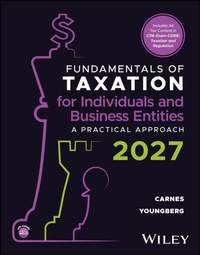
Fundamentals of Taxation for Individuals and Business Entities, with eBook Access Code
A Practical Approach, 2027
4th Edition
Will be published approx. on 16. September 2026
Book
Paperback/Softback
1072 pages
978-1-394-44784-8 (ISBN)
Description
An innovative approach to understanding the federal income tax laws and using them to develop tax-efficient strategies for individuals and businesses
Present the big picture with a practice-based approach to understanding tax laws so students can develop critical thinking and problem-solving skills that prepare them for the real world. Fundamentals of Taxation for Individuals and Business Entities, 2027 Edition introduces a logical foundation for the income tax system so students can understand why a law exists and how to apply the law to practical tax problems. Professional skill-building exercises develop critical thinking and communication skills and the ability to identify and address ethical dilemmas, preparing students to be effective tax professionals.
WILEY ADVANTAGE
Features Professional Skill-Building Exercises that focus on tax-planning skills, analytical skills, research skills, communication skills, and the ability to identify and address ethical dilemmas
Prepares students for their careers and the CPA Exam with Task-Based Simulation Problems that include realistic source documents such as 1099s, W-2s, invoices, and legal agreements that students use to solve problems
Teaches tax planning skills through real-world cases, Spotlight on the Tax Law boxes, and Excel exercises that stimulate critical analysis and evaluation
Creates a realistic environment to teach students how to apply their knowledge that will transfer to job-ready skills with Tax Form and Tax-Return Problems
Includes instructor and student companion sites with an extensive collection of additional resources, such as lesson plans, a Solutions Manual, presentation slides, practice quizzes, downloadable forms, and spreadsheets
AN INTERACTIVE, MULTIMEDIA LEARNING EXPERIENCE
This textbook includes access to an interactive, multimedia e-text. Icons throughout the print book signal corresponding digital content in the e-text.
Videos:Fundamentals of Taxation for Individuals and Business Entities integrates abundant video content development to complement the text and engage readers more deeply.
Content Review Videos provide a detailed review of each learning objective in each chapter and help students learn key concepts and an understanding of tax laws, the big picture, and the Why behind it.
Solutions Walkthrough Videos created by the authors provide step-by-step instruction on how to complete problems like those in the text.
Downloadable Figures and Files: Downloadable Content appears throughout the E-Book, enabling students to see and work with tax forms, legal agreements, and spreadsheets.
Interactive Self-Scoring Quizzes: Concept Check Questions at the end of each section provide immediate feedback, helping readers monitor their understanding and mastery of the material.
Present the big picture with a practice-based approach to understanding tax laws so students can develop critical thinking and problem-solving skills that prepare them for the real world. Fundamentals of Taxation for Individuals and Business Entities, 2027 Edition introduces a logical foundation for the income tax system so students can understand why a law exists and how to apply the law to practical tax problems. Professional skill-building exercises develop critical thinking and communication skills and the ability to identify and address ethical dilemmas, preparing students to be effective tax professionals.
WILEY ADVANTAGE
Features Professional Skill-Building Exercises that focus on tax-planning skills, analytical skills, research skills, communication skills, and the ability to identify and address ethical dilemmas
Prepares students for their careers and the CPA Exam with Task-Based Simulation Problems that include realistic source documents such as 1099s, W-2s, invoices, and legal agreements that students use to solve problems
Teaches tax planning skills through real-world cases, Spotlight on the Tax Law boxes, and Excel exercises that stimulate critical analysis and evaluation
Creates a realistic environment to teach students how to apply their knowledge that will transfer to job-ready skills with Tax Form and Tax-Return Problems
Includes instructor and student companion sites with an extensive collection of additional resources, such as lesson plans, a Solutions Manual, presentation slides, practice quizzes, downloadable forms, and spreadsheets
AN INTERACTIVE, MULTIMEDIA LEARNING EXPERIENCE
This textbook includes access to an interactive, multimedia e-text. Icons throughout the print book signal corresponding digital content in the e-text.
Videos:Fundamentals of Taxation for Individuals and Business Entities integrates abundant video content development to complement the text and engage readers more deeply.
Content Review Videos provide a detailed review of each learning objective in each chapter and help students learn key concepts and an understanding of tax laws, the big picture, and the Why behind it.
Solutions Walkthrough Videos created by the authors provide step-by-step instruction on how to complete problems like those in the text.
Downloadable Figures and Files: Downloadable Content appears throughout the E-Book, enabling students to see and work with tax forms, legal agreements, and spreadsheets.
Interactive Self-Scoring Quizzes: Concept Check Questions at the end of each section provide immediate feedback, helping readers monitor their understanding and mastery of the material.
More details
Edition
4th edition
Language
English
Place of publication
New York
United States
Target group
College/higher education
ISBN-13
978-1-394-44784-8 (9781394447848)
Copyright in bibliographic data and cover images is held by Nielsen Book Services Limited or by the publishers or by their respective licensors: all rights reserved.
Schweitzer Classification
Other editions
Previous edition
Gregory A. Carnes | Suzanne Youngberg
Fundamentals of Taxation for Individuals and Business Entities, with eBook Access Code
A Practical Approach, 2026
Book
09/2025
3rd Edition
Wiley
€179.50
Article exhausted; check for reprint
Persons
GREGORY A. CARNES is the Raburn Eminent Scholar of Accounting at the University of North Alabama. He served as Dean of Sanders College of Business and Technology for 11 years. With a passion for education and taxation, he has dedicated his career to teaching accounting students and guiding them toward successful careers. Specializing in tax, he has taught for over 25 years in CPA review programs and professional tax seminars. In addition to his teaching, he is an accomplished author of tax textbooks and over 30 academic articles.
SUZANNE YOUNGBERG joined the faculty at Northern Illinois University as a full-time member in 2000 and is currently teaching in the accounting graduate and undergraduate programs. Prior to NIU, she worked for five years in the tax department of a medium-sized public accounting firm and then maintained her own tax practice for 30 years specializing in Individual and small business compliance and strategic tax planning. Suzanne received her Bachelor of Science in Accountancy from NIU and her Master of Science in Taxation from DePaul University.
SUZANNE YOUNGBERG joined the faculty at Northern Illinois University as a full-time member in 2000 and is currently teaching in the accounting graduate and undergraduate programs. Prior to NIU, she worked for five years in the tax department of a medium-sized public accounting firm and then maintained her own tax practice for 30 years specializing in Individual and small business compliance and strategic tax planning. Suzanne received her Bachelor of Science in Accountancy from NIU and her Master of Science in Taxation from DePaul University.
Content
DEDICATION III
BRIEF CONTENTS V
LEARNING THE BIG PICTURE OF TAX TO BE A VALUED PROFESSIONAL VI
WHAT ARE OUR STORIES? VII
WHAT MAKES OUR APPROACH TO LEARNING TAX DISTINCTIVE? IX
ASSESSMENT XIII
CONNECTING TO THE PROFESSION XVI
AN INTERACTIVE, MULTIMEDIA LEARNING EXPERIENCE XVIII
PREPARING FOR THE CPA EXAM XIX
FOR INSTRUCTORS XX
ACKNOWLEDGMENTS XXI
TABLE OF CONTENTS XXIII
Part I Introduction to Income Taxation
1 The Professional Practice of Taxation 1-1
1.1 The Basics of Tax Planning 1-4
1.2 Individual Income Tax Formula 1-7
1.3 Tax Compliance vs. Tax Planning 1-15
1.4 Tax Avoidance vs. Tax Evasion 1-27
1.5 Tax Rules vs. GAAP 1-31
1.6 Goals of Tax Policymakers 1-33
1.7 Other Taxes Paid by Individuals 1-38
1.8 Professional Taxation as a Career 1-41
2 Fundamentals of the Federal Income Tax System 2-1
2.1 Taxpayer Activities: Trade or Business, Investment, or Personal Use 2-4
2.2 Classification of Assets 2-10
2.3 Basis 2-14
2.4 Foundations of Income 2-17
2.5 Foundations of Deductions 2-21
2.6 Introduction to Property Transactions 2-24
3 Tax Authority, Research, Compliance Rules, and Professional Responsibilities 3-1
3.1 Sources of Tax Authority 3-5
3.2 Locating and Evaluating Authority 3-17
3.3 Compliance Responsibilities 3-20
3.4 Tax Professional Responsibilities 3-31
3.5 Tax Practice and Procedure 3-36
4 Dependents and Filing Status 4-1
4.1 Dependents-Introduction and Qualifying Child 4-3
4.2 Qualifying Relative and Other Dependency Rules 4-11
4.3 Filing Status-Introduction 4-16
4.4 Head of Household and Qualifying Widow(er) 4-21
4.5 Dependent on Another Return and Kiddie Tax 4-28
4.6 Filing Requirements 4-32
Part II Income
5 Framework for Income Recognition 5-1
5.1 All-Inclusive Approach to Income 5-4
5.2 Judicial Doctrines 5-8
5.3 Accounting Methods and Periods-Income 5-14
5.4 Business Income for Individuals 5-24
5.5 Qualified Business Income Deduction 5-30
6 Income from Personal Activities 6-1
6.1 Income from Prizes, Awards, and Scholarships 6-6
6.2 Taxable Prizes and Awards 6-6
6.3 Exclusion for Awards for Recognition of Civic or Other Achievements 6-7
6.4 Income from Injuries and Other Damage Awards 6-26
6.5 Income from Death of a Taxpayer 6-31
6.6 Forgiveness of Debt 6-35
6.7 Other Inclusions and Exclusions 6-40
7 Income from Services 7-1
7.1 Wages and Tip Income 7-6
7.2 Income from Insurance-Related
7.3 Income from Other Fringe Benefits 7-21
7.4 Stock Options 7-30
7.5 Reimbursement of Employee Business Expenses 7-37
7.6 Retirement Plans 7-39
7.7 Distribution Rules 7-50
7.8 Social Security Benefits 7-57
7.9 Foreign Earned Income 7-60
Part II (Chapters 5-7): Comprehensive Tax Return Problem 7-72
Part III Deductions
8 Framework for Deductions 8-1
8.1 Types of Activities 8-4
8.2 Disallowance of Deductions 8-8
8.3 Types of Deductions 8-13
8.4 Accounting Methods for Deductions 8-16
8.5 Capital Expenditure vs. Repair 8-22
8.6 Accounting for Inventories 8-24
9 Deductions for AGI, Itemized Deductions, and Additional Deductions 9-1
9.1 Deductions for AGI 9-5
9.2 Itemized Deductions: General Rules 9-14
9.3 Medical Expenses 9-17
9.4 Taxes 9-21
9.5 Interest 9-26
9.6 Charitable Contributions 9-31
9.7 Casualty Losses 9-42
9.8 Other Itemized Deductions 9-47
10 Business Expenses 10-1
10.1 Business Expense Requirements 10-4
10.2 Transportation and Travel Expenses 10-8
10.3 Entertainment and Education Expenses 10-14
10.4 Business Interest 10-18
10.5 Bad Debts 10-21
10.6 Net Operating Losses 10-23
10.7 Excess Business Losses 10-29
11 Limitations on Business Losses and Expenses 11-1
11.1 Business Use of a Home 11-4
11.2 Hobby Losses 11-11
11.3 Vacation Homes 11-14
11.4 Basis and At-Risk Limitations 11-23
11.5 Passive Loss Rules 11-25
11.6 Losses from Partnerships and S Corporations 11-34
Part III (Chapters 8-11): Comprehensive Tax Return Problem 11-48
Part IV Taxation of Property Transactions
12 Taxation of Investment Income 12-1
12.1 Interest Income 12-4
12.2 Dividend Income 12-14
12.3 Capital Gains and Losses 12-22
12.4 The 3.8% Net Investment Income Tax 12-37
13 Cost Recovery of Property 13-1
13.1 General MACRS Rules 13-5
13.2 Additional Cost Recovery Rules 13-15
13.3 Amortization 13-27
13.4 Depletion 13-30
14 Taxation of Assets Used in a Trade or Business 14-1
14.1 Distinguishing Section 1231 Assets from Ordinary and Capital Assets 14-4
14.2 Identifying Types of Section 1231 Assets 14-7
14.3 Netting Section 1231 Gains and Losses 14-10
14.4 Section 1245 Depreciation Recapture 14-15
14.5 Section 1250 Depreciation Recapture 14-20
15 Property Transactions: Nonrecognition of Gains and Losses 15-1
15.1 Related-Party Losses 15-4
15.2 Wash Sales 15-9
15.3 Like-Kind Exchanges 15-15
15.4 Involuntary Conversions 15-26
15.5 Loss on Sale of Personal Use Assets 15-32
15.6 Sale of Principal Residence 15-33
Part IV (Chapters 12-15): Comprehensive Tax Return Problem 15-52
Part V Other Individual Topics
16 Personal Tax Credits 16-1
16.1 Introduction to Personal Tax Credits 16-4
16.2 Child Tax Credit 16-7
16.3 Credit for Other Dependents (Family Tax Credit) 16-10
16.4 Child and Dependent Care Credit 16-11
16.5 Earned Income Tax Credit (EITC) 16-18
16.6 Education Credits 16-25
16.7 Other Personal Tax Credits 16-33
17 Alternative Minimum Tax and Other Taxes 17-1
17.1 Alternative Minimum Tax (AMT) 17-4
17.2 Social Security, Medicare, and Self-Employment Taxes 17-17
17.3 Other Taxes 17-24
Part VI CPA Evolution: Core-Tax
18 Business Entity Topics: CPA Exam Core-Taxation and Regulation 18-1
18.1 Corporations: Taxable Income Computation and Special Deductions 18-5
18.2 Other Corporate Tax Issues 18-20
18.3 Business Tax Credits 18-31
18.4 S Corporations 18-42
18.5 Partnerships and Limited Liability Companies 18-63
18.6 Tax-Exempt Organizations 18-73
18.7 State and Local Taxation 18-76
Part VI (Chapter 18): Comprehensive Tax Return Problem 18-109
APPENDIX A Tax Formula Items A-1
APPENDIX B Tax Forms B-1
GLOSSARY G-1
INDEX I-1
BRIEF CONTENTS V
LEARNING THE BIG PICTURE OF TAX TO BE A VALUED PROFESSIONAL VI
WHAT ARE OUR STORIES? VII
WHAT MAKES OUR APPROACH TO LEARNING TAX DISTINCTIVE? IX
ASSESSMENT XIII
CONNECTING TO THE PROFESSION XVI
AN INTERACTIVE, MULTIMEDIA LEARNING EXPERIENCE XVIII
PREPARING FOR THE CPA EXAM XIX
FOR INSTRUCTORS XX
ACKNOWLEDGMENTS XXI
TABLE OF CONTENTS XXIII
Part I Introduction to Income Taxation
1 The Professional Practice of Taxation 1-1
1.1 The Basics of Tax Planning 1-4
1.2 Individual Income Tax Formula 1-7
1.3 Tax Compliance vs. Tax Planning 1-15
1.4 Tax Avoidance vs. Tax Evasion 1-27
1.5 Tax Rules vs. GAAP 1-31
1.6 Goals of Tax Policymakers 1-33
1.7 Other Taxes Paid by Individuals 1-38
1.8 Professional Taxation as a Career 1-41
2 Fundamentals of the Federal Income Tax System 2-1
2.1 Taxpayer Activities: Trade or Business, Investment, or Personal Use 2-4
2.2 Classification of Assets 2-10
2.3 Basis 2-14
2.4 Foundations of Income 2-17
2.5 Foundations of Deductions 2-21
2.6 Introduction to Property Transactions 2-24
3 Tax Authority, Research, Compliance Rules, and Professional Responsibilities 3-1
3.1 Sources of Tax Authority 3-5
3.2 Locating and Evaluating Authority 3-17
3.3 Compliance Responsibilities 3-20
3.4 Tax Professional Responsibilities 3-31
3.5 Tax Practice and Procedure 3-36
4 Dependents and Filing Status 4-1
4.1 Dependents-Introduction and Qualifying Child 4-3
4.2 Qualifying Relative and Other Dependency Rules 4-11
4.3 Filing Status-Introduction 4-16
4.4 Head of Household and Qualifying Widow(er) 4-21
4.5 Dependent on Another Return and Kiddie Tax 4-28
4.6 Filing Requirements 4-32
Part II Income
5 Framework for Income Recognition 5-1
5.1 All-Inclusive Approach to Income 5-4
5.2 Judicial Doctrines 5-8
5.3 Accounting Methods and Periods-Income 5-14
5.4 Business Income for Individuals 5-24
5.5 Qualified Business Income Deduction 5-30
6 Income from Personal Activities 6-1
6.1 Income from Prizes, Awards, and Scholarships 6-6
6.2 Taxable Prizes and Awards 6-6
6.3 Exclusion for Awards for Recognition of Civic or Other Achievements 6-7
6.4 Income from Injuries and Other Damage Awards 6-26
6.5 Income from Death of a Taxpayer 6-31
6.6 Forgiveness of Debt 6-35
6.7 Other Inclusions and Exclusions 6-40
7 Income from Services 7-1
7.1 Wages and Tip Income 7-6
7.2 Income from Insurance-Related
7.3 Income from Other Fringe Benefits 7-21
7.4 Stock Options 7-30
7.5 Reimbursement of Employee Business Expenses 7-37
7.6 Retirement Plans 7-39
7.7 Distribution Rules 7-50
7.8 Social Security Benefits 7-57
7.9 Foreign Earned Income 7-60
Part II (Chapters 5-7): Comprehensive Tax Return Problem 7-72
Part III Deductions
8 Framework for Deductions 8-1
8.1 Types of Activities 8-4
8.2 Disallowance of Deductions 8-8
8.3 Types of Deductions 8-13
8.4 Accounting Methods for Deductions 8-16
8.5 Capital Expenditure vs. Repair 8-22
8.6 Accounting for Inventories 8-24
9 Deductions for AGI, Itemized Deductions, and Additional Deductions 9-1
9.1 Deductions for AGI 9-5
9.2 Itemized Deductions: General Rules 9-14
9.3 Medical Expenses 9-17
9.4 Taxes 9-21
9.5 Interest 9-26
9.6 Charitable Contributions 9-31
9.7 Casualty Losses 9-42
9.8 Other Itemized Deductions 9-47
10 Business Expenses 10-1
10.1 Business Expense Requirements 10-4
10.2 Transportation and Travel Expenses 10-8
10.3 Entertainment and Education Expenses 10-14
10.4 Business Interest 10-18
10.5 Bad Debts 10-21
10.6 Net Operating Losses 10-23
10.7 Excess Business Losses 10-29
11 Limitations on Business Losses and Expenses 11-1
11.1 Business Use of a Home 11-4
11.2 Hobby Losses 11-11
11.3 Vacation Homes 11-14
11.4 Basis and At-Risk Limitations 11-23
11.5 Passive Loss Rules 11-25
11.6 Losses from Partnerships and S Corporations 11-34
Part III (Chapters 8-11): Comprehensive Tax Return Problem 11-48
Part IV Taxation of Property Transactions
12 Taxation of Investment Income 12-1
12.1 Interest Income 12-4
12.2 Dividend Income 12-14
12.3 Capital Gains and Losses 12-22
12.4 The 3.8% Net Investment Income Tax 12-37
13 Cost Recovery of Property 13-1
13.1 General MACRS Rules 13-5
13.2 Additional Cost Recovery Rules 13-15
13.3 Amortization 13-27
13.4 Depletion 13-30
14 Taxation of Assets Used in a Trade or Business 14-1
14.1 Distinguishing Section 1231 Assets from Ordinary and Capital Assets 14-4
14.2 Identifying Types of Section 1231 Assets 14-7
14.3 Netting Section 1231 Gains and Losses 14-10
14.4 Section 1245 Depreciation Recapture 14-15
14.5 Section 1250 Depreciation Recapture 14-20
15 Property Transactions: Nonrecognition of Gains and Losses 15-1
15.1 Related-Party Losses 15-4
15.2 Wash Sales 15-9
15.3 Like-Kind Exchanges 15-15
15.4 Involuntary Conversions 15-26
15.5 Loss on Sale of Personal Use Assets 15-32
15.6 Sale of Principal Residence 15-33
Part IV (Chapters 12-15): Comprehensive Tax Return Problem 15-52
Part V Other Individual Topics
16 Personal Tax Credits 16-1
16.1 Introduction to Personal Tax Credits 16-4
16.2 Child Tax Credit 16-7
16.3 Credit for Other Dependents (Family Tax Credit) 16-10
16.4 Child and Dependent Care Credit 16-11
16.5 Earned Income Tax Credit (EITC) 16-18
16.6 Education Credits 16-25
16.7 Other Personal Tax Credits 16-33
17 Alternative Minimum Tax and Other Taxes 17-1
17.1 Alternative Minimum Tax (AMT) 17-4
17.2 Social Security, Medicare, and Self-Employment Taxes 17-17
17.3 Other Taxes 17-24
Part VI CPA Evolution: Core-Tax
18 Business Entity Topics: CPA Exam Core-Taxation and Regulation 18-1
18.1 Corporations: Taxable Income Computation and Special Deductions 18-5
18.2 Other Corporate Tax Issues 18-20
18.3 Business Tax Credits 18-31
18.4 S Corporations 18-42
18.5 Partnerships and Limited Liability Companies 18-63
18.6 Tax-Exempt Organizations 18-73
18.7 State and Local Taxation 18-76
Part VI (Chapter 18): Comprehensive Tax Return Problem 18-109
APPENDIX A Tax Formula Items A-1
APPENDIX B Tax Forms B-1
GLOSSARY G-1
INDEX I-1