

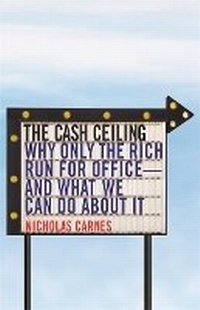
The Cash Ceiling
Why Only the Rich Run for Office--and What We Can Do about It
Published on 11. September 2018
Book
Hardback
344 pages
978-0-691-18200-1 (ISBN)
Description
Why working-class Americans almost never become politicians, what that means for democracy, and what reformers can do about it
Why are Americans governed by the rich? Millionaires make up only three percent of the public but control all three branches of the federal government. How did this happen? What stops lower-income and working-class Americans from becoming politicians? The first book to answer these urgent questions, The Cash Ceiling provides a compelling and comprehensive account of why so few working-class people hold office-and what reformers can do about it.
Using extensive data on candidates, politicians, party leaders, and voters, Nicholas Carnes debunks popular misconceptions (like the idea that workers are unelectable or unqualified to govern), identifies the factors that keep lower-class Americans off the ballot and out of political institutions, and evaluates a variety of reform proposals.
In the United States, Carnes shows, elections have a built-in "cash ceiling," a series of structural barriers that make it almost impossible for the working-class to run for public office. Elections take a serious toll on candidates, many working-class Americans simply can't shoulder the practical burdens, and civic and political leaders often pass them over in favor of white-collar candidates. But these obstacles aren't inevitable. Pilot programs to recruit, train, and support working-class candidates have the potential to increase the economic diversity of our governing institutions and ultimately amplify the voices of ordinary citizens.
Who runs for office goes to the heart of whether we will have a democracy that is representative or not. The Cash Ceiling shows that the best hope for combating the oversized political influence of the rich might simply be to help more working-class Americans become politicians.
Why are Americans governed by the rich? Millionaires make up only three percent of the public but control all three branches of the federal government. How did this happen? What stops lower-income and working-class Americans from becoming politicians? The first book to answer these urgent questions, The Cash Ceiling provides a compelling and comprehensive account of why so few working-class people hold office-and what reformers can do about it.
Using extensive data on candidates, politicians, party leaders, and voters, Nicholas Carnes debunks popular misconceptions (like the idea that workers are unelectable or unqualified to govern), identifies the factors that keep lower-class Americans off the ballot and out of political institutions, and evaluates a variety of reform proposals.
In the United States, Carnes shows, elections have a built-in "cash ceiling," a series of structural barriers that make it almost impossible for the working-class to run for public office. Elections take a serious toll on candidates, many working-class Americans simply can't shoulder the practical burdens, and civic and political leaders often pass them over in favor of white-collar candidates. But these obstacles aren't inevitable. Pilot programs to recruit, train, and support working-class candidates have the potential to increase the economic diversity of our governing institutions and ultimately amplify the voices of ordinary citizens.
Who runs for office goes to the heart of whether we will have a democracy that is representative or not. The Cash Ceiling shows that the best hope for combating the oversized political influence of the rich might simply be to help more working-class Americans become politicians.
Reviews / Votes
"[A] detailed but very accessible study. . . . Carnes deserves credit for focusing attention on an under-the-radar issue." * Publishers Weekly * "The Cash Ceiling is convincing thanks to its well-written arguments, easy-to-understand graphs and data, and moving anecdotes. . . . The tone is always passionate and persuasive. . . . The text expertly analyzes every aspect of the issue at hand, asking why working-class Americans do not run for office in the first place, why they do not get recruited, and so on."---Mya Alexice, Foreword Reviews "This is a great book for political science students (graduate and undergraduate) who are just learning about the system, rather than attempting to engage with it." * Pennsylvania Literary Journal * "Innovative, clearly written, and carefully researched. - William W. Franko, Political Science Quarterly"More details
Series
Language
English
Place of publication
New Jersey
United States
Target group
College/higher education
Professional and scholarly
Product notice
Trade binding
Illustrations
43 b/w illus. 15 tables.
Dimensions
Height: 235 mm
Width: 155 mm
ISBN-13
978-0-691-18200-1 (9780691182001)
Copyright in bibliographic data and cover images is held by Nielsen Book Services Limited or by the publishers or by their respective licensors: all rights reserved.
Schweitzer Classification
Other editions
Additional editions
E-Book
09/2018
1st Edition
Princeton University Press
€24.49
Available for download
Person
Nicholas Carnes is the Creed C. Black Associate Professor of Public Policy and Political Science at Duke University's Sanford School of Public Policy. He is the author of White-Collar Government: The Hidden Role of Class in Economic Policy Making. He lives in Durham, North Carolina.