

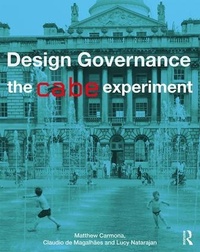
Design Governance
The CABE Experiment
1st Edition
Will be published approx. on 8. March 2017
Book
Paperback/Softback
280 pages
978-1-138-81215-4 (ISBN)
Description
Design Governance focuses on how we design the built environment where most of us live, work, and play and the role of government in that process. To do so, it draws on the experience of the Commission for Architecture and the Built Environment (CABE), a decade-long, globally unique experiment in the governance of design. This book theorises design governance as an arm and aspiration of the state; tells the story of CABE, warts and all, and what came before and after; unpacks CABE's 'informal' toolbox: its methods and processes of design governance; and reflects on the effectiveness and legitimacy of design as a tool of modern-day government. The result is a new set of concepts through which to understand the governance of design as a distinct and important sub-field of urban design.
More details
Language
English
Place of publication
London
United Kingdom
Publishing group
Taylor & Francis Ltd
Target group
Professional and scholarly
Professional, Professional Practice & Development, and Undergraduate
Product notice
Paperback (trade)
Unsewn / adhesive bound
Illustrations
17 farbige Tabellen, 98 Farbfotos bzw. farbige Rasterbilder, 57 farbige Zeichnungen
17 Tables, color; 57 Line drawings, color; 98 Halftones, color
Dimensions
Height: 274 mm
Width: 218 mm
Thickness: 30 mm
Weight
1996 gr
ISBN-13
978-1-138-81215-4 (9781138812154)
Copyright in bibliographic data and cover images is held by Nielsen Book Services Limited or by the publishers or by their respective licensors: all rights reserved.
Schweitzer Classification
Other editions
Additional editions
Book
02/2017
1st Edition
Routledge
€282.25
Shipment within 10-20 days
E-Book
12/2016
Routledge
€94.99
Available for download
E-Book
12/2016
Routledge
€94.99
Available for download
Persons
Matthew Carmona is a Professor of Planning and Urban Design at University College London's (UCL) Bartlett School of Planning, UK. His research has concentrated on urban design, processes of design governance, and the design and management of public space. He is an architect, planner and chair of the Place Alliance.
Claudio de Magalhaes is a Reader of Urban Regeneration and Management at UCL's Bartlett School of Planning, UK. His interests have been in planning and the governance of the built environment, the provision and governance of public space, property development processes, and urban regeneration policy.
Lucy Natarajan is an experienced researcher at UCL's Bartlett School of Planning, UK, where she did her PhD. Her core areas of concern are urban policy, knowledge in decision-making, public participation, spatial strategy, and new technologies of governing. She is an experienced facilitator with a track record of managing collaborative work.
Claudio de Magalhaes is a Reader of Urban Regeneration and Management at UCL's Bartlett School of Planning, UK. His interests have been in planning and the governance of the built environment, the provision and governance of public space, property development processes, and urban regeneration policy.
Lucy Natarajan is an experienced researcher at UCL's Bartlett School of Planning, UK, where she did her PhD. Her core areas of concern are urban policy, knowledge in decision-making, public participation, spatial strategy, and new technologies of governing. She is an experienced facilitator with a track record of managing collaborative work.
Content
A personal acknowledgement
FOREWORD: Exploring design governance
PART ONE: THE GOVERNANCE OF DESIGN
Chapter 1. Design governance (why, what and how - in theory)
Chapter 2. The tools of design governance (formal and informal)
PART TWO: NATIONAL DESIGN GOVERANCE IN ENGLAND
Chapter 3. The RFAC and 75 years of English design review, 1924-1999
Chapter 4. CABE, a story of innovation in the governance of design, 1999 to 2011
Chapter 5. Design governance in an age of austerity, 2011-2016
PART THREE: THE CABE TOOLBOX
Chapter 6. The evidence tools
Chapter 7. The knowledge tools
Chapter 8. The promotion tools
Chapter 9. The evaluation tools
Chapter 10. The assistance tools
AFTERWORD: The impact and legitimacy of design governance
Appendix. Research methods
FOREWORD: Exploring design governance
PART ONE: THE GOVERNANCE OF DESIGN
Chapter 1. Design governance (why, what and how - in theory)
Chapter 2. The tools of design governance (formal and informal)
PART TWO: NATIONAL DESIGN GOVERANCE IN ENGLAND
Chapter 3. The RFAC and 75 years of English design review, 1924-1999
Chapter 4. CABE, a story of innovation in the governance of design, 1999 to 2011
Chapter 5. Design governance in an age of austerity, 2011-2016
PART THREE: THE CABE TOOLBOX
Chapter 6. The evidence tools
Chapter 7. The knowledge tools
Chapter 8. The promotion tools
Chapter 9. The evaluation tools
Chapter 10. The assistance tools
AFTERWORD: The impact and legitimacy of design governance
Appendix. Research methods