

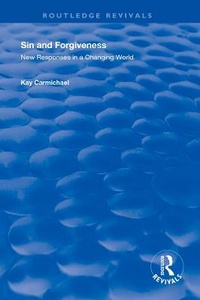
Sin and Forgiveness
New Responses in a Changing World
1st Edition
Published on 28. November 2019
Book
Hardback
188 pages
978-1-138-71565-3 (ISBN)
Description
Originally published in 2003. Western attitudes to crime were in the past rooted in concepts of sin, and therefore of hopes for redemption and forgiveness. So what happens - to offenders and society as a whole - in a world where people no longer talk of sin but of evil. If hopes of redemption go too, will revenge take the place of forgiveness? Kay Carmichael explores these dilemmas in this topical and provocative book. She traces the stories of Myra Hindley, Mary Bell, Sarah Payne, James Bulger and his killers, comparing public responses to such crimes in various Western countries. Art and literature are examined for the light they throw on the evolution of our ideas about sin and forgiveness - from Rembrandt to Nathaniel Hawthorne, Samuel Becket, Dali and writings inspired by the Holocaust. Turning to our own day, Carmichael discusses the emergence of structural sins or 'iniquities' in which we may all find ourselves involved: poverty, slavery, violence and war are her themes. Her analysis leaves her sceptical about many contemporary appeals for forgiveness, but hopeful about ideas of restorative justice.
Reviews / Votes
'This is a guide for the perplexed, a map through the moral maze of a world full of conflicts, some with the capacity to destroy worthwhile life on earth. At a time when terrible atrocities and barbaric acts are still committed across the globe in the name of religion, race, language, and nationalism, this wise and humane work explores how the practical application of the concepts of sin and forgiveness, as understood in the Judaeo-Christian tradition, are expressed in a secular society. Drawing upon a lifetime's practical experience, and the insights of psychology, literature, philosophy, science, this powerful book challenges our collective and personal responsibility to construct humane and peaceful moral processes. This is a timely antidote against ethical aimlessness. It is a work that needs to be read widely and considered deeply.' Lord Anthony Lester QC 'A profound and important book. In this compulsively readable and passionately argued book, Kay Carmichael has helped us to forge a new ethic for a confused world.' Richard Holloway, former Primus of the Scottish Episcopal Church 'In this challenging book Kay Carmichael makes use of the rich experience of her personal and professional life to raise important questions about the conditions in which forgiveness may be appropriate in a post-traditional society. She concludes that moral principles are created as a result of people working together collectively rather than as individuals. In the public arena it is much less important to focus on the issue of personal forgiveness and much more helpful to deal with justice, especially a justice which is based on restoration rather than on retribution. This is a book which is much needed in the uncertain world in which we now live.' Baroness Vivien Stern CBE, Senior Research Fellow, International Centre for Prison Studies, London, UK '... racily written, and relevant at every turn...' Quakers in Criminal Justice Newsletter '... there is much in this well-writtMore details
Series
Language
English
Place of publication
London
United Kingdom
Publishing group
Taylor & Francis Ltd
Target group
College/higher education
Dimensions
Height: 234 mm
Width: 156 mm
Weight
510 gr
ISBN-13
978-1-138-71565-3 (9781138715653)
Copyright in bibliographic data and cover images is held by Nielsen Book Services Limited or by the publishers or by their respective licensors: all rights reserved.
Schweitzer Classification
Other editions
Additional editions
Book
11/2003
Ashgate Publishing Limited
€44.75
Article exhausted; check different version
Person
Kay Carmichael
Content
Introduction; Narratives of a modern dilemma; Responses to sin and forgiveness in art and literature; The move to a contemporary view of sin; Contemporary perspectives on forgiveness; The persistence and intensification of structural sin; How do we live together? Final conclusions.