

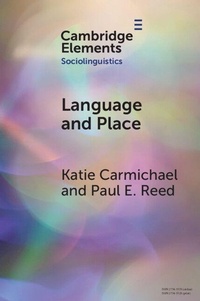
Language and Place
Published on 20. February 2025
Book
Paperback/Softback
114 pages
978-1-009-38086-7 (ISBN)
Description
Place has been central to sociolinguistic research from the beginning. How speakers conceptualize and orient to place can influence linguistic productions. Additionally, places can and do have myriad meanings - some strongly contested. Further, place is not static, as people move and the ideologies regarding certain places evolve over time. This Element probes these themes. It begins by reviewing the existing work on language and place within sociolinguistics according to key themes in the literature - place orientation, gentrification, globalization, and commodification, amongst others. Then it introduces key concepts and frameworks for studying place within allied fields such as geography, sociology, architecture, and psychology. Each author then presents a case study of language and place within their respective field sites: rural Appalachia and Greater New Orleans. The authors end by identifying areas for future development of place theory within sociolinguistics. This title is also available as Open Access on Cambridge Core.
More details
Series
Language
English
Place of publication
Cambridge
United Kingdom
Product notice
Paperback (trade)
Illustrations
Worked examples or Exercises
Dimensions
Height: 229 mm
Width: 152 mm
Thickness: 7 mm
Weight
178 gr
ISBN-13
978-1-009-38086-7 (9781009380867)
Copyright in bibliographic data and cover images is held by Nielsen Book Services Limited or by the publishers or by their respective licensors: all rights reserved.
Schweitzer Classification
Other editions
Additional editions
Katie Carmichael | Paul E. Reed
Language and Place
Book
02/2025
Cambridge University Press
€75.30
Shipment within 15-20 days
Persons
Content
1. Introduction; 2. How we got here; 3. Place in sociolinguistics; 4. Place in allied fields; 5. The view from the periphery: agency, authenticity, and place orientation in post-Katrina greater New Orleans; 6. The evocation of a stigmatized place: Hollering the Holler; 7. Urban or rural, rooted or unrooted, what's local is local: summarizing case study themes; 8. Conclusions and future directions; References.