

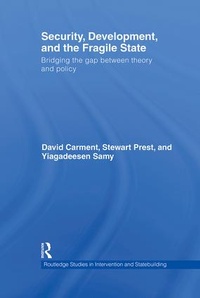
Security, Development and the Fragile State
Bridging the Gap between Theory and Policy
1st Edition
Published on 22. July 2009
Book
Hardback
290 pages
978-0-415-48083-3 (ISBN)
Description
This book provides theoretical clarity about the concepts of failed and fragile states, which have emerged strongly since the 9/11 attacks.
Recent contributions often see the fragile state as either a problem of development or of security. This volume argues that that neither perspective on its own is a sufficient basis for good policy. In a wide-ranging treatment, drawing on large samples as well as case studies, the authors create an alternative model of the fragile state emphasizing the multidimensional, multifaceted nature of the "fragile state problematique". On the basis of their model and empirical evidence, they then derive a number of policy-relevant insights regarding the need for contextualized and ongoing country analysis, the perils and pitfalls of unstructured development assistance, and the need to move whole-of-government approaches from the realm of rhetoric to reality. In offering both a synthesis of existing research and an innovative approach to understanding the fragile state, this volume will be of great interest to students of war and conflict studies, risk, conflict management, and international relations in general. It will also be of use to practitioners in policy circles and to NGOs.
Recent contributions often see the fragile state as either a problem of development or of security. This volume argues that that neither perspective on its own is a sufficient basis for good policy. In a wide-ranging treatment, drawing on large samples as well as case studies, the authors create an alternative model of the fragile state emphasizing the multidimensional, multifaceted nature of the "fragile state problematique". On the basis of their model and empirical evidence, they then derive a number of policy-relevant insights regarding the need for contextualized and ongoing country analysis, the perils and pitfalls of unstructured development assistance, and the need to move whole-of-government approaches from the realm of rhetoric to reality. In offering both a synthesis of existing research and an innovative approach to understanding the fragile state, this volume will be of great interest to students of war and conflict studies, risk, conflict management, and international relations in general. It will also be of use to practitioners in policy circles and to NGOs.
More details
Series
Language
English
Place of publication
London
United Kingdom
Publishing group
Taylor & Francis Ltd
Target group
College/higher education
Product notice
Paper over boards
Illustrations
36 s/w Zeichnungen, 36 s/w Tabellen
36 Tables, black and white; 36 Line drawings, black and white
Dimensions
Height: 234 mm
Width: 156 mm
Weight
720 gr
ISBN-13
978-0-415-48083-3 (9780415480833)
Copyright in bibliographic data and cover images is held by Nielsen Book Services Limited or by the publishers or by their respective licensors: all rights reserved.
Schweitzer Classification
Other editions
Additional editions
David Carment | Stewart Prest | Yiagadeesen Samy
Security, Development and the Fragile State
Bridging the Gap between Theory and Policy
Book
02/2011
1st Edition
Routledge
€71.80
Shipment within 15-20 days
David Carment | Stewart Prest | Yiagadeesen Samy
Security, Development and the Fragile State
Bridging the Gap between Theory and Policy
E-Book
09/2009
Routledge
€64.49
Available for download
David Carment | Stewart Prest | Yiagadeesen Samy
Security, Development and the Fragile State
Bridging the Gap between Theory and Policy
E-Book
09/2009
Routledge
€64.49
Available for download
Persons
David Carment is Professor of International Affairs at the Norman Paterson School of International Affairs, Carleton University, Canada, and Fellow of the Canadian Defence and Foreign Affairs Institute (CDFAI). His book publications include Who Intervenes? Ethnic Conflict and Interstate Crises (2006) and Peacekeeping Intelligence (2006, Routledge). Stewart Prest is a PhD student in the department of political science at the University of British Columbia, Canada. Yiagadeesen Samy is Associate Professor of International Affairs at the Norman Paterson School of International Affairs, Carleton University, Canada.
Content
1: Introduction 2: Policy Analysis: Contending and Complementary Approaches 3: A Fragile States Framework 4: The Determinants and Consequences of State Fragility: An Empirical Assessment 5: Assessing Policy Inputs: Aid Allocation and Effectiveness in Fragile States Environments 6: Profiles of Fragility for Effective Risk Analysis and Monitoring 7: Fragility Relevance and Impact Assessment