


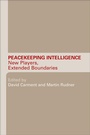
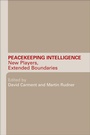
Peacekeeping Intelligence
New Players, Extended Boundaries
Will be published approx. on 27. April 2006
Book
Hardback
246 pages
978-0-415-37489-7 (ISBN)
Description
This is a new evaluation of the role, dynamics and challenges of intelligence in peacekeeping activities and its place in a much wider social, economic and political context.
It assesses the role of coalition forces, law enforcement agencies, development institutions, and non-governmental organisations who have become partners in peace support activities.
Peacekeeping Intelligence (PKI) is a new form of intelligence stressing predominantly open sources of information used to create Open Source Intelligence (OSINT), and that demands multi-lateral sharing of intelligence at all levels. Unlike national intelligence, which emphasizes spies, satellites, and secrecy, PKI brings together many aspects of intelligence gathering including the media and NGOs. It seeks to establish standards in open source collection, analysis, security, counterintelligence and training and produces unclassified intelligence useful to the public. The challenges facing peacekeeping intelligence are increasingly entwined with questions of arms control, commercial interests, international crime, and ethnic conflict.
This book will be of great interest to all students and scholars of military and security studies, intelligence and peacekeeping.
It assesses the role of coalition forces, law enforcement agencies, development institutions, and non-governmental organisations who have become partners in peace support activities.
Peacekeeping Intelligence (PKI) is a new form of intelligence stressing predominantly open sources of information used to create Open Source Intelligence (OSINT), and that demands multi-lateral sharing of intelligence at all levels. Unlike national intelligence, which emphasizes spies, satellites, and secrecy, PKI brings together many aspects of intelligence gathering including the media and NGOs. It seeks to establish standards in open source collection, analysis, security, counterintelligence and training and produces unclassified intelligence useful to the public. The challenges facing peacekeeping intelligence are increasingly entwined with questions of arms control, commercial interests, international crime, and ethnic conflict.
This book will be of great interest to all students and scholars of military and security studies, intelligence and peacekeeping.
More details
Series
Language
English
Place of publication
London
United Kingdom
Publishing group
Taylor & Francis Ltd
Target group
College/higher education
Professional and scholarly
Illustrations
1 s/w Photographie bzw. Rasterbild, 8 s/w Zeichnungen
8 Line drawings, black and white; 1 Halftones, black and white
Dimensions
Height: 240 mm
Width: 161 mm
Thickness: 18 mm
Weight
537 gr
ISBN-13
978-0-415-37489-7 (9780415374897)
Copyright in bibliographic data and cover images is held by Nielsen Book Services Limited or by the publishers or by their respective licensors: all rights reserved.
Schweitzer Classification
Other editions
Additional editions

Book
01/2009
1st Edition
Routledge
€83.60
Shipment within 15-20 days
E-Book
01/2007
Routledge
€77.99
Available for download
E-Book
01/2007
Routledge
€77.99
Available for download
Persons
Director, Centre for Security and Defence Studies, Norman Paterson School of International Affairs, Carleton University, Canada
Content
1. Introduction: Peacekeeping Intelligence: New Players and Extended Boundaries Part I. Peacekeeping and its Intelligence Requirements 2. Beyond the Next Bound: The Future of Military Intelligence in Peace Support Operations 3. A Reading Of Tea Leaves - Toward a Framework for Modern PKI 4. SIGINT And Peacekeeping: The Untapped Intelligence Resource 5. C4ISR and Peacekeeping Part II. Evolution of Intelligence in Multinational Peacekeeping Missions 6. Intelligence at UN Headquarters? The Information and Research (I&R) Unit and the Intervention in Eastern Zaire (1996) 7. International Anarchy and Coalition Interoperability in High Tech Environments 8. Peacekeeping Intelligence and Civil Society: Is CIMIC the missing link? Part III. New Elements of Intelligence Analysis 9. Field Research on Small Arms and Its Importance for Peace Operations: A Practitioner's View 10. Peacekeeping Intelligence for the Stakeholders: An Underutilized Open Source Resource 11. Just Peacekeeping: Managing the Relationship between Peacekeeping Intelligence and the Prevention and Punishment of International Crimes 12. Ethical Issues: Peacekeeping and Intelligence 13. Enabling Intelligence in Peacekeeping: Laying the Groundwork for Effective Education and Training 14. A Bridge too Far?: The Theory and Practice of the Effects-Based Concept and the Multinational Inter-Agency Role