

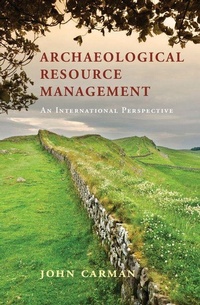
Archaeological Resource Management
An International Perspective
Published on 9. September 2015
Book
Hardback
256 pages
978-0-521-84168-9 (ISBN)
Description
Archaeological resource management (ARM) is the practice of recording, evaluating, preserving for future research and presenting to the public the material remains of the past. Almost all countries uphold a set of principles and laws for the preservation and professional management of archaeological remains. This book offers a critical and comparative perspective on the law and professional practices of managing archaeological remains. Beginning with a global history of ARM, John Carman provides an overview of legal and professional regulations governing ARM today. He then turns to consider the main practices involved in managing archaeological remains, namely, their identification and recording, their evaluation for 'significance', their preservation and their presentation to the public. As a whole, the book offers an overview of what ARM 'does' in the world, with implications for understanding the role of archaeology as a contemporary set of practices that determine how future generations will access material remains of the past.
Reviews / Votes
'Archaeological Resource Management is the big success story of recent decades, relevant in every corner of the globe from America to Zanzibar. This first-rate volume explores current theory and practice in an accessible way with refreshingly clear insights into the history, structure and working of modern archaeology.' Timothy Darvill, Bournemouth University 'John Carman skilfully guides us through a panorama of archaeological resource management, and when we reach its exit, we will have gained a clearer grasp of and objectives for our everyday archaeological practice, that has to be more concerned with its social, cultural, economic, political and regal implications than ever before. A must-read not only for archaeological resource management specialists but also for anyone who is interested in the implications of archaeology as a social practice.' Koji Mizoguchi, Kyushu University 'This is a most useful and comprehensive overview of what constitutes the field of archaeological heritage in its totality, and as such it is unparalleled. As most archaeologists today are being employed within the heritage field, a book of this kind will appeal to a wide audience.' Kristian Kristiansen, University of GothenburgMore details
Language
English
Place of publication
Cambridge
United Kingdom
Target group
College/higher education
Professional and scholarly
Illustrations
18 Tables, unspecified
Dimensions
Height: 235 mm
Width: 157 mm
Thickness: 18 mm
Weight
526 gr
ISBN-13
978-0-521-84168-9 (9780521841689)
Copyright in bibliographic data and cover images is held by Nielsen Book Services Limited or by the publishers or by their respective licensors: all rights reserved.
Schweitzer Classification
Other editions
Additional editions
Book
09/2015
Cambridge University Press
€48.90
Shipment within 15-20 days
E-Book
09/2015
Cambridge University Press
€24.49
Available for download
E-Book
08/2015
Cambridge University Press
€29.49
Available for download
Person
John Carman is Senior Lecturer in Heritage Valuation at Ironbridge International Institute for Cultural Heritage at the University of Birmingham. His authored works in the field of archaeological resource management include Valuing Ancient Things: Archaeology and Law (1996), Archaeology and Heritage (2002) and Against Cultural Property (2005). He has co-authored Archaeological Practice in Great Britain (2011) and co-edited Managing Archaeology (1995), World Heritage: Global Challenges, Local Solutions (2007), Heritage Studies: Methods and Approaches (2009) and The Oxford Handbook of Public Archaeology (2012).
Content
Part I. History and Principles: 1. Historical antecedents to archaeological resource management; 2. The development of current structures; 3. Systems of regulation; Part II. Practices: 4. Inventory; 5. Evaluation; 6. Preservation; 7. Presentation; Part III. Conclusions: 8. Archaeology in the world.