

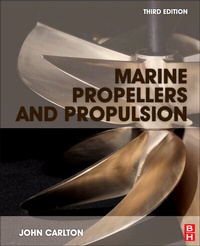
Marine Propellers and Propulsion
3rd Edition
Published on 20. September 2012
Book
Hardback
544 pages
978-0-08-097123-0 (ISBN)
Description
Propulsion technology is a complex, multidisciplinary topic with design, construction, operational and research implications. Bringing together a wealth of disparate information from the field, Marine Propellers and Propulsion provides comprehensive and cutting edge coverage to equip marine engineers, naval architects and anyone involved in propulsion and hydrodynamics with the knowledge needed to do the job.
Drawing on experience from a long and varied career in consultancy, research, design and technical investigation, author John Carlton breaks the subject into three main sections - hydrodynamic theory, materials and mechanical considerations, and design, operation and performance. Connecting essential theory to practical problems in design, analysis and operational efficiency, Marine Propellers and Propulsion is an invaluable resource, packed with hard-won insights, detailed specifications and data.
Drawing on experience from a long and varied career in consultancy, research, design and technical investigation, author John Carlton breaks the subject into three main sections - hydrodynamic theory, materials and mechanical considerations, and design, operation and performance. Connecting essential theory to practical problems in design, analysis and operational efficiency, Marine Propellers and Propulsion is an invaluable resource, packed with hard-won insights, detailed specifications and data.
Reviews / Votes
"The third edition of this text/reference for marine engineers, naval architects, and students studying propulsion and hydrodynamics is updated to cover the latest theory, best practices, legislation, and industry standards since 2007. There is new material on the physics of cavitation development and collapse, erosive effects on propeller materials, and the effects of shipping activity on the behavior of marine mammals." --Reference and Research Book News, December 2013More details
Edition
3rd edition
Language
English
Place of publication
Oxford
United Kingdom
Publishing group
Elsevier Science & Technology
Target group
Professional and scholarly
Practicing marine engineers and naval architects; Marine engineering students on propulsion & hydrodynamics courses; Academic/corporate libraries
Illustrations
Approx. 350 illustrations
Dimensions
Height: 219 mm
Width: 276 mm
Weight
1560 gr
ISBN-13
978-0-08-097123-0 (9780080971230)
Copyright in bibliographic data and cover images is held by Nielsen Book Services Limited or by the publishers or by their respective licensors: all rights reserved.
Schweitzer Classification
Other editions
New editions
John Carlton
Marine Propellers and Propulsion
Book
12/2018
4th Edition
Butterworth-Heinemann
€171.13
Shipment within 15-20 days
Additional editions
John Carlton
Marine Propellers and Propulsion
Book
11/2018
3rd Edition
Butterworth-Heinemann
€123.99
The article will not be published
John Carlton
Marine Propellers and Propulsion
E-Book
01/2012
3rd Edition
Elsevier
€124.00
Available for download
Previous edition
John Carlton
Marine Propellers and Propulsion
Book
06/2007
2nd Edition
Butterworth-Heinemann
€186.01
Article exhausted; check for reprint
Person
John Carlton is a Fellow of the Royal Academy of Engineering and Professor of Marine Engineering at City University, London. He recently served as the 109th President of the IMarEST and was formerly Global Head of Marine Technology and Investigations at Lloyd's Register. Over a long and distinguished career he has authored more than a hundred technical papers and articles on marine technology, received numerous awards, chaired international committees and contributed to various government and naval initiatives on maritime matters.
Content
1. The early development of the screw propeller
2. Propulsion systems
3. Propeller geometry
4. The propeller environment
5. The wake field
6. Propeller performance characteristics
7. Theoretical methods - basic concepts
8. Theoretical methods - propeller theories
9. Cavitation
10. Propeller noise
11. Propeller-ship interaction
12. Ship resistance and propulsion
13. Thrust augmentation devices
14. Transverse thrusters
15. Azimuthing and podded propulsors
16. Waterjet propulsion
17. Full-scale trials
18. Propeller materials
19. Propeller blade strength
20. Propeller manufacture
21. Propeller blade vibration
22. Propeller design
23. Operational problems
24. Service performance and analysis
25. Propeller tolerances and inspection
26. Propeller maintenance and repair
2. Propulsion systems
3. Propeller geometry
4. The propeller environment
5. The wake field
6. Propeller performance characteristics
7. Theoretical methods - basic concepts
8. Theoretical methods - propeller theories
9. Cavitation
10. Propeller noise
11. Propeller-ship interaction
12. Ship resistance and propulsion
13. Thrust augmentation devices
14. Transverse thrusters
15. Azimuthing and podded propulsors
16. Waterjet propulsion
17. Full-scale trials
18. Propeller materials
19. Propeller blade strength
20. Propeller manufacture
21. Propeller blade vibration
22. Propeller design
23. Operational problems
24. Service performance and analysis
25. Propeller tolerances and inspection
26. Propeller maintenance and repair