

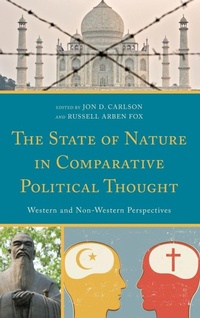
The State of Nature in Comparative Political Thought
Western and Non-Western Perspectives
Published on 11. November 2013
Book
Hardback
328 pages
978-0-7391-6763-2 (ISBN)
Description
This book addresses a fundamental concept in political thought-the "state of nature"-through a comparative and cross-cultural approach. Western social contract thinking usually falls along lines identified with scholars like Hobbes or Rousseau, with accordant debate over whether humans are good, bad, or just selfish; conflict prone or cooperative; egocentric or altruistic; with subordinate discussions about the proper limits of sovereign authority. Depending on how one views the "natural" condition of human beings and the communities which they build, various questions arise. What constitutes a "good" or natural political order? What is the best basis for understanding the "nature" of sovereignty or political legitimacy, and what is its future? In an age of increased global interaction and potential cultural, civilization-based, misunderstanding, this volume takes the Hobbesian rhetorical device of a pre-social contract "state of nature" and seeks to address this concept-and thereby, many of the aforementioned questions-in light of contributions from non-Western thinkers. In our globalizing age when cultures and peoples increasingly talk and interact, it is not viable to use only Western political thinkers to address allegedly universal concepts. So we overtly seek to break open the frame of reference for any future discussion of the "state of nature."
This volume adds to the emerging body of work grouped under the heading "comparative political thought" and serves as a model for how key political concepts may be addressed in a comparative and cross-civilizational manner. Chapters engage Chinese, Indic, Polynesian, Jewish, Babylonian, and Islamic interpretations of this fundamental question of politics. In addressing competing interpretations of the state of nature, the exclusionary hegemonic aspects of the Western canon may be both exposed and potentially reconciled with alternative visions of political behavior, legitimacy, justice, rights, and "appropriate" social and political behavior.
This volume adds to the emerging body of work grouped under the heading "comparative political thought" and serves as a model for how key political concepts may be addressed in a comparative and cross-civilizational manner. Chapters engage Chinese, Indic, Polynesian, Jewish, Babylonian, and Islamic interpretations of this fundamental question of politics. In addressing competing interpretations of the state of nature, the exclusionary hegemonic aspects of the Western canon may be both exposed and potentially reconciled with alternative visions of political behavior, legitimacy, justice, rights, and "appropriate" social and political behavior.
Reviews / Votes
In this collection there are some fine individual essays which have important lessons for comparative political thought . . . so too does the volume as a whole. * History of Political Thought * This book draws together an admirably extensive range of contributors to broaden and complicate the 'state of nature,' a concept which plays a pivotal role in Euro-American political theory. Chapters attempt to move beyond simplistic East versus West comparisons, to consider deeper questions in culturally diverse settings about the relationship of politics to conceptions of nature, society, and religion. The arguments in this book are sure to be controversial, but they draw much-needed attention to important political ideas from a diverse set of places and times. -- Leigh Jenco, London School of Economics and Political Science This excellent, timely, and erudite collection of essays successfully demonstrates the significance and necessity of adopting a comparative perspective in western political theory. Thematic focus of the volume, on notions of the natural condition of mankind across cultures and civilizations, presents compelling reasons for political theorists and social scientists alike to revisit, re-contextualize, and renew existing understandings of the political. -- Hassan Bashir, Texas A&M University at QatarMore details
Series
Language
English
Place of publication
United States
Publishing group
Bloomsbury Publishing Plc
Target group
Professional and scholarly
Dimensions
Height: 235 mm
Width: 157 mm
Thickness: 22 mm
Weight
647 gr
ISBN-13
978-0-7391-6763-2 (9780739167632)
Copyright in bibliographic data and cover images is held by Nielsen Book Services Limited or by the publishers or by their respective licensors: all rights reserved.
Schweitzer Classification
Persons
Jon D. Carlson is a lecturer in social sciences, humanities, and arts at the University of California, Merced. His recent works include Myths, State Expansion and the Birth of Globalization and a co-edited volume Maritime Piracy and the Construction of Global Governance.
Russell Arben Fox is professor of political science and director of the Political Science Program at Friends University.
Russell Arben Fox is professor of political science and director of the Political Science Program at Friends University.
Content
Introduction: Comparative States of Nature
Russell Arben Fox
Part One: The State of Nature and Applications in Chinese Thought
Chapter 1. Self-Transformation and Civil Society: Lockean vs. Confucian
Sungmoon Kim, City University of Hong Kong
Chapter 2. Han Feizi's Philosophical Psychology: Human Nature, Scarcity, and the
NeoDarwinian Consensus
Owen Flanagan and Jing Hu, Duke University
Chapter 3. The Confucian Tradition, Nature, and Civil Education
Russell Arben Fox, Friends University
Chapter 4. States of Nature: Counter-Confucianism and the Daoist Encounter with Liberalism
Eric Goodfield, American University, Beirut
Chapter 5. Mozi, Hobbes, Locke and the State of Nature
Al Martinich and Siwing Tsoi, University of Texas
Chapter 6. Chinese Sage Kings and the Hobbesian State of Nature: Bridging Comparative
Political Thought and International Relations Theory
Jon D. Carlson, University of California, Merced
Part Two: The State of Nature in Islam, India and Beyond
Chapter 7. States of Nature and Islands of Politics: Animality, Death, Colonialism
Murad Idris, Penn University, Cornell University
Chapter 8. Ibn Khaldoun: Writing from the Margin-'The State of Nature'-To Remain There.
Magid Shihade, Birzeit University
Chapter 9. The State of Nature and Domesticated Differences in Ancient Indian Political
Thought: A Historical-Comparative Approach
Stuart Gray, University of California, Santa Barbara, Johns Hopkins University
Chapter 10. On Matsyanyaya: The State of Nature in Indian Thought (from Asian Philosophy)
David Slakter, University of Central Oklahoma
Chapter 11. I'd Rather Just Devolve, Thank You: Enkidu, Gilgamesh, and an Ambiguous State
of Nature
Stefan Dolgert, Brock University
Chapter 12. The Problem of the State of Nature in Medieval Jewish Political Philosophy
Abraham Melamed, University of Haifa
Chapter 13. The Nature of the State without the State of Nature: Micronesia and Polynesia
Michael Stoil, University of Guam
Conclusion. States of Nature: Consilience, Syncretism, and Challenges for Comparative Political Thought
Jon D. Carlson, University of California, Merced
Russell Arben Fox
Part One: The State of Nature and Applications in Chinese Thought
Chapter 1. Self-Transformation and Civil Society: Lockean vs. Confucian
Sungmoon Kim, City University of Hong Kong
Chapter 2. Han Feizi's Philosophical Psychology: Human Nature, Scarcity, and the
NeoDarwinian Consensus
Owen Flanagan and Jing Hu, Duke University
Chapter 3. The Confucian Tradition, Nature, and Civil Education
Russell Arben Fox, Friends University
Chapter 4. States of Nature: Counter-Confucianism and the Daoist Encounter with Liberalism
Eric Goodfield, American University, Beirut
Chapter 5. Mozi, Hobbes, Locke and the State of Nature
Al Martinich and Siwing Tsoi, University of Texas
Chapter 6. Chinese Sage Kings and the Hobbesian State of Nature: Bridging Comparative
Political Thought and International Relations Theory
Jon D. Carlson, University of California, Merced
Part Two: The State of Nature in Islam, India and Beyond
Chapter 7. States of Nature and Islands of Politics: Animality, Death, Colonialism
Murad Idris, Penn University, Cornell University
Chapter 8. Ibn Khaldoun: Writing from the Margin-'The State of Nature'-To Remain There.
Magid Shihade, Birzeit University
Chapter 9. The State of Nature and Domesticated Differences in Ancient Indian Political
Thought: A Historical-Comparative Approach
Stuart Gray, University of California, Santa Barbara, Johns Hopkins University
Chapter 10. On Matsyanyaya: The State of Nature in Indian Thought (from Asian Philosophy)
David Slakter, University of Central Oklahoma
Chapter 11. I'd Rather Just Devolve, Thank You: Enkidu, Gilgamesh, and an Ambiguous State
of Nature
Stefan Dolgert, Brock University
Chapter 12. The Problem of the State of Nature in Medieval Jewish Political Philosophy
Abraham Melamed, University of Haifa
Chapter 13. The Nature of the State without the State of Nature: Micronesia and Polynesia
Michael Stoil, University of Guam
Conclusion. States of Nature: Consilience, Syncretism, and Challenges for Comparative Political Thought
Jon D. Carlson, University of California, Merced