

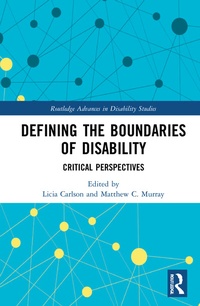
Defining the Boundaries of Disability
Critical Perspectives
1st Edition
Published on 8. March 2021
Book
Hardback
144 pages
978-0-367-42747-4 (ISBN)
Description
This ground-breaking volume considers what it means to make claims of disability membership in view of the robust Disability Rights movement, the rich areas of academic inquiry into disability, increased philosophical attention to the nature and significance of disability, a vibrant disability culture and disability arts movement, and advances in biomedical science and technology.
By focusing on the statement, "We are all disabled", the book explores the following questions: What are the philosophical, political, and practical implications of making this claim? What conceptions of disability underlie it? When, if ever, is this claim justified, and when or why might it be problematic or harmful? What are the implications of claiming "we are all disabled" amidst this global COVID-19 pandemic? These critical reflections on the boundaries of disability include perspectives from the humanities, social sciences, law, and the arts. In exploring the boundaries of disability, and the ways in which these lines are drawn theoretically, legally, medically, socially, and culturally, the authors in this volume challenge particular conceptions of disability, expand the meaning and significance of the term, and consider the implications of claiming disability as an identity.
It will be of interest to a broad audience, including disability scholars, advocates and activists, philosophers and historians of disability, moral theorists, clinicians, legal scholars, and artists.
By focusing on the statement, "We are all disabled", the book explores the following questions: What are the philosophical, political, and practical implications of making this claim? What conceptions of disability underlie it? When, if ever, is this claim justified, and when or why might it be problematic or harmful? What are the implications of claiming "we are all disabled" amidst this global COVID-19 pandemic? These critical reflections on the boundaries of disability include perspectives from the humanities, social sciences, law, and the arts. In exploring the boundaries of disability, and the ways in which these lines are drawn theoretically, legally, medically, socially, and culturally, the authors in this volume challenge particular conceptions of disability, expand the meaning and significance of the term, and consider the implications of claiming disability as an identity.
It will be of interest to a broad audience, including disability scholars, advocates and activists, philosophers and historians of disability, moral theorists, clinicians, legal scholars, and artists.
More details
Series
Language
English
Place of publication
London
United Kingdom
Publishing group
Taylor & Francis Ltd
Target group
College/higher education
Illustrations
1 s/w Abbildung, 1 s/w Zeichnung
1 Line drawings, black and white; 1 Illustrations, black and white
Dimensions
Height: 234 mm
Width: 156 mm
Weight
450 gr
ISBN-13
978-0-367-42747-4 (9780367427474)
Copyright in bibliographic data and cover images is held by Nielsen Book Services Limited or by the publishers or by their respective licensors: all rights reserved.
Schweitzer Classification
Other editions
Additional editions
Book
09/2022
1st Edition
Routledge
€62.70
Shipment within 15-20 days
E-Book
03/2021
1st Edition
Routledge
€55.49
Available for download
E-Book
03/2021
1st Edition
Routledge
€55.49
Available for download
Persons
Licia Carlson is Professor of Philosophy at Providence College, USA. She is the author of a book on philosophy and intellectual disability and has co-edited volumes on disability and moral philosophy, and phenomenology and the arts. She has published numerous articles and chapters in the philosophy of disability, bioethics, philosophy of music, and feminist philosophy. Her current research interests include the ethics of genetic testing, and the intersection of philosophy, music, and disability.
Matthew C. Murray is the Senior Project Adviser for the Growthpolicy.org project at the Mossavar-Rahmani Center for Business and Government at the Harvard Kennedy School of Government and serves as Visiting Assistant Professor of Philosophy at Providence College, USA. Matthew is actively researching and publishing in the areas of critical theories of justice and their effects on the ideas of and applications of distributive and social justice.
Matthew C. Murray is the Senior Project Adviser for the Growthpolicy.org project at the Mossavar-Rahmani Center for Business and Government at the Harvard Kennedy School of Government and serves as Visiting Assistant Professor of Philosophy at Providence College, USA. Matthew is actively researching and publishing in the areas of critical theories of justice and their effects on the ideas of and applications of distributive and social justice.
Content
Introduction: What does it mean to claim "we are all disabled"? PART 1: Theoretical considerations 1. Power, disability, and the academic production of knowledge 2. Depending on the undependable: Disability, fragility, and instability 3. The universal view of disability and its danger to the civil rights model 4. On (not) deserving disadvantage: What kind of difference does "disability" make? 5. Being and deafness: Examining ontology and ethics within the dialectic of hearing-loss and deaf-gain and deafness-and-disability PART 2: Spaces, representations, and lived boundaries 6. Poems 7. "We are all disabled": Feathers, continuities, and a neglected musical argument? 8. Robinson Crusoe and Peter the Wild Boy: What Daniel Defoe inadvertently tells us about disability 9. "We are all disabled": The conundrum of problems and solutions 10. Borderlands and neurodiversity: Aren?t we all humans? 11. We are all disabled, until we are not 12. Thoughts on precarity, disablement, and risk during COVID-19 13. Toward disability justice in a pandemic world