

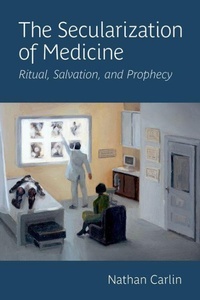
The Secularization of Medicine
Ritual, Salvation, and Prophecy
Published on 9. October 2025
Book
Hardback
256 pages
978-0-19-757400-3 (ISBN)
Description
Why do doctors take the Hippocratic Oath? Is this like reciting a religious creed? Is the White Coat Ceremony a kind of medical ordination? These medical rituals do seem to offer grounding for moral life in the profession. People from all over the globe make pilgrimages to places like the Mayo Clinic and the Texas Medical Center in search of salvation--not of their souls, but of their bodies. Are cardiologists, oncologists, and other specialists the secular high priests of our time? Patients do sacrifice large sums of cash in exchange for hope.
While it is true that medicine and religion once had overt connections that have since declined, The Secularization of Medicine argues that religion as a social force in medicine has not been extinguished. Instead, religious material or ideas have migrated to non-religious or secular spaces and have been absorbed by the surrounding culture. This is a process of transposition, seen most clearly in the religious names of many hospitals and medical research institutions, continuing the tradition of Christian missions that care for the sick and see education as part of their religious duties.
In this book, Nathan Carlin identifies three new types of transposition--instrumental transpositions, idealized transpositions, and imaginative transpositions--and explores them in various domains of medicine that resemble or recall religious belief or practice. He discovers that medicine is not as secular as we might imagine it to be, and this has implications for the well-being of physicians.
While it is true that medicine and religion once had overt connections that have since declined, The Secularization of Medicine argues that religion as a social force in medicine has not been extinguished. Instead, religious material or ideas have migrated to non-religious or secular spaces and have been absorbed by the surrounding culture. This is a process of transposition, seen most clearly in the religious names of many hospitals and medical research institutions, continuing the tradition of Christian missions that care for the sick and see education as part of their religious duties.
In this book, Nathan Carlin identifies three new types of transposition--instrumental transpositions, idealized transpositions, and imaginative transpositions--and explores them in various domains of medicine that resemble or recall religious belief or practice. He discovers that medicine is not as secular as we might imagine it to be, and this has implications for the well-being of physicians.
Reviews / Votes
The Secularization of Medicine is a thoughtful, richly textured, and intellectually generous work. By resisting reductionist accounts of secularization and illuminating the ritual, ethical, and imaginative dimensions of medicine, Carlin provides readers with a panoramic and deeply humanistic perspective and offers a compelling invitation to rethink what it means to practice medicine in a secular age. Thus, the book will be of particular interest to scholars and practitioners in medical humanities, bioethics, theology, and clinical medicine. * Monica Consolandi, Theoretical Medicine and Bioethics * Carlin's book is a carefully argued and creatively considered addition to secularization discourses that draws much-needed attention to the spiritual structures of contemporary medicine. * Ashley Moyse, Journal of Medical Humanities * Carlin helps illuminate in concrete ways the often made claim of bioethicists and other cultural critics that medicine has replaced religion or that people now look to medicine and not religion to save their lives. ... This book will interest scholars of medicine and religion, bioethicists, and practitioners. * A. W. Klink, CHOICE *More details
Language
English
Place of publication
New York
United States
Target group
College/higher education
Product notice
sewn/stitched
Cloth over boards
Dimensions
Height: 217 mm
Width: 149 mm
Thickness: 26 mm
Weight
381 gr
ISBN-13
978-0-19-757400-3 (9780197574003)
Copyright in bibliographic data and cover images is held by Nielsen Book Services Limited or by the publishers or by their respective licensors: all rights reserved.
Schweitzer Classification
Other editions
Additional editions
E-Book
08/2025
OUP eBook
€45.99
Available for download
E-Book
08/2025
OUP eBook
€45.99
Available for download
Person
Nathan Carlin is the Director of the McGovern Center for Humanities and Ethics at The University of Texas Health Science Center at Houston (UTHealth Houston), where he holds the Samuel Karff Chair. He also serves as Editor-in-Chief for the Journal of Medical Humanities. Carlin has published twelve books, including Pastoral Aesthetics: A Theological Perspective on Principlist Bioethics, as well as Medicine, Meaning, and Identity, which is co-edited with Keisha Ray.
Content
Acknowledgments Introduction Chapter 1: Ritual
Chapter 2: Salvation
Chapter 3: Prophecy Conclusion Bibliography Index
Chapter 2: Salvation
Chapter 3: Prophecy Conclusion Bibliography Index