

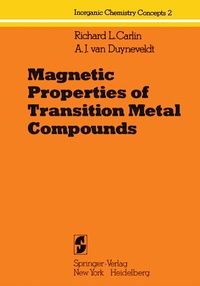
Magnetic Properties of Transition Metal Compounds
Published on 9. April 2012
Book
Paperback/Softback
XV, 264 pages
978-3-642-87394-2 (ISBN)
Description
This is a textbook of what is often called magnetochemistry. We take the point of view that magnetic phenomena are interesting because of what they tell us about chemical systems. Yet, we believe it is no longer tenable to write only about such subjects as distinguishing stereochemistry from the measurement of a magnetic susceptibility over a restricted temper ature region; that is, paramagnetism is so well-understood that little remains to explore which is of fundamental interest. The major purpose of this book is to direct chemists to some of the recent work of physicists, and in particular to a lengthy exposition of magnetic ordering phenomena. Chemists have long been interested in magnetic interactions in clusters, but many have shied away from long-range ordering phenomena. Now however more people are investigating magnetic behavior at temperatures in the liquid helium region, where ordering phenomena can scarcely be avoided. The emphasis is on complexes of the iron-series ions, for this is where most of the recent work, both experimental and theoretical, has been done. The discussion therefore is limited to insulating crystals; the nature of magnetism in metals and such materials as semiconductors is sufficiently different that a discussion of these substances is beyond our purposes. The book is directed more at the practical experimentalist than at the theoretician.
More details
Series
Edition
Softcover reprint of the original 1st ed. 1977
Language
English
Place of publication
Berlin
Germany
Publishing group
Springer Berlin
Target group
Professional and scholarly
Research
Illustrations
1 s/w Abbildung
XV, 264 p. 1 illus.
Dimensions
Height: 244 mm
Width: 170 mm
Thickness: 16 mm
Weight
495 gr
ISBN-13
978-3-642-87394-2 (9783642873942)
DOI
10.1007/978-3-642-87392-8
Schweitzer Classification
Other editions
Additional editions
R. L. Carlin | A. J. van Duyneveldt
Magnetic Properties of Transition Metal Compounds
E-Book
12/2012
Springer
€96.29
Available for download
R. L. Carlin | A. J. van Duyneveldt
Magnetic Properties of Transition Metal Compounds
Book
02/1978
Springer
€85.55
Article exhausted; check different version
Content
I. Paramagnetism: The Curie Law.- A. Introduction.- B. Diamagnetism and Paramagnetism.- C. Magnetic Moment of a Magnetic Ion Subsystem.- D. Some Curie Law Magnets.- E. Susceptibilities of the Lanthanides.- F. Temperature Independent Paramagnetism.- References.- II. Thermodynamics and Relaxation.- A. Introduction.- B. Thermodynamic Relations.- C. Thermal Effects.- D. Adiabatic Demagnetization.- E. Relaxation Time and Transition Probability.- F. Spin-lattice Relaxation Processes.- G. Susceptibility in Alternating Fields.- H. Adiabatic Susceptibilities.- References.- III. Paramagnetism: Zero-Field Splittings.- A. Introduction.- B. Schottky Anomalies.- C. Adiabatic Demagnetization.- D. Van Vleck's Equation.- E. Paramagnetic Anisotropy.- F. Effective Spin.- G. Direct Measurement of D.- H. Electron Paramagnetic Resonance (EPR).- References.- IV. Dimers and Clusters.- A. Introduction.- B. Energy Levels and Specific Heats.- C. Magnetic Susceptibilities.- D. Copper Acetate and Related Compounds.- E. Some Other Dimers.- F. EPR Measurements.- G. Clusters.- H. The Ising Model.- References.- V. Long-Range Order.- A. Introduction.- B. Molecular Field Theory of Ferromagnetism.- C. Thermal Effects.- D. Molecular Field Theory of Antiferromagnetism.- E. Ising, XY, and Heisenberg Models.- F. Critical Point Exponents.- G. Cu(NO3)2·21/2H2O.- H. Dipole-Dipole Interactions.- I. Exchange Effects on Paramagnetic Susceptibilities.- J. Superexchange.- References.- VI. Short-Range Order.- A. Introduction.- B. One-Dimensional or Linear Chain Systems.- C. Two-Dimensional or Planar Systems.- D. Long-Range Order.- References.- VII. Special Topics: Spin-Flop, Metamagnetism, Ferrimagnetism and Canting.- A. Introduction.- B. Phase Diagrams and Spin-Flop.- C. Metamagnetism.- D. Ferrimagnetism.- E.Canting and Weak Ferromagnetism.- References.- VIII. Selected Examples.- A. Introduction.- B. Some Single Ion Properties.- C. Some Examples.- References.- Append.- A. Physical Constants.- B. Hyperbolic Functions.- Formula Index.