

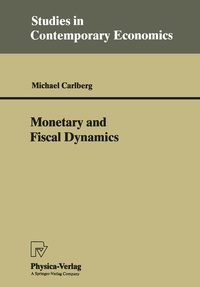
Monetary and Fiscal Dynamics
Published on 17. June 1992
Book
Paperback/Softback
VIII, 194 pages
978-3-7908-0619-9 (ISBN)
Description
The analysis will be conducted within an IS-LM model augmen-
ted by the dynamics of money wages, private capital and
public debt. A macroeconomic shock induces an extended
process of adjustment that is characterized by unemployment.
This in turn requires a dynamic path of monetary and fiscal
policy: As a response to the shock, the central bank
continuouslyadapts the quantity of money so as to keep up
full employment all the time. And the government
continuously accommodates its purchases of goods and
services. Can this be sustained? Or will public debt tend to
explode, thereby driving the stock of capial down to zero?
More details
Series
Edition
Softcover reprint of the original 1st ed. 1992
Language
English
Place of publication
Heidelberg
Germany
Target group
Professional and scholarly
Research
Illustrations
VIII, 194 p.
Dimensions
Height: 244 mm
Width: 170 mm
Thickness: 12 mm
Weight
362 gr
ISBN-13
978-3-7908-0619-9 (9783790806199)
DOI
10.1007/978-3-642-47689-1
Schweitzer Classification
Other editions
Additional editions
Content
I. Basic Model.- 1. Overlapping Generations.- 2. Short-Run Equilibrium.- 3. IS-LM and AD-AS Diagrams.- 4. Long-Run Equilibrium.- 5. Stability.- 6. Monetary Shock.- 7. Savings Shock.- 8. Demographic Shock.- 9. Investment Shock.- 10. Wage Shock.- 11. Flexible Money Wages.- 12. Fixed Money Wages.- 13. Monetary Policy.- 14. Cyclical Adjustment.- II. Economy with Public Sector.- 1. Overlapping Generations.- 2. Short-Run Equilibrium.- 3. Long-Run Equilibrium.- 4. Flexible Money Wages.- 5. Fixed Money Wages.- 6. Slow Money Wages.- 7. Continuous Budget Balance.- 8. Monetary Policy.- 9. Fiscal Policy.- 10. Monetary Policy versus Fiscal Policy.- III. Growing Economy.- 1. Solow Model.- 2. Short-Run Equilibrium.- 3. IS-LM and AD-AS Diagrams.- 4. Long-Run Equilibrium.- 5. Stability.- 6. Monetary Shock.- 7. Savings Shock.- 8. Investment Shock.- Conclusion.- Result.- Symbols.- References.