

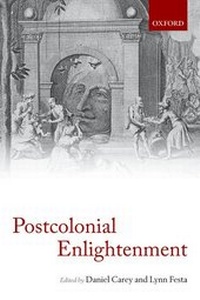
The Postcolonial Enlightenment
Eighteenth-Century Colonialism and Postcolonial Theory
Published on 16. May 2013
Book
Paperback/Softback
392 pages
978-0-19-967759-7 (ISBN)
Description
Over the last thirty years, postcolonial critiques of European imperial practices have transformed our understanding of colonial ideology, resistance, and cultural contact. The Enlightenment has played a complex but often unacknowledged role in this discussion, alternately reviled and venerated as the harbinger of colonial dominion and avatar of liberation, as target and shield, as shadow and light. This volume brings together two arenas - eighteenth-century studies and postcolonial theory - in order to interrogate the role and reputation of Enlightenment in the context of early European colonial ambitions and postcolonial interrogations of Western imperial aspirations.
With essays by leading scholars in the field, Postcolonial Enlightenment address issues central not only to literature and philosophy but also to natural history, religion, law, and the emerging sciences of man. The contributors situate a range of writers - from Hobbes and Herder, Behn and Burke, to Defoe and Diderot - in relation both to eighteenth-century colonial practices and to key concepts within current postcolonial theory concerning race, globalization, human rights, sovereignty, and national and personal identity. By enlarging the temporal and geographic framework through which we read, the essays in this volume open up alternate genealogies for categories, events and ideas central to the emergence of global modernity.
With essays by leading scholars in the field, Postcolonial Enlightenment address issues central not only to literature and philosophy but also to natural history, religion, law, and the emerging sciences of man. The contributors situate a range of writers - from Hobbes and Herder, Behn and Burke, to Defoe and Diderot - in relation both to eighteenth-century colonial practices and to key concepts within current postcolonial theory concerning race, globalization, human rights, sovereignty, and national and personal identity. By enlarging the temporal and geographic framework through which we read, the essays in this volume open up alternate genealogies for categories, events and ideas central to the emergence of global modernity.
Reviews / Votes
Review from previous edition The Postcolonial Enlightenment: Eighteenth-Century Colonialism and Postcolonial Theory, edited by Daniel Carey and Lynn Festa, is a significant publication. The eight essays, substantial introduction, and coda that make up this collection mark an important development in both Enlightenment studies and postcolonial criticism: each is considered in relation to the other, addressing the previous critical neglect of the role which Enlightenment thought played in the construction and critique of European colonial ideology. * The Year's Work in English Studies *More details
Language
English
Place of publication
Oxford
United Kingdom
Target group
College/higher education
Professional and scholarly
Students and scholars of Postcolonial Studies; students and scholars of Eighteenth-Century Studies and the Enlightenment; historians of empire.
Illustrations
9 black-and-white halftones
Dimensions
Height: 233 mm
Width: 156 mm
Thickness: 22 mm
Weight
596 gr
ISBN-13
978-0-19-967759-7 (9780199677597)
Copyright in bibliographic data and cover images is held by Nielsen Book Services Limited or by the publishers or by their respective licensors: all rights reserved.
Schweitzer Classification
Other editions
Additional editions
Daniel Carey | Lynn Festa
The Postcolonial Enlightenment
Eighteenth-Century Colonialism and Postcolonial Theory
Book
02/2009
Oxford University Press
€133.09
Shipment within 15-20 days
Persons
Daniel Carey is the author of Locke, Shaftesbury, and Hutcheson: Contesting Diversity in the Enlightenment and Beyond (Cambridge, 2006), and editor of Asian Travel in the Renaissance (Blackwell, 2004) and Les voyages de Gulliver: mondes lointains ou mondes proches (Presses universitaires de Caen, 2002). He is senior lecturer in English at the National University of Ireland, Galway.
Lynn Festa is the author of Sentimental Figures of Empire in Eighteenth-Century Britain and France (John Hopkins, 2006). She has taught at Harvard University, the University of Wisconsin, Madison, and is currently associate professor of English at Rutgers University.
Lynn Festa is the author of Sentimental Figures of Empire in Eighteenth-Century Britain and France (John Hopkins, 2006). She has taught at Harvard University, the University of Wisconsin, Madison, and is currently associate professor of English at Rutgers University.
Content
PART ONE: SUBJECTS AND SOVEREIGNTY; PART TWO: ENLIGHTENMENT CATEGORIES AND POSTCOLONIAL CLASSIFICATIONS; PART THREE: NATION, COLONY, AND ENLIGHTENMENT UNIVERSALITY