

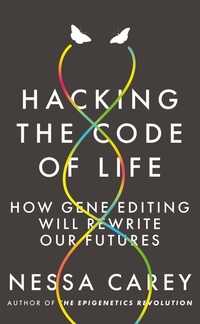
Hacking the Code of Life
How gene editing will rewrite our futures
Will be published approx. on 7. March 2019
Book
Paperback/Softback
176 pages
978-1-78578-497-2 (ISBN)
Description
'An excellent, brisk guide to what is likely to happen as opposed to the fantastically remote.' - Los Angeles Review of Books
In 2018 the world woke up to gene editing with a storm of controversy over twin girls born in China with genetic changes deliberately introduced by scientists - changes they will pass on to their own offspring.
Genetic modification (GM) has been with us for 45 years now, but the new system known as CRISPR or gene editing can manipulate the genes of almost any organism with a degree of precision, ease and speed that we could only dream of ten years ago.
But is it ethical to change the genetic material of organisms in a way that might be passed on to future generations? If a person is suffering from a lethal genetic disease, is it unethical to deny them this option? Who controls the application of this technology, when it makes 'biohacking' - perhaps of one's own genome - a real possibility?
Nessa Carey's book is a thrilling and timely snapshot of a cutting-edge technology that will radically alter our futures and the way we prevent disease.
'A focused snapshot of a brave new world.' - Nature
'A brisk, accessible primer on the fast-moving field, a clear-eyed look at a technology that is already driving major scientific advances - and raising complex ethical questions.' - Emily Anthes, Undark
In 2018 the world woke up to gene editing with a storm of controversy over twin girls born in China with genetic changes deliberately introduced by scientists - changes they will pass on to their own offspring.
Genetic modification (GM) has been with us for 45 years now, but the new system known as CRISPR or gene editing can manipulate the genes of almost any organism with a degree of precision, ease and speed that we could only dream of ten years ago.
But is it ethical to change the genetic material of organisms in a way that might be passed on to future generations? If a person is suffering from a lethal genetic disease, is it unethical to deny them this option? Who controls the application of this technology, when it makes 'biohacking' - perhaps of one's own genome - a real possibility?
Nessa Carey's book is a thrilling and timely snapshot of a cutting-edge technology that will radically alter our futures and the way we prevent disease.
'A focused snapshot of a brave new world.' - Nature
'A brisk, accessible primer on the fast-moving field, a clear-eyed look at a technology that is already driving major scientific advances - and raising complex ethical questions.' - Emily Anthes, Undark
Reviews / Votes
Carey's trawl of potential applications - such as high-yield rice varieties, therapies for sickle-cell disease and germline gene editing - is edifying. A focused snapshot of a brave new world. * Nature * [A]n excellent, brisk guide to what is likely to happen as opposed to the fantastically remote. * Los Angeles Review of Books * A brisk, accessible primer on the fast-moving field, a clear-eyed look at a technology that is already driving major scientific advances - and raising complex ethical questions. -- Emily Anthes * Undark *More details
Series
Language
English
Place of publication
Duxford
United Kingdom
Product notice
Paperback (trade)
Unsewn / adhesive bound
Dimensions
Height: 216 mm
Width: 134 mm
Thickness: 17 mm
Weight
210 gr
ISBN-13
978-1-78578-497-2 (9781785784972)
Copyright in bibliographic data and cover images is held by Nielsen Book Services Limited or by the publishers or by their respective licensors: all rights reserved.
Schweitzer Classification
Other editions
Additional editions
E-Book
03/2019
Icon Books
€8.39
Available for download
Person
Nessa Carey worked in the biotech and pharma industry for thirteen years and is a Visiting Professor at Imperial College London. Her previous books for Icon are The Epigenetics Revolution (2011), described by The Guardian as 'a book that would have had Darwin swooning', and Junk DNA (2015), 'a cutting-edge guide to the ever-more mysterious genome' (New Scientist).